


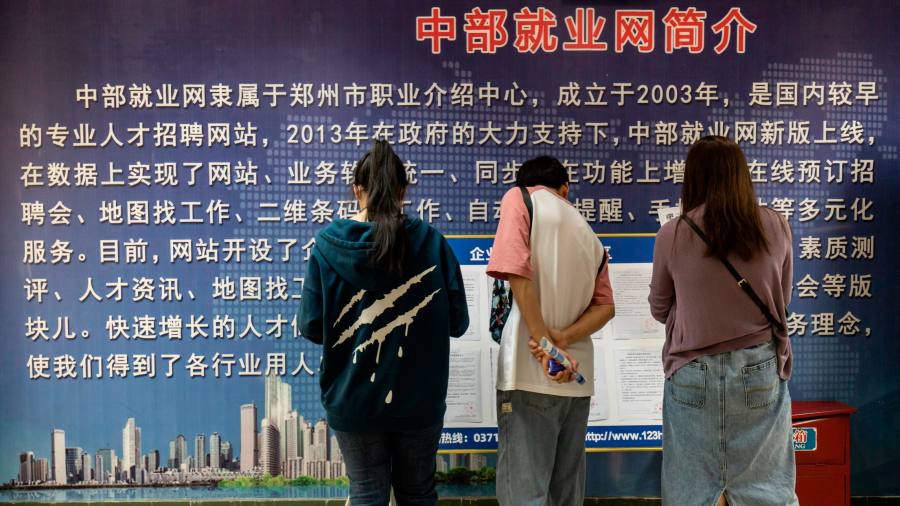
Job opportunities scream from posters at an employment fair in central China’s Zhengzhou. “Join us for the future!” urges one advertising positions for graduates to sell electric vehicles. Others seek “courageous” candidates or “attractive females” to sell medical equipment.
But many of the jobs require 70 hours of work a week and command salaries as low as Rmb3,000 ($400) a month. Wang, a commerce graduate, struggles to get enthused.
Zhengzhou, the industrial capital of a province of about 100mn people and home to the world’s largest Apple iPhone factory, ought to be able to offer its graduates better career prospects, said Wang, who did not want his full name to be published.
The first member of his rural family to get a tertiary degree, he wondered if he would ever be able to get a decent job, let alone buy a house. “Right now, experience matters more than a university degree because there are too many graduates around,” he said.
As the world’s second-largest economy emerges from three years of Covid-19 restrictions, young jobless graduates such as Wang are bearing the brunt of a tepid recovery. In May, 20.8 per cent of 16 to 24-year-olds were unemployed, the largest proportion since the data series started in 2018 and higher than in European countries such as France and Italy.
The Chinese economy is still generating millions of jobs, and the overall unemployment rate was stable at 5.2 per cent in May. Yet many openings are in low-end work unattractive to university graduates. Beijing’s crackdown of the last few years on the technology, finance and gaming sectors has choked off opportunities in what were once appealing sources of employment.
An employment index for graduates compiled by the China Institute for Employment Research, a Beijing-based think-tank, has indicated an oversupply of labour for six quarters in a row since late 2021. The situation could get worse, with a record crop of 11.6mn university graduates entering the job market in June and July.
While the number of graduates may be small compared with the overall workforce, their plight is indicative of China’s sputtering economic recovery, which lost pace in the second quarter as the property market and manufacturing struggled. “The Chinese economy is very weak at this stage, confidence is low, so I would say that’s the biggest factor in youth unemployment,” said Larry Hu, chief China economist with Macquarie.
Others said there were indications the rise in youth unemployment was a structural issue that could eventually even threaten political stability.
“We estimate that the problem of youth unemployment may continue for 10 years in the future and continue to worsen in the short term,” said a report from the China Macroeconomy Forum think-tank co-authored by prominent economist Liu Yuanchun. “If handled improperly, it will lead to further social issues outside the economic field and even become the trigger for political issues.”
President Xi Jinping, who was himself forced to labour in a rural village during the Cultural Revolution, has little sympathy for graduates reluctant to do low-paid jobs. He has constantly urged young people to zizhao kuchi — “ask for hardship”.
The government recently launched a campaign to persuade graduates to “find a job first and then choose a career”. However, such messaging only confirms what many young graduates suspect: despite shelling out for degrees that can cost roughly Rmb30,000 a year at public universities — about a fifth of the average household income for a family of three — qualifications from all but the best universities lack value in the job market.
In Chengdu, a city known for its more relaxed character and tech industries that typically attracted young workers from around the nation, a statue of a grinning panda holds a sign with the slogan “happiness comes from arduous work”.
Yang, an accounting graduate from a private second-tier university, has secured a job that pays just Rmb3,000 a month, about a third of what her father earns as a construction worker.
“My father has paid so much money for my education, he thinks the investment is not worthwhile,” she said, adding that she could not imagine saving enough money to buy a home, marry or start a family.
The jobs crisis afflicting China’s graduates is all the more surprising given that this cohort is the country’s most highly educated ever.
Covid restrictions are partly to blame, economists said. With travel, restaurants and other businesses shut down for three years, new jobs in the services sector probably contracted last year, after adding 16mn jobs in 2018-19, according to Macquarie.
The private sector in general, which accounts for 80 per cent of urban employment in China, still lacks confidence post-Covid, analysts said. Private fixed-asset investment, a measure of business activity, turned negative in May for the first time since 2020.
Government crackdowns on high-growth sectors that were big employers of young people, including ecommerce, education platforms, gaming and finance, have not helped. Worried about tech competition with the US, Beijing is now emphasising advanced electronic hardware such as semiconductors. Youth unemployment has more than doubled since the government began this “de-risking” in 2018, Macquarie’s Hu said in a report.
“A policy focus more on security and less on growth also puts pressure on youth unemployment,” Hu said.
“There is a skills mismatch,” said Eswar Prasad, senior fellow at the Brookings Institution. He added that the government was trying to shift the economy to high-tech manufacturing, but the services sector was lagging and unable to provide enough employment for graduates, while the high-tech sector was not ready to absorb all the engineering students coming out of universities.
Some argue the underlying causes go deeper. Michael Pettis, a senior associate at the Carnegie China Center, said Beijing’s investment model remained geared towards manufacturing and investment rather than the domestic consumption ultimately needed to create jobs.
“Chinese growth is not very labour-intensive,” Pettis said. Chinese policymakers’ instinct is to invest in infrastructure, manufacturing and property to pump up growth. But the country’s ratios of investment to gross domestic product are already among the highest in history for a large economy, he said.
“When you build your manufacturing competitiveness based on low wages, once low wages become a problem because of weak domestic demand, you’re sort of stuck,” Pettis said.
Young people are resorting to whatever they can to improve their employment prospects. Until last year, Beijing’s Lama Temple was mainly frequented by older people praying for good health. But on a recent hot Sunday, the Tibetan Buddhist haven received hundreds of jobless young people conducting shaoxiang baifo — burning incense to pray for better fortune.
Lu, an accounting graduate, wished to set up a dance training business in her hometown of Guiyang in south-western China, having failed to find a job after graduating from a second-tier university in Beijing.
“There’s no chance for me to land a job in Beijing,” said Lu, outside the gold-inscribed Falun Hall — a favourite among the temple’s many pavilions for the young jobless.
Along with many other young people, Lu sat China’s gruelling national civil service examination, which drew a record 2.6mn applicants this year, nearly twice the number in 2019. She failed — the success rate was just 1.4 per cent.
But she said her second wish at the temple was to sit the exam again next year and get a job at the Guiyang tax bureau.
“That’s what my parents want,” she said. “They think I should prioritise stability.”
Some have had luck. Zhou, 26, visited the temple in February to pray for work after losing her job and was returning to offer the deity her thanks.
She successfully secured a position at a medical equipment maker in Zhengzhou. Although the new job pays less than half what she previously earned at a metaverse company in Beijing, she said she was “OK with this”.
“There’s not much opportunity in Beijing,” she said, “so I just had to get a job first.”
Read the full article here