


Unlock the Editor’s Digest for free
Roula Khalaf, Editor of the FT, selects her favourite stories in this weekly newsletter.
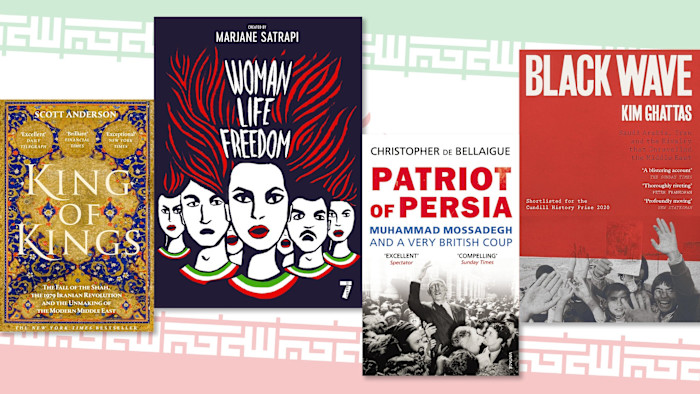
King of Kings: The Fall of the Shah, the 1979 Iranian Revolution and the Unmaking of the Modern Middle East
by Scott Anderson
The story of the 1979 Islamic revolution, told over several decades and from multiple perspectives — both inside and outside the country — recounting how an astonishingly rich imperial Iran, allied to the west, became a repressive autocracy. A brilliant tale of greed, paranoia and hubris, according to the FT’s reviewer, and a good place to start for anyone seeking to understand the long run-in to the current crisis.
Iran: Empire of the Mind
by Michael Axworthy
“Who are the Iranians? Where did they come from?” To answer these questions, the author — a former British diplomat — explores the history of the beleaguered nation, going beyond the “violence and drama” to take the reader on a journey through Iran’s cultural past. The book spans the ancient era of the Prophet Zoroaster, the Persian empire, and the 1979 Islamic revolution, concluding during the presidency of Mahmoud Ahmadi-Nejad — the last time Iran was treated as a pariah state. Through this comprehensive history, Axworthy attempts to address the paradoxical nature of one of the world’s oldest and most influential civilisations and explain why perceptions of the nation have shifted over time.
Woman, Life, Freedom
EDITED by Marjane Satrapi, translated by Una Dimitrijevic
This multi-authored collection of stories offers a vivid visualisation of the protests and subsequent government crackdown that took place across Iran after the death of a young Kurdish-Iranian woman in September 2022 at the hands of Iran’s morality police. Edited by Satrapi, author of the autobiographical graphic novel series Persepolis, the book provides first-hand perspectives on Iranian resistance and government crackdowns. The collection explores the nature of the regime’s tyranny and the extent of its divisive techniques, which create a culture of fear through surveillance, humiliation and intimidation. Shedding a light on the collective yearning for a better Iran, the stories conclude that political change, if not revolution, is inevitable.
Iran’s Grand Strategy: A Political History
by Vali Nasr
The west’s understanding of Iran “is hopelessly inadequate and dangerously outdated”, says Iranian-American academic Nasr. In Iran’s Grand Strategy, the author suggests that western nations must look beyond the prism of the 1979 revolution and argues that Iran’s foreign policy is not driven by ideology but by a pragmatic, long-term strategy rooted in its history and experience. The book explores how events such as the Iran-Iraq war, the US invasion of Iraq and the ongoing threat of American containment have shaped Iran’s tactical outlook, focusing on a fear of external intervention and a desire to secure its position in the region.

Patriot of Persia: Muhammad Mossadegh and a Very British Coup
by Christopher de Bellaigue
To fully understand Iranians’ mistrust of the US and the UK in the modern era, look no further than the Anglo-American inspired coup that overthrew Muhammad Mossadegh, Iran’s elected prime minister, in 1953. Rich in detail, this book outlines the struggle over Iran’s oil resources after Mossadegh’s plan to nationalise the sector made him a national hero but also drew the wrath of the UK, for whom control of Iranian oil was crucial to imperial interests.
Black Wave: Saudi Arabia, Iran, and the Rivalry That Unravelled the Middle East
by Kim Ghattas
Published in 2020, Black Wave examines how the 1979 Islamic revolution reverberated across the Middle East. Ghattas, a veteran Middle East reporter, explores how the birth of the theocratic state triggered a bitter rivalry between Sunni Saudi and Shia Iran, which continues to play out today. It provides a timely reminder that the tensions rippling across the region are not only the result of hostilities between Iran and the west, but also have a dangerous regional dimension.
The Mantle of the Prophet: Religion and Politics in Iran
by Roy Mottahedeh
Mottahedeh’s tale of Islam and politics in revolutionary Iran, first published in 1985, draws from first-hand accounts of eyewitnesses to provide a comprehensive overview of the traditions, systems and “complexity of culture” that govern Iranian public life, all told through the tale of a cleric’s progression from student to teacher. The book, which Mottahedeh, who taught at Harvard, started before and published during Iran’s most tumultuous decade, provides rare insights into the teachings and lives of the Shia religious class and the events that led up to the 1979 revolution.
Join our online book group on Facebook at FT Books Café and follow FT Weekend on Instagram, Bluesky and X
Read the full article here