


Receive free Asia-Pacific companies updates
We’ll send you a myFT Daily Digest email rounding up the latest Asia-Pacific companies news every morning.
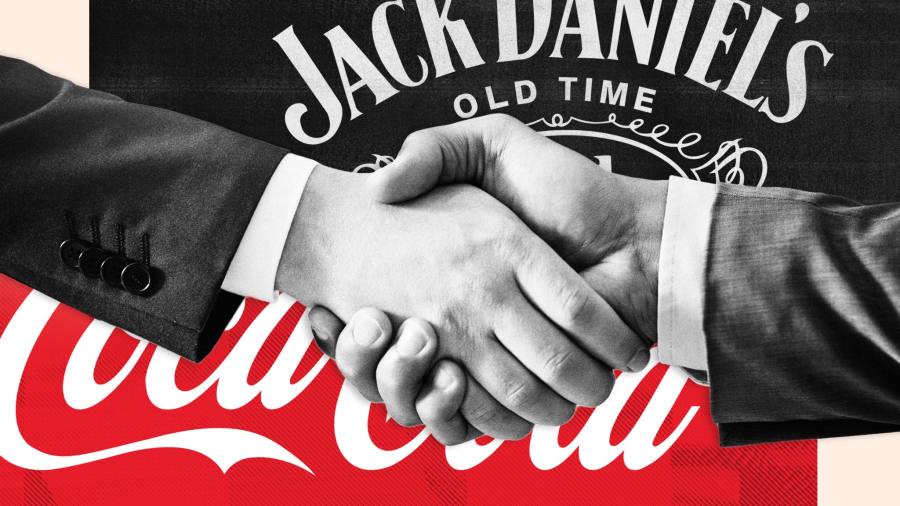
The idea of mixing Jack Daniel’s and Coca-Cola in the same glass has been around for well over 100 years. The idea of flogging the two in a single can — with both brands prominent on the label — has occurred only very recently.
But we live in mashed-up, collaborative times and the combination of diminishing marketing budgets, panicky ad agencies and artificial intelligence looks likely to intensify and embolden the mashing.
Strictly speaking, the Jack-and-Coke-in-a-can wheeze is not a mash-up. That specific pairing has slurred off the tongues of barflies since the turn of the 20th century, so the belated commercialising of the combo looks less a product of out-of-the-box creativity and more a triumph of opportunism, my-people-will-talk-to-your-people diarising and legal meetings.
As the soft drink side of the partnership, Coca-Cola may have had to move further philosophically to get the product on the shelves, but the Atlanta-based company barrelled merrily into Japan’s booze market in 2018 with a canned lemon alcopop, so the moral heavy lifting was already done. The patchy state of the alcoholic beverages market, where the young are less thirsty and ready-to-drink cocktails are a hotspot, will also have played a role in jamming the brands together.
Elsewhere, though, the march of the mash-up is producing less immediately likely — though often highly successful — unions. Burberry and Minecraft, for example, make an oddly handsome couple in their designer game. “We know it doesn’t get much better than kicking back in comfort with a Cheesy Gordita Crunch, so pairing our Mellow Slide with Taco Bell is the perfect combo!” reads a joint press release last month as the shoemaker Crocs revealed that it would be selling a $60 limited edition sandal in partnership with the burrito-based fast food titan.
The gambit is alluring anywhere but its embrace in Japan has been particularly strong — and revealing. The use of “x” to mark the supposedly fecund (often very short-term) conjunction of brands or people is now ubiquitous; the likes of Louis Vuitton, Givenchy, Loewe and Fendi have all bear-hugged Japanese artists, architects and cool local brands to the delight (and expenditure) of fans.
US skatewear brand Supreme teamed up with blue-collar metal-basher Toyo Steel to make a toolbox; the Japanese couture brand Beams worked with Ziploc to create a range of accessories designed to unleash the “charm of the freezer bag”. The arrival of generative AI, with its capacity to produce an instant visualisation of any brand cocktail, has dramatically accelerated the “I wonder . . . ” part of the creative process.
Some marketing industry veterans are snooty, grumbling that the whole phenomenon is last-resort stuff. But, economically, the rationale looks powerful. Saturated markets, reduced budgets and increasing costs are a deeply uncomfortable trio for marketers. For now at least, the collab is an easy solution. If done well, collabs offer companies a chain of small, staccato cost synergies and a potentially hefty sales windfall. Because the participants are not direct competitors, they can also exchange valuable customer data without losing anything.
The best interpretation, says the head of one Japanese advertising agency, is that the mash-ups are a new variation of the Lanchester strategy — the set of business theories that evolved from the pioneering work on assessing relative military strengths by a British army engineer during the first world war. The resulting strategy — focusing resources on a small part of a stronger foe’s forces — was gratefully adopted by the Japanese decades ago. It is often cited as one of the ways that during the photocopier wars of the 1980s, for example, Canon was able to become dominant at the expense of the world’s biggest incumbent, Xerox.
The mash-up or collab is a new way of playing the Lanchester strategy: a concentration of two companies’ resources on a single (often very small) part of the market (toolboxes/plastic beach sandals/transparent rucksacks) where the combined force is enough to ensure victory. Victory here not being purely sales but being noticed in an incredibly crowded market.
A second element for Japan in particular is that the collabs often represent a much bigger psychological step for companies than they might appear. Japanese corporations large and small have tended not to see any of their intellectual property as an asset to be deployed outside the company. Nintendo’s Mario, for example, has only very recently begun a life outside Nintendo’s games. Whether driven to it by desperation or through an active decision, the mash-ups are thriving in a new Japan.
Read the full article here