


Receive free Russian politics updates
We’ll send you a myFT Daily Digest email rounding up the latest Russian politics news every morning.
The writer is an FT contributing editor, the chair of the Centre for Liberal Strategies, Sofia, and fellow at IWM Vienna
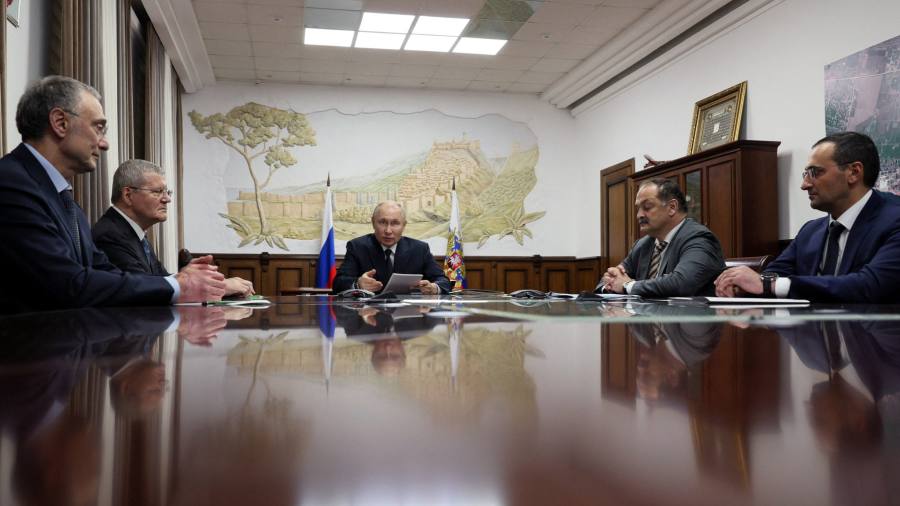
It was an unforgettable political spectacle. On February 21 2022, the eve of Russia’s full-fledged war on Ukraine, President Vladimir Putin presided over a televised meeting of Russia’s national security council. He asked the council’s members to declare if they favoured Moscow recognising the independence of the Donbas separatist republics.
The stage-managed event left the impression of a lonely, loony tsar disdainful of his senior advisers. They fear him while desperately trying to please him. He humiliates them just for the pleasure of it.
The Kremlin’s response to the recent mutiny of Yevgeny Prigozhin, the Wagner mercenary boss, forces us to reconsider this picture. It was not Putin but the “collective Putin” (a mystical figure including, among others, Alexander Lukashenko, the dictator of Belarus) that decided the outcome of the crisis. Putin the individual was irate and humiliated by Wagner’s betrayal and went on TV threatening “to be harsh”. But the “collective Putin” concluded that it would be wiser to negotiate with the rebels and find an exit strategy. We now know Putin met Prigozhin and other Wagner commanders on June 29. For someone obsessed with treason and betrayal, this was a bitter pill to swallow.
What has changed? Primarily, the relationship between Putin and the Russian elites. He now fears them no less than they fear him. He fears less their voice than their exit. Many of his closest collaborators blame him personally for the current state of affairs. It was Putin’s decision to instrumentalise the competition between Wagner and the defence ministry that ultimately led to Wagner’s march towards Moscow.
Prigozhin’s mutiny has revealed the central contradiction of Putin’s personnel politics. To win the war, Putin needs ambitious, ruthless leaders like Wagner’s boss. However, to secure his power and guarantee the unity of the elites, he needs to rely on uncharismatic figures such as defence minister Sergei Shoigu and General Valery Gerasimov, chief of the general staff. The fear of the “Zhukov effect” — the emergence of a popular general like Georgy Zhukov, the Soviet commander who captured Nazi Berlin — explains why Prigozhin had to go. The public could view such a figure as an alternative to Putin.
The secret of colonial wars is that they can succeed only if people forget about them. Putin’s war is no different. His insistence that the fighting in Ukraine is a special military operation, not a real war, was an attempt to reassure Russians that nothing really has changed in their lives at a time when everything has changed. Wagner’s mercenaries shattered the facade of normality that is so important for the Kremlin. It is not enough any more to protect living standards to persuade Russians that they have nothing to worry about.
All coups start with conspiracy. Failed coups end in paranoia. Therefore, it is logical to expect dramatic changes at the top in the Kremlin. But these expectations could be wrong. Purges at lower levels of the security services are inevitable, but it is unclear if the Kremlin will risk changes higher up.
In the first year of the war in Ukraine, the changes at the top of the pecking order in Moscow were strikingly limited. And while wars usually bring to power ambitious and often ruthless leaders who have proved themselves in the fight, only two groups have risen in Putin’s hierarchy since February 2022. These are the sons of Putin’s old friends and his adjutants — in short, those who are believed to be loyal and whom the leader knows personally.
Stability has trumped the need for more effective leadership. Now, following the Wagner mutiny, Putin faces a tricky choice. He can hardly dismiss Russia’s military leadership without acknowledging that Prigozhin was right. But he can hardly win the war with this leadership. The Wagner insurrection has strengthened the “collective Putin”.
The different perceptions of the mutiny in and outside Russia shed light on its unintended consequences. While most Russians were terrified by the prospect of civil war and Prigozhin’s approval ratings have collapsed, the new consensus in the west is that any change of power in Russia is an opportunity, insofar as any leader other than Putin — regardless of his political views — will be more likely to stop the war.
It would be wishful thinking to view Prigozhin’s march on Moscow as a precursor to the end of Putin’s regime. It would also be a mistake to neglect its importance. What it signals is a shift of power from Putin the tsar to the collective Putin.
Read the full article here