


Stay informed with free updates
Simply sign up to the US economy myFT Digest — delivered directly to your inbox.
As 2026 begins, the most optimistic observers of the US economy are those seeking to become the next Federal Reserve chair. All see the technological gains stemming from artificial intelligence propelling the US towards rapid growth and higher living standards without inflation. For them, the late 2020s are a rerun of the 1990s.
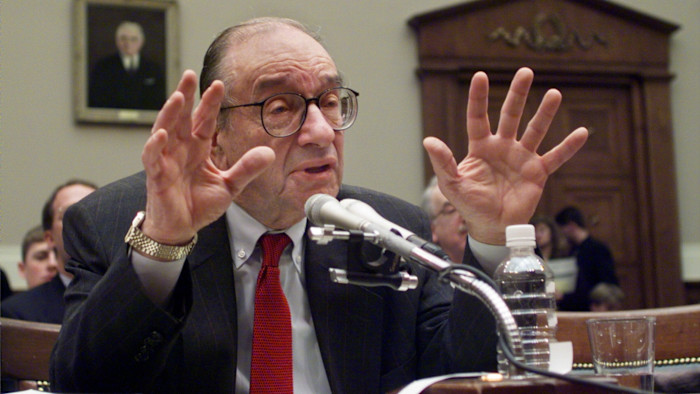
Whether it is Kevin Hassett seeing “a productivity boom”, Kevin Warsh writing that AI will be a “significant disinflationary force” or Scott Bessent expecting “a 1990s scenario . . . [with] lower interest rates, higher growth and higher productivity”, all three think the new Fed chair can emulate Alan Greenspan. Justifying low interest rates, of course, is also a prerequisite to getting the job, since President Donald Trump has demanded lower rates.
It is important not to dismiss the productivity boom thesis entirely. Jay Powell, the incumbent, has also highlighted productivity improvements as the rationale for the Fed boosting its growth forecasts for 2026 by half a percentage point to 2.3 per cent in December. Powell said that US productivity growth had been “structurally higher for several years”. It is now improving output per hour far faster than most other advanced economies, where it has stagnated since the pandemic.
The superior US performance is real and linked to its dynamic technology sector. But it is important not simply to substitute AI for 1990s computerisation and conclude that the economy is sure to follow the earlier experience with a prolonged non-inflationary upswing.
For a start, instead of declaring unending US economic superiority, America should be concerned that Europe and other advanced economies have not seen the same AI-related productivity gains. An all-conquering new technology is more convincing if it lifts all boats, rather than just those in the country undergoing a capital expenditure boom in building data centres. Maybe Europe’s lack of equivalent investment activity is simply due to the strangling force of its regulations and the legacy of a brutal energy shock that the US avoided, but talk of an AI-driven productivity boom would be more compelling if we saw the evidence coming from companies using the technology worldwide rather than in those building it with highly speculative returns.
If the technology story does not entirely resemble the 1990s, today’s other big economic forces have nothing in common with that decade. Then, the end of the cold war allowed companies to invest in the story of a globalised future without major conflict, where countries played by well-defined international rules. Globalisation was wonderful for corporate efficiency. Outsourcing, offshoring and trade boomed.
The victory of liberal democracy and Francis Fukuyama’s “end of history” defined the zeitgeist. This could not be more different to today’s geopolitics — shaped by the notion that might is right and companies must invest in efficiency-sapping resilience.
In the 1990s, US immigration was also on an upward trend, allowing many more people to come and work in the country. This was a release valve for inflation as much as higher productivity and it came on top of rising labour-force participation. Immigration has now dropped significantly and participation has been trending down since 2000 as the US population ages.
Fiscal policy is also loose and set to become significantly looser with tax cuts in 2026 from the One Big Beautiful Bill Act and any further measures the Trump administration takes to ease the domestic affordability problems.
The US productivity boom is real and is something all potential Fed chairs would be mad to ignore when a resolve to lower interest rates is a pre-requisite for the top job. But do not take the 1990s narrative too far. It simply does not stack up and the Fed would be reckless to bet the house on it.
Read the full article here