


Unlock the White House Watch newsletter for free
Your guide to what Trump’s second term means for Washington, business and the world
Nobody has campaigned for a Nobel Peace Prize quite like Donald Trump.
The US president has been brazen and unrelenting in his quest for one of the world’s most prestigious honours, saying it would be a “big insult” were he not to receive it.
But experts are sceptical about the unprecedented lobbying campaign bearing fruit when the Norwegian Nobel Committee awards it on Friday. The reasons range from Trump’s own behaviour at home and abroad to the fact that the prize is meant to honour actions in 2024 — when he was elected but not yet in office.
“Putting pressure on the committee, going on talking about ‘I need the prize, I’m the worthy candidate’ — it’s not a very peaceful approach,” said Nina Græger, director of the Peace Research Institute Oslo.
Halvard Leira, research director at the Norwegian Institute of International Affairs, added: “There have been campaigns before, but they have been more subtle.” He pointed to a “fairly sophisticated” push by South Korea to award its then-president Kim Dae-jung, which it did in 2000.
None of that deters Trump. His approach has been full of hyperbole and public declarations of his worth. “I ended seven wars,” he has said on more than one occasion. “They will never give me a Nobel Peace Prize. It’s too bad, I deserve it,” he said in February.
Trump has also put pressure on the Norwegian government. He brought the award up in at least one telephone call with finance minister and former Nato chief Jens Stoltenberg, according to Norwegian officials.
Espen Barth Eide, Norway’s foreign minister, stressed that the Nobel committee was independent of the government and that he had “solid experience” in explaining that to various countries.
Few in Oslo believe the committee, whose five members include a human rights advocate, foreign policy expert, and three former ministers, will give the prize to Trump this year. But the US president could still influence the outcome, with the winner potentially an individual or a rights group that is not seen as too antagonistic to the US or Israel.
Even those who have derided some of Trump’s recent peace efforts — such as repeatedly confusing Albania with Armenia — say that his attempt to end the war in Gaza could be a significant argument in his favour.
“It has been hard to take some of his proclamations seriously — but this is different. Gaza would be a big deal,” said one European diplomat.
Israel’s Prime Minister Benjamin Netanyahu is one of the world leaders who have appealed to the Nobel committee to pick Trump for the peace prize. A group representing the families of Israeli hostages still held by Hamas in Gaza has also written to the Oslo-based committee, arguing Trump had “made possible what many said was impossible”.
European officials believe Trump is rushing to secure a deal between Israel and Hamas before Friday’s prize announcement to try to sway the decision.
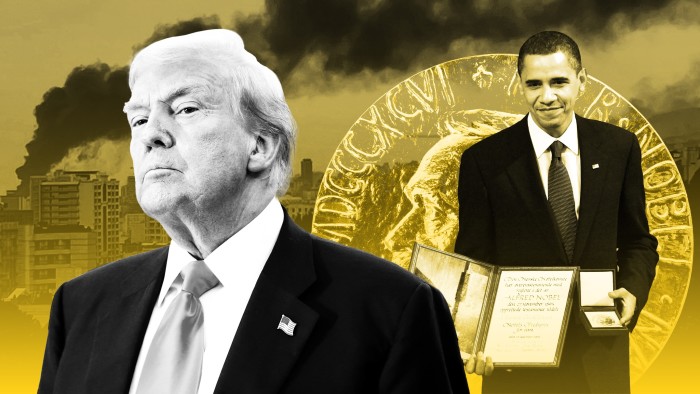
Trump’s main bone of contention with the committee is over its 2009 decision to give the award to his arch-rival Barack Obama for his “extraordinary efforts to strengthen international diplomacy and co-operation between peoples”. The prize was granted even though Obama had just started his presidency after winning the election the previous year.
“If I were named Obama, I would have had the Nobel prize given to me in 10 seconds,” Trump complained last year.
At least five Republican lawmakers have sent formal letters nominating Trump to the Norwegian committee. “The only thing that irks me about it is that I wasn’t the first one to do this,” Brian Mast, the Republican congressman from Florida who chairs the House Foreign Relations Committee, told the Financial Times.
Trump’s Nobel fixation is also being used as a way to flatter him and draw attention to other foreign policy issues. Taiwanese President Lai Ching-te told a conservative US radio show this week that Trump should “undoubtedly be a Nobel Peace Prize laureate” if he convinced China to “abandon any military aggression against Taiwan”.
There is a certain sense of trepidation in Oslo over Trump’s potential retaliation with tariffs or other measures if he is not the winner on Friday. An additional irritant is a recent controversy after the Norwegian sovereign wealth fund decided to sell out of US company Caterpillar over the use of its bulldozers by Israel.
Those considerations could sway the committee to choose someone that could “pacify Trump”, for instance awarding a humanitarian group such as Emergency Response Rooms in Sudan, said Leira. The group was also tipped by Græger.

But Leira added that some committee members have intimated they do not “react well” to pressure, with a potentially more provocative outcome. Græger suggested the International Criminal Court or the Committee to Protect Journalists could be choices that would irk Trump, as his administration has imposed sanctions on the ICC, and has moved to restrict the work of journalists covering the White House and the Pentagon.
A European diplomat also pointed to Trump recently renaming the defence ministry the Department of War. Him winning the peace prize “would send out a strange signal”, the diplomat said.
“But we all live in Trump’s world now. This Nobel discussion only highlights that.”
Additional reporting by Abigail Hauslohner, Owen Walker, Marton Dunai, William Wallis, Humza Jilani, Andrew England and Polina Ivanova
Read the full article here