


Stay informed with free updates
Simply sign up to the EU trade myFT Digest — delivered directly to your inbox.
New Delhi and Brussels have agreed a trade deal that will eliminate up to €4bn of tariffs on EU exporters and could double shipments from the bloc to India.
The pact, billed by Brussels as the largest ever concluded by either side, will slash or shrink tariffs on 96.6 per cent of EU exports to India, reducing the costs of European goods including cars, alcohol and machinery. Sensitive agricultural sectors for both sides, such as dairy, sugar and some meats, were left untouched.
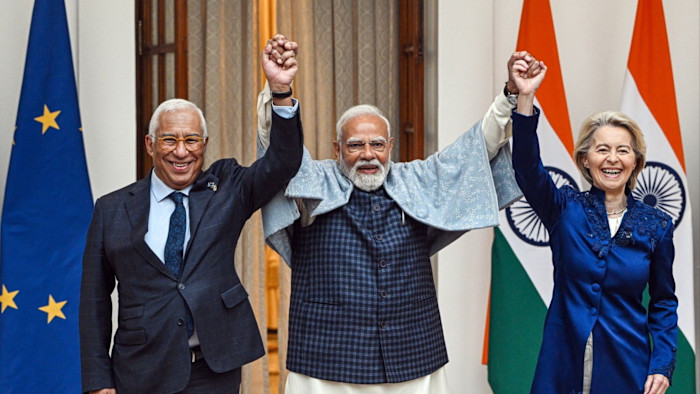
The sides sealed the agreement on Tuesday during a visit to India by European Commission president Ursula von der Leyen and European Council president António Costa.
“Dear Narendra, we did it. We have delivered the mother of all trade deals,” von der Leyen told India’s Prime Minister Narendra Modi. “This is a tale of two giants — the world’s second and fourth largest economies,” she added.
Modi said the agreement would offer “major opportunities” for the Indian and European markets. “This is a perfect example of a partnership between two major economies of the world,” he said.
The agreement comes as both Brussels and New Delhi have faced a barrage of tariffs from US President Donald Trump, who has imposed levies of up to 50 per cent on some Indian exports over the country’s purchases of Russian oil.
Last week, he threatened EU countries with additional tariffs of 10 per cent if they opposed his ambitions to control Greenland.
According to an EU statement, New Delhi will grant Brussels tariff reductions “that none of its other trading partners have received”. Levies on European cars will be gradually reduced from 110 per cent to 10 per cent, with a quota of 250,000 vehicles a year.
Tariffs of up to 44 per cent on machinery, 22 per cent on chemicals and 11 per cent on pharmaceuticals will be mostly eliminated. Steel and iron levies of up to 22 per cent will also be phased out over a 10-year period.
Tariffs of more than 36 per cent on European food products, which the EU called “prohibitive”, will also be reduced or removed, the bloc said.
Indian wine tariffs will fall from 150 per cent to 75 per cent and eventually to levels as low as 20 per cent, while those on olive oil will go from 45 per cent to zero over five years. Tariffs on processed agricultural products such as bread and confectionery of up to 50 per cent will also be eliminated.
The deal will go to the European Council and parliament as well as India’s cabinet for approval before it comes into effect. The EU and India trade more than €180bn worth of goods and services per year, according to Brussels.
India has sealed a flurry of recent trade pacts, including with the UK, New Zealand and Oman. Modi’s government has closed or is negotiating agreements with countries that account for about 55 per cent of its total trade, according to Barclays economists.
The Confederation of Indian Textile Industry hailed the deal as a “game-changer”.
But European industry groups remained sceptical of how far India would open its market. Steel industry group Eurofer said ahead of the agreement that trade was “heavily unbalanced, largely as a result of highly protectionist steel standards and procurement policies in India”.
The Indian dairy industry, a politically delicate sector for New Delhi, was excluded. Sensitive European agricultural sectors such as beef, chicken, rice, sugar and ethanol were also carved out of the agreement.
EU lawmakers last week voted to postpone ratification of a long-sought trade agreement with the Mercosur group of South American economies, which was opposed by the farmers in the bloc who argue they cannot compete with cheaper imports.
Additional reporting by Krishn Kaushik and Chris Kay in Mumbai. Data visualisation by Haohsiang Ko in Hong Kong
Read the full article here