


Unlock the Editor’s Digest for free
Roula Khalaf, Editor of the FT, selects her favourite stories in this weekly newsletter.
A leading Chinese hardware maker is taking a stronger grip of the supply chain around Meta’s artificial intelligence-powered spectacles, despite the US tech giant seeking to align with the Trump administration’s anti-Beijing stance.
Shandong-based Goertek has increased its stranglehold over the smart glasses industry, and the social media platform’s own extended supply chain, through a spate of dealmaking.
It was also manufacturing the forthcoming iteration of Meta’s smart glasses, dubbed “Hypernova”, according to people familiar with the matter, which are expected to be unveiled this week.
The Chinese hardware supplier’s dealmaking includes taking control of Shanghai OmniLight, which makes micro-nano optical devices used in smart glasses, and helping to finance a takeover of Plessey, a UK-based optics supplier to Meta.
Those moves come as Meta has attempted to diversify its hardware supply chain outside China. This year, the US company started some production of its Quest virtual reality headsets in Vietnam, according to people familiar with the matter. But Goertek remains one of its main hardware partners in Vietnam, one person said.
“Goertek is very aggressive. Early on, they spotted the opportunity presented by the metaverse,” said someone familiar with the situation. “Meta has no choice but to work with them because they are the most stable and reliable supplier for key components.”
The continued reliance on Goertek for its next-generation wearable devices stands in marked contrast to Meta chief Mark Zuckerberg’s hawkish turn on China.
The Facebook platform was banned in China in 2008, but Zuckerberg continued to lobby to expand its services in the country. Those efforts failed, allowing Chinese rivals to take control of the market.
By this year, Zuckerberg had told President Donald Trump of the importance of the US dominating on AI against China, according to people familiar with these discussions.
Goertek’s strategies have previously caused concern at Meta. In 2022, Facebook’s parent company found that the Chinese group had started selling a cheaper version of its VR glasses model on local ecommerce platforms that were similar to the Quest, according to people familiar with the matter.
Meta executives debated launching a lawsuit against its Chinese supplier, but ultimately decided against pursuing a case, the people said.
Goertek manufactures Meta’s virtual reality Quest headsets and its popular Ray-Ban smart glasses, while providing some components to the company. Meta also sources components from other suppliers from countries such as Japan and the US.
It said: “We have a robust, diversified supply chain so we’re not solely dependent on any one manufacturer, and we’re constantly reviewing and exploring supply chain opportunities around the world.”
Goertek did not respond to a request for comment.
Meta bought virtual reality headset maker Oculus in 2014, renaming the headset to Quest when it announced its multibillion-dollar plan in 2021 to build an avatar-filled “metaverse”, which it said would be accessed by wearable devices.
More recently, Zuckerberg has pivoted to becoming an “AI leader”, which has included racing to develop more lightweight wearable devices that are powered by its AI models.
Meta is also collaborating with the US government on efforts to modernise its military technology. Andrew Bosworth, Meta’s chief technology officer, was this June commissioned as a reserve lieutenant colonel with the Department of Defense, advising on the use of AI for military purposes. Meta also recently announced a partnership with defence tech group Anduril around designing VR and AR headsets for use by the US army.
The Ray-Ban Meta glasses, which Meta sells in partnership with eyewear group EssilorLuxottica and feature inbuilt speakers and cameras, became a surprise hit among consumers after their launch in September 2023, selling 2mn pairs by February 2025.
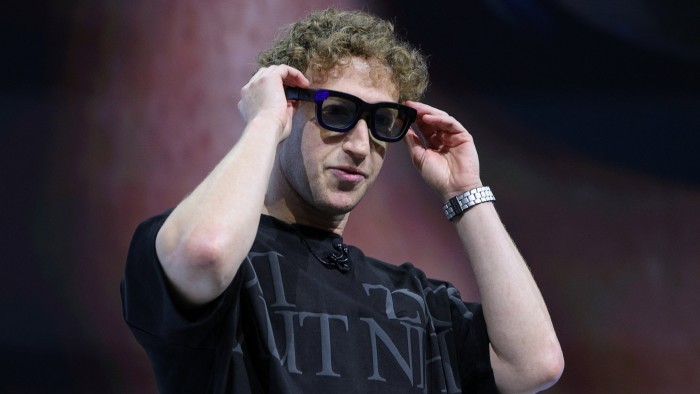
Meta’s Hypernova smart glasses would for the first time have a small display on one of the lenses, according to two people familiar with the matter and first reported by Bloomberg, overlaying notifications or responses from Meta’s AI assistant on to the real world.
Read the full article here