


Donald Trump has throughout his presidential career fought the Federal Reserve and its chair Jay Powell with public bluster and verbal threats to try to get his way on interest rates.
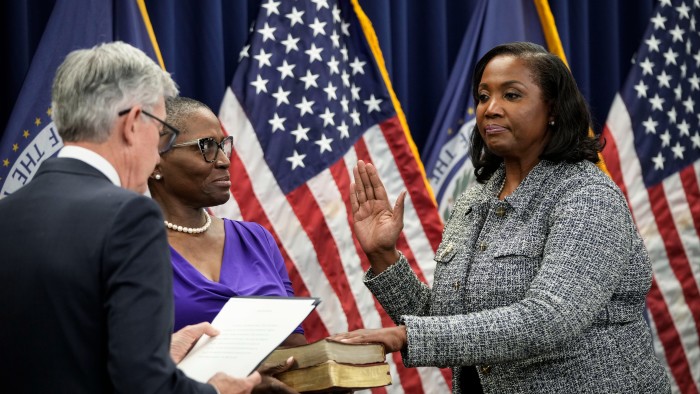
But on Monday night the US president took his assault on the world’s most important central bank to the next level, saying he would remove governor Lisa Cook from office with “immediate effect”.
Trump’s late-night putsch represents one of the gravest challenges to the Fed since it became independent 74 years ago, and marks a stunning escalation in the president’s attack on the US economic establishment.
Cook, the first Black woman to join the Fed’s board of governors, has vowed to fight Trump and remain in office, saying the president had “no authority” to fire her.
But the president’s move showed a ruthless determination to seize decision-making at the central bank, even at the cost of the independence that for decades has helped sustain faith in US economic policymaking and the dollar’s status as a reserve currency.
“This is unprecedented,” said Lev Menand, a professor at Columbia Law School. “If this removal sticks . . . it spells something close to the end of central bank independence in the US.”
David Wessel, director of the Hutchins Center for Fiscal and Monetary Policy at the Brookings Institution, had an even starker warning. “President Trump seems determined to control the Fed — and will use any lever he has to get a majority on the Federal Reserve Board of Governors,” he said. “This is one more way in which the president is undermining the foundations of our democracy.”
Trump’s attack on Cook, who the president’s federal housing director has accused of lying on her mortgage paperwork, comes just weeks after he fired the head of the Bureau of Labor Statistics following a monthly jobs report that pointed to a sharp slowdown in hiring in recent months.
The president has also challenged the independence of the country’s judges and used his executive authority to attack the academic establishment, media groups and law firms.
But his moves against economic agencies have unnerved investors, who have grown increasingly worried about institutions that have long been at the forefront of data analysis and policymaking.
Investors sold long-term US Treasury bonds following Trump’s intervention, pushing the 30-year yield up 0.05 percentage points to 4.94 per cent. The dollar also slipped against its peers, but the moves were more subtle than those during other recent bouts of market tumult.
“Unless and until the bond market responds poorly to the attacks on Fed independence, there is no reason for the administration to change their tune: they are slowly gaining control over the institution and there appears to be little that will stand in their way,” said Eric Winograd, senior economist for fixed income at AllianceBernstein.
Trump’s imprint is already present at the Fed. Two of its seven board members, Christopher Waller and Michelle Bowman, were selected by him during his first term in office.
This month, Adriana Kugler, who was tapped to be governor by former president Joe Biden, announced she was stepping down before the end of her term next year, prompting Trump to pick Stephen Miran, one of his closest economic advisers, to succeed her.
If Trump succeeds in ousting Cook, whose term runs to 2038, it would give his nominees control of the seven-member board of governors. Moreover, the presidents of the 12 regional Feds, all of whom serve five-year terms, will need to be renewed at the end of February 2026. The decision to renew their terms lies with the Fed’s board.
“If the president were successful [in ousting Cook], the outcome would be momentous,” said Michael Feroli, chief US economist at JPMorgan.
In his letter to Cook, Trump cited allegations brought by Bill Pulte, head of the Federal Housing Finance Agency, of mortgage fraud prior to her time at the Fed as his justification for removing her. The justice department last week called for Powell to remove Cook, but she has not been charged with wrongdoing by prosecutors.
Cook’s attorney, Abbe David Lowell, said on Monday evening that “we will take whatever actions are needed”.
Cook’s first step in fighting back is likely to be an application for a preliminary injunction from a federal-district court. This path was set by Gwynne Wilcox of the National Labor Relations Board and Cathy Harris, the Merit Systems Protection Board chair, both of whom were dismissed by Trump earlier this year.
If an injunction were granted, the Trump administration would almost certainly appeal against the decision to a higher court, with the case ultimately reaching the Supreme Court.
Trump’s push to sack Cook comes even as the Fed is moving in the monetary policy direction he has been advocating for — an interest rate cut as early as September.
“From a bond investor standpoint, it just adds a little more uncertainty and too much emphasis on the Fed, as opposed to the underlying economy and what the data is telling us,” said Jack McIntyre, portfolio manager for Brandywine Global Investment Management.
Steven Englander, head North America strategist at Standard Chartered, said Trump’s move could be read as a warning to Fed officials that they will “face a lot of legal, financial and political pressure if they drift too far from the administration line”. That could bring lower rates and a cheaper dollar, he added.
Still, the attack by Trump will leave a mark, drawing more comparisons with authoritarian leaders in emerging markets — such as Turkish strongman Recep Tayyip Erdoğan — who have tried to bend monetary policy to their will, crushing confidence in their economic management.
“The US situation and what we have seen in Turkey are eerily familiar,” said Lars Christensen, who heads Paice, a consultancy. “It takes a while to erode an institution’s credibility. But once trust is broken, the cost is immense.”
Additional reporting by Aiden Reiter in New York
Read the full article here