


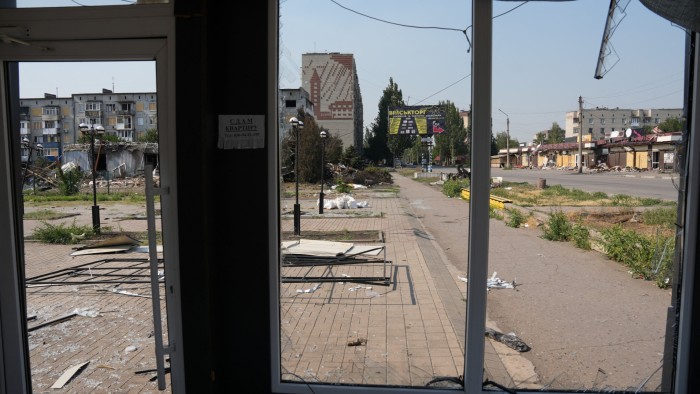
A Russian breach on Ukraine’s eastern frontline has triggered a wave of indignation and confusion in Kyiv ahead of a crucial summit between Donald Trump and Vladimir Putin on Friday, in which the Russian president is expected to try to lock in battlefield gains.
Ukrainian and western military analysts said that Russian forces had advanced nearly 15km over the past few days along a narrow corridor parallel to Dobropillia, a coal mining town turned key logistical hub north of the stronghold of Pokrovsk that Russian troops have nearly encircled.
The shock advance threatens to cut off a vital road linking Dobropillia to Kramatorsk, the de facto capital of Ukrainian-held Donetsk region which the Russians aim to capture, while allowing the Kremlin’s forces to bypass and flank a belt of fortifications and defensive lines built in recent months.
It marks some of the most significant Russian gains in the past year, and comes at a perilous moment for Ukraine, whose army is struggling with shortages of manpower and ammunition.
The US, Kyiv’s biggest political and military backer, is also pressing Ukraine to make concessions to end Moscow’s war. Ukrainian President Volodymyr Zelenskyy fears the Kremlin will use this week’s Trump-Putin meeting to consolidate its military momentum and steer the war’s direction in its favour.
“The situation is quite chaotic, with the enemy advancing into our depth after identifying gaps in the defence, before consolidating its positions and gathering forces for new advances,” DeepState, a Ukrainian war monitoring group with ties to the defence ministry, wrote on its Telegram page.
The command of the Dnipro operational group, which oversees defence operations in eastern Ukraine, denied in a statement released on Monday that there had been a breakthrough, writing that the infiltration of small Russian assault groups “past the first line of Ukrainian positions . . . is not equal to ‘taking control of the territory’”.
“Of course, the situation is and remains difficult, and the fighting in this region is the most intense compared to other sections of the frontline,” the statement added.
Ukraine’s general staff did not confirm the advance on Tuesday morning but said the previous evening reinforcements had been dispatched to the Pokrovsk part of the frontline “by decision of the commander-in-chief”.
Ukraine’s top general, Oleksandr Syrsky, attempted to play down the deteriorating situation at the front, writing on social media that things were “difficult” but his forces were “holding back the enemy”.
The Ukrainian military has been “conducting active operations and have had some success in moving forward, in liberating Ukrainian land” in Sumy region, he said.
But the reality was much starker than had been predicted, according to Ukrainian soldiers and military analysts.
“Russia’s recent tactical breakthrough north of Pokrovsk is unsurprising given the lack of cohesive defensive lines, and could further develop negatively,” said Mike Kofman, a military analyst and senior fellow in the Russia and Eurasia Program at the Carnegie Endowment for International Peace.
The Russian advance has triggered a wave of criticism online from Ukrainian military figures and volunteers.
They have been warning about a gradual weakening of defensive lines caused by months of incessant Russian assaults and the increasing use of strike drones to target Ukrainian logistics behind the frontline. They add that this has been exacerbated by a manpower shortage that has left depleted holdouts.
“The situation unfolding in the Donetsk region is the result of actions or inaction that has been constantly warned about . . . for a year and a half,” said Taras Chmut, founder of Come Back Alive, one of the largest Ukrainian charities providing weapons to the military.
Bohdan Krotevych, former chief of staff of the Azov brigade and a National Guard lieutenant colonel, made a public appeal to Zelenskyy.
“Mr President, I sincerely don’t know what exactly is being reported to you, but I’m informing you: on the Pokrovsk-Kostyantynivka line, without exaggeration, it’s complete chaos,” he wrote on social media. “And this chaos has been growing for a long time, worsening with each passing day.”
Warning of the penetration of Ukraine’s defences on the eastern front, he added: “A stable line of combat contact, as such, effectively doesn’t exist.”
Syrsky, the general, said in early August that Russian forces were increasingly resorting to “sabotage operations in our rear” as part of its infantry tactics. Small units described as Russian sabotage and reconnaissance groups have been reported inside the Ukrainian-held city of Pokrovsk in recent weeks and Dobropillia in recent days.
The Centre For Defence Strategies (CDS), a Ukrainian security think-tank, said in a note on Monday that the situation around Dobropillia was of “particular concern” because a Russian advance northwards would also make it harder to defend the towns of Druzhkivka and Kostyantynivka.
Some observers said the situation could be explained by Ukraine’s thinly manned defensive lines rather than new Russian tactics.
Stanislav Bunyatov, a Ukrainian serviceman and military blogger, said on Telegram “the entire defence line is like a sieve”.
Read the full article here