


Unlock the White House Watch newsletter for free
Your guide to what Trump’s second term means for Washington, business and the world
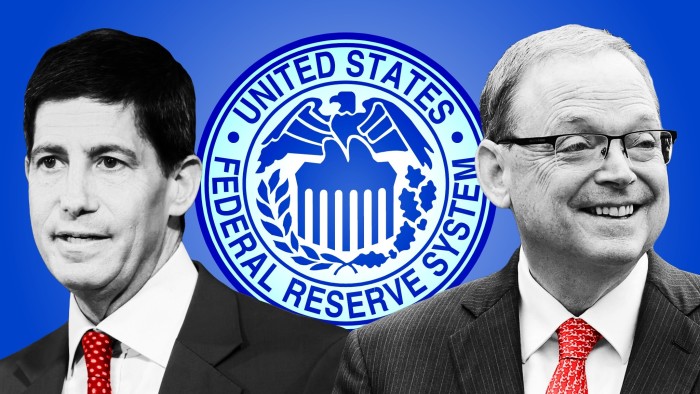
Donald Trump has said Kevin Hassett and Kevin Warsh are now the front-runners in the race to succeed Federal Reserve chair Jay Powell when his term leading the world’s most powerful central bank ends next May.
“We’ve started the interviewing process, we have some great candidates, it’s probably down to three,” the president said at a press briefing on Wednesday afternoon.
When asked by a reporter whether Hassett and Warsh were the top contenders, Trump said: “The two Kevins are absolutely . . . they’re both very good.”
The process to choose as new Fed chair comes as Trump has harshly criticised Powell, who he has called a “stubborn mule” and a “moron” for the central bank’s refusal to cut interest rates this year.
Trump contends borrowing costs should be cut from a 4.25 per cent to 4.5 per cent range to 1 per cent. But Powell and several other policymakers have said rates need to be held at restrictive levels because of the risks the president’s tariffs cause a fresh bout of severe inflation.
Hassett, a Trump ally who is the director of the National Economic Council, and Warsh, a former Fed governor who narrowly lost out to Powell for the job in 2017, have already begun campaigning for lower borrowing costs — which analysts view as a crucial prerequisite for the president’s endorsement.
“The odds are pretty high that it will be one of the two Kevins,” said Stephen Moore, an economist with close ties to the president. “Trump respects them both, and he likes them both.”
Beyond Hassett and Warsh, Christopher Waller, who was appointed to the Fed board by Trump during his first term, is considered by many investors and economists as a candidate for chair.
Fed governor Adriana Kugler’s decision at the end of last week to step down, well before her term was due to end in January, has, however, complicated the process.
Trump said on Wednesday that he would “probably go with a temp”, who would serve out the rest of Kugler’s term and then quit. He would then nominate a “permanent” candidate who would use Kugler’s seat to become the new Fed chair.
Powell’s term as chair ends in May 2026, but he could remain at the Fed as governor until January 2028. Trump said he would name the temporary replacement to Kugler in the coming days.
Neither Hassett nor Warsh are likely to settle for the temporary role. That could instead go to long-shot candidates for the chair’s job, such as former World Bank boss David Malpass, economists and investors said.
Fed governors need to be confirmed by a Senate majority. Warsh, Waller and Malpass did not immediately respond to requests for comment on their candidacy for roles at the Fed. The White House declined to comment on Hassett’s candidacy.
Between the two Kevins, Warsh, a former Morgan Stanley executive and adviser to president George W Bush, is seen by many Wall Street investors as a more orthodox choice. Hassett is viewed by some as more likely to support Trump’s desire for steep reductions in borrowing costs.
While Hassett lacks Warsh’s experience as a senior Fed official, some analysts say the president considers him a more loyal steward of the White House’s economic policies.
Hassett also has more political experience, having served as an adviser to several prominent Republican presidential campaigns including those of Bush, John McCain and Mitt Romney. During Trump’s first term, he headed up the Council of Economic Advisors for two years.
Though Warsh backed calls for lower borrowing costs in a television interview last month, many investors note that he took a hawkish tilt during his time at the Fed.
A transcript of a Federal Open Market Committee meeting held on September 16 2008 — the day after Lehman Brothers fell into bankruptcy — shows that the former Fed governor was worried about price pressures even when the global financial system was teetering on collapse.
Warsh — a fellow at the Hoover Institution at Stanford, which counts monetary hawks such as John Taylor among its staff — has tried to sidestep concerns he will prove too hawkish by claiming that his desire to drastically slim down the Fed’s balance sheet will pave the way for multiple rate cuts.
Still, Trump signalled that he may harbour some doubts about Warsh’s willingness to aggressively cut borrowing costs earlier this week.
The president acknowledged that Warsh was “very good”, but then added: “Sometimes they’re all very good until you put them in there and then they don’t do so good.”
Additional reporting by Ian Hodgson in Washington
Read the full article here