


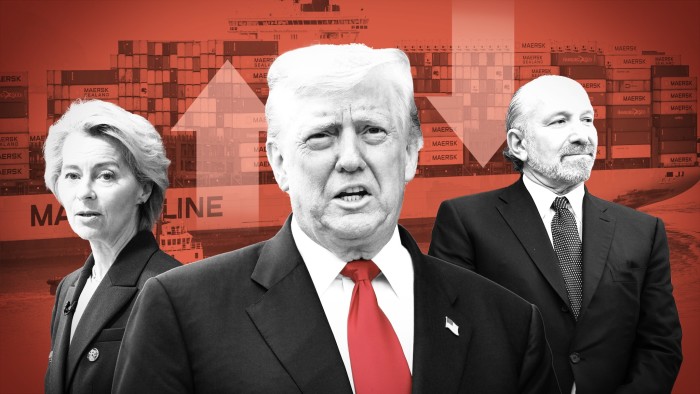
Donald Trump made two big public announcements on the day he launched a battery of new tariffs and upended the global trading order: one about a new ballroom at the White House and another about sports.
“We’re making a lot of deals,” the president said on Thursday afternoon, turning his attention briefly to trade while flanked by an array of football and golf stars. “We just made a couple of others a little while ago — I don’t know if you’d be interested right now. I won’t even bother to tell you.”
The comments seemed designed to taunt US trading partners such as Canada, Taiwan and India, which lobbied frantically for days to avoid more Trump tariffs — but were still bereft as the clock raced towards the US president’s August 1 deadline to strike new deals.
Officials could not say which new trade deals Trump was referring to, and none of them has since been announced.
It was another example of the mixed signals from Washington, reflecting much internal debate up until the last moment among the president’s own advisers.
Since April 2, when Trump unveiled his “liberation day” trade war, his approach had been a case study in volatility.
He imposed so-called reciprocal tariffs, sending global markets into a tailspin, and then paused them. He escalated a trade war with China so quickly that economists warned of global recession, then agreed a truce, prompting critics to declare a Taco doctrine: “Trump always chickens out”. He imposed levies on Mexico and Canada, but then exempted most products. He vowed to strike 90 trade deals within 90 days, but secured a fraction of that number.
Even late on Thursday, just hours before the White House published executive orders slapping new tariffs on dozens of countries, officials said Trump was undecided about which trading partners to punish and which to spare.
As the deadline neared, he gathered his top advisers for crucial meetings: Treasury secretary Scott Bessent, commerce secretary Howard Lutnick and US trade representative Jamieson Greer spent hours in the Oval Office, hashing out final plans.
Foreign negotiators and journalists were left to constantly refresh their Truth Social feeds, waiting for any news from within the West Wing.
The sudden blitz of announcements just after 7.30pm in Washington caught many of the US’s largest partners and most important allies flat-footed. Big exporters to the US, including India, Taiwan, and Canada — a US ally and its biggest source of foreign oil — were left disappointed.
Direct contact with the president, it turned out, was important.
European Commission president Ursula von der Leyen sealed the EU’s deal with a trip to see Trump at his golf course in Scotland; an act of symbolic supplication that drew criticism in the bloc, where Germany and France also chafed at the agreement’s generous terms for the US.
While some world leaders — notably Mexican President Claudia Sheinbaum — managed to reach Trump personally and avert an economic disaster for their country, he ignored the entreaties of others.
Canada’s Prime Minister Mark Carney, who shot to power in Ottawa by promising he would contain Trump, had dispatched a team to Washington for last-ditch talks to seal a deal. When it failed, he tried to get the president on the phone. His calls went unanswered and unreturned.
Carney’s failure came after he said Canada would recognise Palestinian statehood, a move Trump said on Thursday would make it “very hard” to do a deal with Ottawa. Later, Lutnick said Carney’s move was “tone deaf” given his hopes to win over the president.
The treatment of close allies went down badly with Trump’s critics.
Ron Wyden, the top Democrat on the Senate’s committee overseeing trade, accused him of spreading “chaos” and “dragging down the economy”.
“All Trump has delivered are vastly higher taxes on essential products that Americans buy from other countries,” he said.
Although the executive order announcing the new tariff regime on Thursday talked of the US effort to close trading deficits and raise income, political considerations were also paramount.
Brazil discovered just that when Trump suddenly hit the country with an extra 40 per cent levy because of its treatment of rightwing ex-president Jair Bolsonaro this week, a former ally of the US leader.
Other countries stumbled at the last hurdle for reasons beyond their control.
Taiwan, the world’s most important semiconductor exporter, had come close to clinching a deal almost a month ago, people familiar with the talks said.
But the White House sat on Taipei’s offer, worried that it could affect the more consequential negotiations with China and a possible Trump summit with President Xi Jinping. Uncertainty around potential US tariffs on chips also slowed talks.
By Thursday night, the US president had placed a 20 per cent tariff on Taiwan. Its president took to Facebook to say he would try to negotiate his country out of it.
India was also blindsided. It hired Jason Miller, a central Trump campaign adviser last year, to try to get the president’s ear. But New Delhi struggled to convince him that it was doing enough to open its markets to US exporters.
Each time Lutnick presented Trump with a new Indian proposal, the president sent him back to negotiate harder, people familiar with the matter said. As the clock wound down, Trump lashed out at India’s “dead” economy and warned it of further penalties for relations with Russia.
One senior US official suggested Trump was just using America’s power. He “understood the leverage of the US market”, and was using it to “shift the global trading system to be one that is more beneficial for American workers and their families”.
At the centre of Trump’s talks were men with wildly different personalities and backgrounds. Lutnick, the gregarious Wall Street financier, was tasked with pitching deals to the president.
Accompanying him has been the White House’s trade representative Greer, a veteran trade lawyer who shuns the limelight, and a protégé of Trump’s former trade tsar Bob Lighthizer.
Greer approached the talks as a seasoned trade negotiator, while Lutnick brought some of Trump’s transactional dealmaking energy to meetings, people familiar with different negotiations have said.
US Treasury secretary Scott Bessent was put in charge of talks with China, the world’s second-largest economy and Washington’s most delicate economic relationship.
Bessent, who has emerged as a voice of assurance to global investors sometimes alarmed at Trump’s approach, was less involved in front-line negotiations, but was in the room for big trade decisions, a US official said.
In the final weeks before Trump’s August 1 deadline, negotiators vied to find a formula that would win over this combination of advisers — but always knowing the president could trash any deal for his own reasons later.
After they emerged from two days of talks with Bessent and Greer in Sweden last week, Chinese negotiators said they had agreed to extend the truce in their trade war. Then Bessent spoke, saying that was Trump’s call. The president has not yet decided if the truce will stretch beyond August 12.
The deals that Trump has approved have varied in style and substance, but fall into two broad types, according to one US official.
Countries either had to lower most of what the US said were non-tariff barriers, such as car safety rules or standards on medicines, or they had to “buy down” the tariffs with pledges to make big inward investments in the US.
Even then, it could depend on Trump’s mood. He intervened personally in several deals, at one point joining a call between the Indian trade minister and Lutnick, according to two people familiar with the talks. He has also almost always personally closed deals, insisting on calls with other world leaders.
Japan’s negotiator, Ryosei Akazawa, visited Washington almost every second week for meetings with Bessent, Greer and Lutnick in recent months. But it was only after Akazawa secured a 70-minute meeting with Trump in the Oval Office that the critical US ally was able to strike a deal.
While Trump has so far reversed course and backed away from some threats, many foreign capitals are now locked into higher tariff rates through their agreements with Washington.
Others, such as Canada, are now redoubling efforts to reduce the extra tariffs announced on Thursday, negotiating from a weaker position.
Myron Brilliant, a senior counsellor at DGA-Albright Stonebridge Group, said Trump was playing “Russian roulette” with the global economy but that his resolve seemed firm.
“Bet on him to stay the course on tariffs unless the market crashes,” he said.
Read the full article here