


Unlock the Editor’s Digest for free
Roula Khalaf, Editor of the FT, selects her favourite stories in this weekly newsletter.
The writer is a philanthropist, private investor and co-founder of Pimco
Some say the world will end in fire,
Some say in ice.
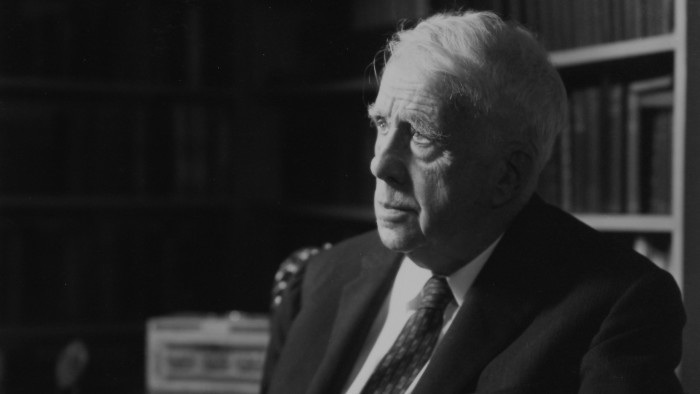
— Robert Frost
The American poet Robert Frost once wrote of the world’s potential destruction by fire (desire) or ice (hate). While obviously not meant as a reference to markets and economies, it could describe the opposing menaces of inflation (fire) and deflation (ice) that have loomed over them in the past century.
The 1930s Great Depression showed the economic devastation wrought by deflationary ice, produced in this case by a combination of misguided fiscal and monetary policies. Franklin D Roosevelt fought it with the New Deal until the second world war finally brought a resurgence of inflationary fire.
A host of battles followed between the menaces and attempts to counter them, the next being the early 1970s after the elimination of the gold standard. This made monetary policy a much more significant weapon to control the firestarter of Opec’s oil price shock, and Paul Volcker became the first monetary policy iceman as Federal Reserve chair. But economic breakdowns during the 2008-9 Great Financial Crisis and the pandemic years of the early 2020s required policymakers to instead fight the spread of ice.
My point from this history is that our finance-based economy has been in a long-term fight to produce stability in the midst of destructive forces, some brought about by Keynesian attempts by governments to stimulate demand, others more influenced by the fragility of credit creation first explained by Hyman Minsky in the early 1980s.
Current growth in government debt — a source of much market concern — is inflationary in the long term, but nothing is new about it except its seemingly unstoppable growth rate. We are still experiencing a Robert Frost-like juxtaposition of fire and ice.
Into the mix have come new forms of lighter fluid that have influenced credit creation over the past decade, such as an array of “shadow banking” platforms. The excess liquidity in the system engendered by the Fed has been clear to see in spates of crypto speculation, esoteric ETF launches, meme-based investing and the NFT mania. In addition, it must be acknowledged that recent tariff rises and President Donald Trump’s “big, beautiful bill” also have potential to add to the fire.
As a deflationary counter, though, China’s struggle to reinflate its economy with bold measures demonstrates the ever-present possibility of ice and the difficulty of generating growth.
In my mind, there’s only a slight doubt that financial markets will be closer in the future to a singe than a freeze. Finance-based capitalism, alongside the neglect of big governments of the inflationary consequences of the growth rate of debt, tilt the long-term odds in favour of fire. Financial markets should be alert to the prospect of increasing interest rates that counter the rise of AI and its assumed boost to productivity.
But pinpointing 10-year Treasury rates, or even forecasting a range for them on the basis of increased supply, can be a mug’s game in the short run. Ten-year yields have declined over the past six months even with the expectation of Trump’s BBB, for instance.
Some calculations can be made, such as determining the R-star, the level of interest rates that has a neutral impact on the economy, and then adding a premium for holding a Treasury bond over 10 years. When added to the current US consumer price inflation of 2.4 per cent, that produces a 10-year rate of 4.25 per cent — only a little below where we are now.
But when observing how yields on 30-year bonds have become more volatile versus those on five and 10 years, the situation is far from calm. Spreads between yields on long- and short-dated bonds are at cyclical highs and moving higher.
And in the intermediate to long term, more supply requires more buying. And dollar weakness and geopolitical/tariff unrest raises the likelihood of higher inflation — perhaps to 3 per cent and higher. These forces likely lead to increasing premiums for holding longer-term paper.
Even with the 30-year yield at 4.9 per cent — some 0.9 percentage points above its 12-month lows — long-term bonds remain risky because of the high sensitivity of their prices to small changes in interest rates. A 0.2 percentage point rise in yields — which pushes Treasury prices down — would wipe out the annual return an investor can expect to make from coupon payments. That’s not a bonfire but the heat is above normal.
Fire has of course been what Robert Frost suspected all along. “From what I’ve tasted of desire,” he concluded, “I hold with those who favour fire.”
Read the full article here