


Unlock the Editor’s Digest for free
Roula Khalaf, Editor of the FT, selects her favourite stories in this weekly newsletter.
French Prime Minister François Bayrou has proposed a broad spending freeze for next year and scrapping two national holidays, putting his political survival on the line to narrow the deficit.
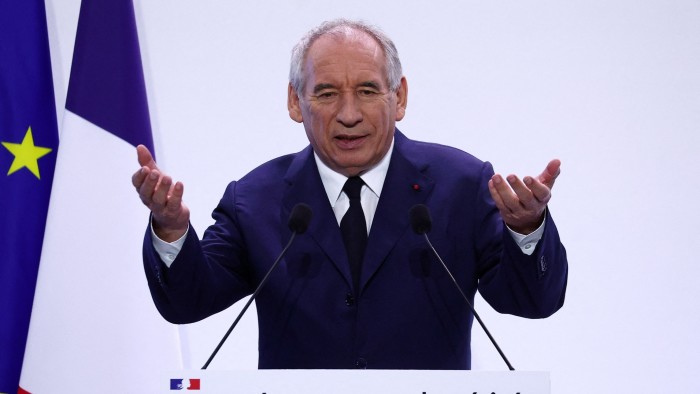
In a press conference on Tuesday, Bayrou unveiled the outline of a 2026 fiscal package of €44bn in tax rises and spending cuts, including curbs to pensions and social welfare benefits and a not yet defined “solidarity contribution” from the wealthy.
“This is our moment of truth,” said Bayrou, warning that France could face a debt crisis similar to the one that hit Greece in 2008. “We have become addicted to public spending.”
The French needed to work more to catalyse stronger growth, he said, adding that scrapping the national holidays on Easter Monday and Victory in Europe Day on May 8 would generate €4.2bn in revenue. France has 11 public holidays a year, compared to 8 in the UK. Bayrou is also proposing scaling back unemployment benefits.
Only defence spending has been spared amid rising threats from Russia. President Emmanuel Macron instructed Bayrou to put through a roughly 10 per cent increase for the military in the next two budget cycles, or about €6.5bn.
Many of the proposed measures have come under fire from leftist and far-right opposition parties. They are already threatening to topple the government over what they call an austerity budget that would hit poor people, workers and retirees.
The fragile centrist alliance that supports Macron and Bayrou does not have a majority in the national assembly, so the prime minister will have to use a constitutional clause to override lawmakers to pass the budget. That then would open up the government to a no-confidence vote in which the key swing votes would be Marine Le Pen’s far-right Rassemblement National and the Socialists.
Le Pen’s MPs ousted Bayrou’s predecessor, Michel Barnier, last year over the budget, citing a plan to de-link pensions from inflation for a year, an idea that Bayrou has now revived.
Le Pen slammed Bayrou’s announcements as taking aim at “all the French, workers, and retirees, rather than hunting down wasteful government spending”. She warned that her MPs would not shy away from toppling the government: “If Bayrou does not revise his plan, we will censure him.”
Mujtaba Rahman, managing director for Europe at consultancy Eurasia Group, called Bayrou’s announcements “a kamikaze move”.
“Bayrou is looking to go out in a blaze of glory, telling a divided assembly and country what needs to be done for France to escape its fiscal mess, knowing full well these measures have no chance of being implemented,” Rahman said.
France’s deficit ballooned to 5.8 per cent of GDP at the end of 2024, the third-worst in the EU after Romania and Poland, according to Eurostat. Bayrou’s draft budget, to be officially presented to parliament in the autumn, will aim to reduce the deficit to 4.6 per cent of GDP by the end of 2026 and the government wants to hit 3 per cent of GDP by the end of 2029.
But Barclays analysts wrote in a recent note that the 2026 deficit target might be “unattainable” given the political constraints and risk of a no-confidence vote. They predicted “a virtually unchanged deficit over the next two years”.
One particular lightning rod has been Bayrou’s concept of an année blanche, or a year where government spending, pensions and welfare programmes are held steady, without the usual automatic increases and inflation adjustments. He said it would generate €7.1bn in savings in 2026 — the second-biggest single bucket of savings of his plan — while symbolising how all French people and the state had to make an effort.
In addition to the budget proposal next year, Bayrou sketched out a five-year plan to stabilise the overall debt-to-GDP level by 2029. A single capped welfare payment for low-income people should be established, instead of having multiple ones now, he said. Healthcare spending on everything from medicines to long-term sick leave should be rationalised.
France’s interest costs this year will reach about €62bn, roughly equal to annual combined spending on defence and education, excluding pensions, and these costs will climb to roughly €100bn by 2029 if nothing is done.
Bayrou admitted that he knew his ideas would leave him at the mercy of parliament. “We know perfectly well the risks,” he said, adding that he “had the obligation and the desire to overcome these obstacles” in the national interest.
Read the full article here