


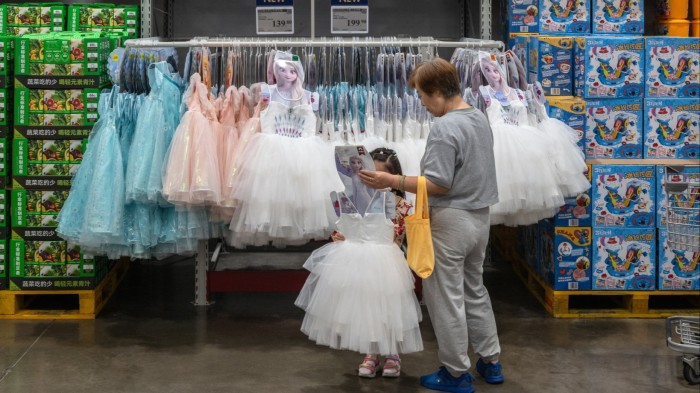
On a recent weeknight in Shanghai, customers packed one of the city’s six Sam’s Clubs, scouting for deals among the wide aisles stacked to the ceiling with groceries and merchandise.
“At least half our family’s stuff is bought here,” said Peter Xu, a 34-year-old shopper at the front of a long queue for free samples of Chaoshan beef noodles.
Sam’s Club, Walmart’s warehouse chain, is one of China’s fastest-growing foreign retailers, with 56 stores in the country and plans for 60 by the end of the year, said a person familiar with its expansion. This compares with seven China stores from Costco, the dominant warehouse club operator in the US.
Even as economic momentum has slowed in China, Sam’s Club’s income from memberships there grew more than 40 per cent year on year in the first quarter, as consumers flocked to the warehouses for their low prices and bulk purchases.
China, one of Walmart’s three international growth markets alongside India and Mexico, may be its most fraught. The world’s second-largest economy is grappling with weak consumption at a time when trade tensions with Washington have risen.
The company not only has stores in China but also purchases billions of dollars of goods there to feed its primary business in the US.
Sam’s Club has “inculcated itself into the fabric of Chinese life in a way that people would probably forget it’s an American company”, said Bryan Gildenberg, managing director at Retail Cities, a consultancy.

The warehouse club business was pioneered in the US in the 1970s. Customers pay annual fees for entry into utilitarian big-box stores carrying a limited assortment of several thousand products sold in bulk at a modest mark-up.
Walmart entered China in 1996, five years before the country joined the World Trade Organization, with a Walmart-brand hypermarket and a Sam’s Club in the southern city of Shenzhen.
An urbanisation wave in the early 2000s led to a Chinese supermarket boom, but it has lost steam in the past decade with the rise of digital retail. Walmart, France-based Carrefour and even domestic bricks-and-mortar retailers such as Suning have struggled to keep up with local app-based commerce, some of which has been subsidised by the government.
Walmart has closed dozens of its hypermarkets in China since 2020, leaving about 280. The Arkansas-based company has exited other markets entirely, including the UK, Japan and Argentina.

But with Sam’s Club, Walmart has found a way to expand in China by deploying warehouses as both shopping destinations and ecommerce delivery hubs. The chain accounts for 80 per cent of Walmart’s sales in the country, according to Oliver Chen, a retail analyst at TD Cowen.
Walmart’s sales in China rose 17 per cent to $20bn in its latest fiscal year. Eight of the Sam’s Club stores are forecast to each register half a billion dollars in sales this year, Christina Zhu, chief executive of Walmart China, told investors in April. A Walmart spokesperson declined a request for an interview with Zhu and would not comment on the company’s business in China.
Even as China’s economy cools, the company believes there are opportunities to sell to the millions of middle and upper-middle-class consumers who can afford the membership fees, which start at Rmb260 ($36) a year. Goods range from sea cucumbers and Fuji apples from Gansu province to toys such as Land Rover monster trucks and Mickey Mouse swimming sets.
“There are definitely still groups of consumers out there who want to be surprised, who want the treasure hunt experience,” said Weiwei Xing, a Hong Kong-based partner at Bain & Co focusing on consumer products.

“A member [in China] told me she doesn’t have to shop around for the best prices . . . because . . . she trusts that Sam’s Club is always going to have the lowest prices on whatever it is that her family needs,” Kathryn McLay, chief executive of Walmart International, told investors in April.
Half of Walmart’s China sales are online, compared with less than 20 per cent in the US. To fulfil ecommerce orders, China CEO Zhu described Sam’s Club locations as “mother clubs” that stockpile goods for networks of eight to 15 delivery hubs serving dense neighbourhoods within a three-mile radius.
One curb on Sam’s Club’s China growth is a shortage of affordable and suitable land, which is owned by local governments and a crucial source of fiscal revenue.
Walmart executives are also dealing with strained US-China relations that have worsened with US President Donald Trump’s steep tariffs on Chinese goods. About a third of Walmart’s US merchandise is imported, with China a leading source.

The view inside Walmart is that it has become more complicated to be an American company in China. Authorities summoned executives this year over reports the US retailer had asked suppliers to cut prices in response to Trump’s tariffs, according to state media. The retail giant had also warned it was not be able to “absorb all the pressure” from the duties and would need to raise some US prices as a result.
But the company’s long-standing presence in China has raised hopes it can weather potential frictions. One person with knowledge of Walmart’s retail business in China said it was in a “non-sensitive sector” and could “help to keep a foundation of co-operation between the countries”.
Deborah Weinswig, chief executive of retail consultancy Coresight Research, said Sam’s Club’s longevity in the country and efforts to sell local products meant it was “looked at as a more native company in the market than others”.
At a Walmart in Shanghai packed with local products including dried mushrooms commonly used to make soup, one 66-year-old customer who had been shopping there for “many years” said: “The bad relations between the US and China have no impact on us.”
Additional reporting by Wang Xueqiao in Shanghai
Read the full article here