


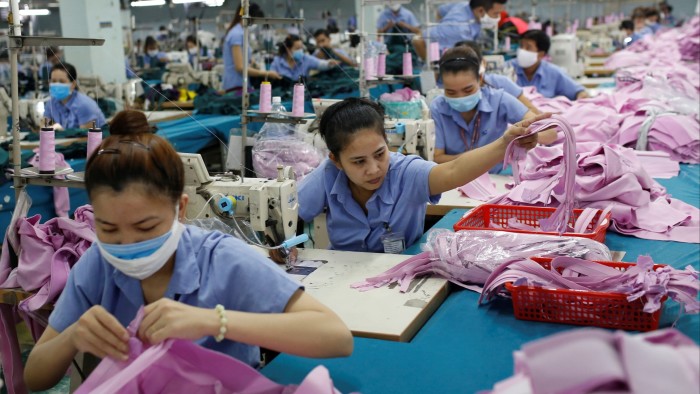
For Thanh Cong Garment, a Vietnamese supplier to apparel companies including Adidas, Calvin Klein and Columbia, a trade deal to avoid the worst of US President Donald Trump’s tariffs should have been a huge relief.
Vietnam was one of only two countries that Trump said has clinched a deal with the US by a July 9 deadline to avoid his so-called reciprocal tariffs. This week, many of its neighbours received letters from the White House threatening, in some cases, higher levies.
But the company was left puzzling over the lack of detail in the agreement. Trump announced a blanket 20 per cent tariff rate, down from an initial threat of 46 per cent, but neither Vietnam nor the US has provided further details or released a final version of a trade agreement.
Hanoi has also not confirmed the new tariff rate, saying only that the two sides had reached a “fair and balanced reciprocal trade agreement framework”, raising further uncertainty for companies.
The US side also included a clause threatening a 40 per cent rate on goods “transshipped” — or rerouted — through Vietnam, though it did not define transshipment. But the clause has stoked concerns among businesses that they will be penalised for using Chinese inputs, which are critical to supply chains in Vietnam.
Tran Nhu Tung, the company’s chair, noted that the 20 per cent base rate was not much higher than the 15-17 per cent import tax currently paid by Vietnamese garment makers. But the transshipment clause could prove to be a huge challenge.
“For the products that [have] materials from China but manufactured in Vietnam, what is the tariff to export to the US? 20 per cent or 30 per cent or 35 per cent?” said Tung. “We need to wait.”
Vietnam, one of the biggest suppliers of apparel, shoes, electronics and other products to the US, became a manufacturing powerhouse in recent years, attracting the likes of Apple, Nike and Samsung as companies rushed to relocate production out of China to avoid blowback from geopolitical tensions.
Many of those companies are clambering to figure out the new trade deal will work — and whether by moving quickly, Vietnam has scored favourable terms or hemmed itself in.
“There is a sigh of relief that at least we know what the answer is for Vietnam . . . but there is still quite a lot of uncertainty in the agreement that exists right now,” said Rich McClellan, founder of the RMAC Advisory, whose clients include companies and the Vietnamese government.
The transshipment clause is “the most ambiguous and most potentially risky portion of this agreement”, he added.
Vietnam has a lot at stake. One of the world’s most trade dependent countries, with an exports-to-GDP ratio of nearly 90 per cent, a third of its exports go to the US alone, making a higher tariff rate a significant risk for economic growth.
Its trade surplus with the US has surged in recent years to $123bn in 2024, the third-largest behind China and Mexico.
The country also drawn accusations of serving as a conduit for Chinese companies seeking to avoid Washington’s tariffs. A large amount of manufacturing investment in Vietnam has come from China, which accounted for almost one in three new projects last year.
Experts say the Trump administration’s definition of transshipment could refer to a range of practices from simply repackaging Chinese goods with a counterfeit “made in Vietnam” label or to using Chinese raw materials in goods manufactured in Vietnam.
“The impact may be more limited if these 40 per cent tariffs are enforced solely for the most egregious practices of plain diversion of trade to avoid US tariffs,” said MUFG analyst Michael Wan.
“In contrast, if there is a stricter determination of transshipment defined as a certain threshold of foreign value added, the impact . . . may be pronounced.”
Given the Trump administration’s interest in isolating China, businesses fear a wider definition. This would be extremely damaging for Vietnam, where many businesses rely on Chinese raw materials and components, and warned that removing them would be impossible.
“That is not realistic, that does not take into account how global supply chains work,” said one American businessman in Hanoi. “It’s not just impossible for Vietnam. It’s impossible for everybody.”
Another big unknown is how Vietnam’s tariff rate will compare with those of its neighbours — a difference that will be critical to Vietnam retaining its competitive advantage as a manufacturing hub. Trump has set a new deadline of August 1 for countries to come to an agreement with the US.
“Whether the negotiated tariff is ultimately a win or loss for Vietnam will largely depend on whether other ‘China plus one’ markets secure similar deals,” said Marco Förster, Asean director at Dezan Shira & Associates.
Official data for the first half of the year shows FDI increased nearly a third to $21.5bn, suggesting that investment had not been scared off by the tariff uncertainty. Vietnam also has an edge in certain incentives and cheaper costs for producers.
But Steve Greenspon, founder of US home goods retailer Honey-Can-Do, warned that even “a 20 per cent tariff will result in higher prices and inflation on goods”.
“This will certainly lead to reduced demand for goods, hurting American businesses and jobs,” he said. “Companies will continue to produce their products in Vietnam, though at a lower pace than prior to the tariffs.”
For Tung, orders from US customers for the third quarter had already dropped between 15 and 20 per cent, after a rush to ship orders before the July 9 deadline. Up to 70 per cent of raw materials for garment manufacturing, from cotton yarn to zippers and elastic, are sourced from China, making it difficult for the industry to avoid being caught up in transshipment.
“Most of the garment materials of Vietnamese garment firms are imported from China,” said Tung. “So it’s difficult to find another materials supplier apart from China.”
Data visualisation by Haohsiang Ko in Hong Kong
Read the full article here