


Ted Seides is the founder of Capital Allocators and former president of Protégé Partners.
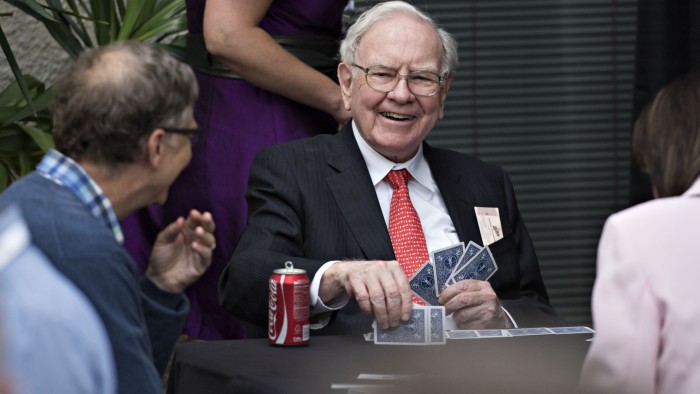
On a slow summer day 18 years ago, I began communicating with Warren Buffett about a bet that pitted the performance of hedge funds against the S&P 500.
The suggestion turned into a charitable 10-year wager from January 1, 2008 to December 31, 2017. Carol Loomis announced it in Fortune as “Buffett’s Big Bet”. It looked good for the hedge funds in the early years around the global financial crisis, but the market rallied strongly thereafter. By the time of Berkshire Hathaway’s 2016 annual report, Buffett was able to take a victory lap.
Lots of virtual ink has been spilled about what the bet meant — some of it on pink pixels. Warren initially assessed his odds of winning at 60 per cent (but wrote in his 2016 annual letter as if victory was preordained). I initially called it at 85 per cent in our favour. Lots of outcomes could have happened, but only one did. In retrospect, I was overconfident, but I caution those who read too much into the results.
Annie Duke calls this “resulting”, a behavioural bias where people judge the quality of a decision based on the outcome rather than on the decision process itself. I still believe the odds were heavily in favour of hedge funds at the time, and an unprecedented act by the Fed bailed out the market from what could have been a lost decade.
Regardless of cause and effect, the bet led to unanticipated connections, relationships, and experiences. Warren and I met for dinner nearly every year, typically accompanied by a guest or two. Those guests included Todd Combs; Ted Weschler; my partner at the time and now Treasury secretary, Scott Bessent; hedge fund founder Bobby Jain; podcast star Patrick O’Shaughnessy; Permanent Equity founder Brent Beshore, and investor Steve Galbraith — which led directly to Warren honouring Steve’s close friend Jack Bogle at Berkshire’s annual meeting in 2017. I had a chance to meet Charlie Munger, who stereotypically said my bet was “stupid”.
Most importantly, with Warren’s win, Girls Inc of Omaha received over $2mn and purchased the Protégé House to provide residential support and guidance to Girls Inc. alumni. The growth of the $1mn bet into $2mn in proceeds is a story unto itself. We initially split the purchase of a zero-coupon bond that would mature in 10 years at $1mn. After the Fed dropped rates to zero, the $640,000 outlay had grown around 50 per cent. We decided to sell the bonds and buy Berkshire Hathaway stock, coincidentally shortly before Warren repurchased shares for the first time. The performance of the collateral for the bet far surpassed both the S&P 500 and the hedge funds.
Since then, many others have naturally reached out to me and proposed many different wagers.
Each came with conviction — Bitcoin HODLers, China bulls, emerging market mean-reverters, and Japan governance reformers. I don’t know if any communicated with Warren, but I didn’t see a relevant comparison in any of them.
A few weeks ago though, I thought of another bet that has equal — or greater — importance than the first. What’s the bet you ask? Private equity versus the S&P 500.
Comparing a portfolio of North American buyouts to the S&P 500 has important consequences, as private equity enters wealth management and seeks to access pension plans. In fact, I’d argue that this match-up could help shed light on one of the thorniest, most contentious debates in finance today.
I imagine we know what Warren thinks — high fees and extra expenses will doom private equity investors. A lot of outside factors could have impacted the result of our first bet (I wrote about it here), but that’s unlikely to happen with this comparison. This bet is much closer to faithfully representing Warren’s initial premise: that intelligent professionals with strong economic incentives to perform still cannot overcome the high fees they charge.
Both the S&P 500 and North American buyouts offer diversified exposure to the US economy. Businesses in public and private markets are similarly impacted by macroeconomic variables and have common geographic and sector exposure. (While the Mag 7 dominates the S&P 500, software and technology are the most represented sectors in buyouts.) Their pricing (P/E of stock and EV/EBITDA of buyouts) is correlated, in part because transactions between the two markets can arbitrage large pricing discrepancies.
The question, then, is whether their differences are enough for private equity to make up for the costs of doing business. Leverage, size, dispersion, illiquidity, and control each — in theory — positively impact private equity returns relative to the S&P 500.
— Leverage: The S&P 500 is approximately 0.6x debt-to-equity. Private equity is 1.5x. Assuming positive returns over a decade and a ROA above the cost of capital, leverage would boost private equity returns relative to the market.
— Size: Private equity-owned businesses are smaller than those in the S&P 500. Historically, small-cap companies outperformed large ones, although that hasn’t been true for a while.
— Dispersion: The dispersion of returns across private equity managers has been far wider than those in the public equity markets. This creates an opportunity to outperform within the asset class.
— Illiquidity: By design, private equity is illiquid. While illiquidity may not impact returns directly, it likely helps investors avoid getting in their own way. Dalbar’s quantitative analysis of investor behaviour consistently shows that public market investors earn far lower returns than the investments themselves.
— Control: Private equity firms are control owners of businesses and compensate management teams aligned with results. Public companies tend to have less engaged shareholders and less executive ownership.
Putting numbers to these concepts: assuming a 10 per cent return of the S&P 500 over 10 years, private equity would need to deliver approximately a 15 per cent gross return to beat the index. Higher leverage can make up 2-3 percentage points of that gap at current interest rates and spreads. However, the forty-year tailwind of declining interest rates will no longer support private market returns as it did in the past.
Next, smaller companies can grow faster than larger ones, a factor that could benefit private markets over time. Over the last century, small-cap stocks in the US have outperformed large by approximately 1.5 per cent per year, although that premium has been slightly negative since the GFC.
Adding up those two effects, private equity’s structural benefits could make up perhaps 80 per cent of the gap. The rest is up to allocators to select top private equity managers, private equity firms to make above-average investments, and management teams to deliver better operating results.
I described twelve examples of private equity transactions in my book, Private Equity Deals. These managers have many tools at their disposal to create value. When reading their stories, it’s hard to imagine they won’t find a way to deliver.
But as I learned from betting with Warren, the future is much harder to predict than the past. When you add it up, I’d put the odds of private equity outperforming the S&P 500 net of fees at around 40 per cent, which says next to nothing about what investors will actually experience.
Over the next few months, I’m going to speak to some podcast guests to see if we can identify an investable option to represent North American buyouts, and someone to take each side of the bet.
It might be fun to create a shadow wager starting on January 1 and report the results annually for the next 10 years. I’m even more excited to see if any unexpected benefits and connections surface this time around.
So . . . what do you think?
Read the full article here