


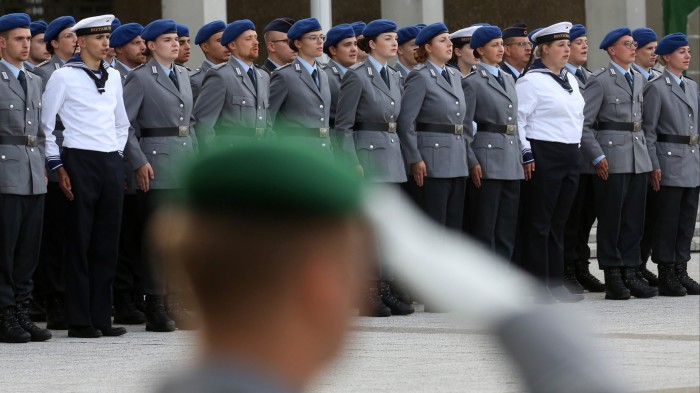
The German army’s growing need for new recruits is making businesses anxious that their struggle to find staff will get even harder.
Corporate representatives told the Financial Times that they backed efforts to bolster the military of Europe’s largest nation as Nato seeks to strengthen its deterrence against Russia.
But they are concerned that a return to some form of conscription — as well as a drive to get more civilians to serve as reservists — would further strain companies that are trying to recruit skilled workers in a tight labour market.
“The security situation is dramatic,” said Steffen Kampeter, director of the BDA, the country’s biggest employers’ group, adding that he welcomed efforts to strengthen the armed forces. But he warned that the military would be competing with civilian demand for personnel.
“Yes, we need more active soldiers,” he said. “Yes, we need to expand the system of reservists. But only a strong economy can make that possible.”
German defence minister Boris Pistorius plans to introduce a voluntary conscription model that would initially see about 5,000 18-year-olds drafted into the military each year.
But he has also acknowledged that such a scheme is unlikely to fill the large gaps in the military, floating a fallback option of a return to conscription. Until 2011, young people were compelled to either do military service or a civilian alternative.
Pistorius, who is from the Social Democrats, has not said how an obligatory enlistment model should work. But he has expressed support for the system in Sweden, where roughly 10 per cent of young people are called up each year after a screening process.
While employment is at record highs, Germany has the shortest average working hours of any wealthy economy, according to OECD data.
The country’s new government, led by conservative chancellor Friedrich Merz, has promised to get the nation working more as part of a push to revive the sluggish economy.
Merz hopes that boosting working hours will also help with acute skills shortages in sectors such as health, education and the engineering industry.
Kampeter said this effort would be even more vital if the armed forces were going to add to competition for workers. “If the necessary personnel are pulled away from us, that means issues like weekly working hours, the length of the working life, better integration of part-time workers into the labour market — all of those topics become even more important,” he said.
A representative of another business group, who asked for their association not to be named, said they had “a lot of questions” about a return to conscription.
The person said there was “no doubt that something has to be done” about recruitment to the Bundeswehr, as the German armed forces are known. But they added: “There are two conflicting goals — economic prosperity and defence.”
A study last year by the Munich-based Ifo Institute found that it was better to spend money making a voluntary military service programme attractive, rather than resorting to conscription.
The research, which was commissioned by the German finance ministry, warned that an obligatory model would carry high economic costs for the country, as well as taking a toll on individuals and their own financial prospects by delaying their entry into study or work.
“Different people are good at different activities,” said Panu Poutvaara, one of the authors. “If you have conscription, which is not voluntary, it would force people who are not good at being in the military to serve in the military.”
The Ifo Institute found that a well-paid voluntary model that persuaded 5 per cent of Germany’s annual cohort of 18-year-olds to sign up — about 39,000 people — would cost the government €1.5bn per year in salary payments.
That would be more than double the cost of a compulsory conscription model of the same size, which it assumed would offer a lower wage. But it would be offset by a smaller hit to gross national income. The effect would be greater if the government wanted to attract more recruits.
The military needs to expand by about 80,000 people over the next decade to meet Germany’s Nato commitments.
Senior military officials say that the size of the army reserves — made up of civilians who work with the military for a few weeks a year — needs to reach 200,000 in the years ahead.
Merz, who has cast himself as strongly pro-business, has called on the corporate world to make sacrifices to support this.
Jens Günther and his family-owned interiors business Günther-Innenausbau last year won a defence ministry prize for allowing one of their carpenters to serve 15-20 days per year as a reservist. He said it had been a positive experience. “I like to do my part . . . I get a motivated employee who broadens his own horizons a bit and brings things back into the company.”
But he said the company, which has about 20 employees, could not cope with having any more reservists. “If there were two or three, it wouldn’t be possible.”
Carlo Masala, a professor for International Politics at the Bundeswehr University Munich, said concerns about the economic impact of a return to some form of conscription were “overblown”.
Even under a compulsory model, he said, he expected that no more than about 25,000 young people would be called up each year — far less than the more than 200,000 West German conscripts at the height of the cold war.
“My general feeling is that the German business community has realised that they need to be involved in some positive way in the issue of defence,” Masala said. “At the end of the day, they have to accept it.”
Read the full article here