


Unlock the Editor’s Digest for free
Roula Khalaf, Editor of the FT, selects her favourite stories in this weekly newsletter.
Nvidia will spend hundreds of billions of dollars on chips and other electronics manufactured in the US over the next four years, its chief executive has said, as the company tilts its supply chain back from Asia in the face of Donald Trump’s tariff threats.
The huge spending projection from the world’s most valuable semiconductor group follows multibillion-dollar US investment plans announced by other technology companies including Apple, as the impact of Trump’s “America First” trade policies ripples through the global economy.
“Overall, we will procure, over the course of the next four years, probably half a trillion dollars worth of electronics in total,” Jensen Huang, Nvidia’s chief executive and co-founder, told the Financial Times. “And I think we can easily see ourselves manufacturing several hundred billion of it here in the US.”
In a wide-ranging interview, Huang said the leading artificial intelligence chipmaker was now able to manufacture its latest systems in the US through suppliers such as Taiwan Semiconductor Manufacturing Company and Foxconn, and that he saw a growing competitive threat from Huawei in China.
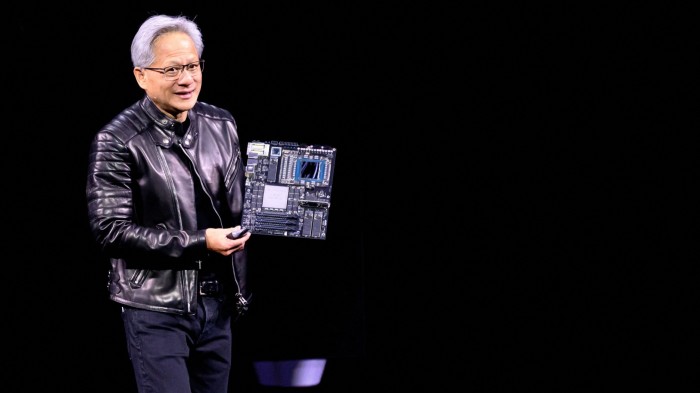
This week, at Nvidia’s annual developers’ conference, Huang unveiled the next generation of its AI chip, Vera Rubin, outlining his plan to build clusters of millions of interconnected chips in giant data centres that will require a vast power supply.
Huang said he believed the Trump administration could accelerate the development of America’s AI industry. “Having the support of an administration who cares about the success of this industry and not allowing energy to be an obstacle is a phenomenal result for AI in the US,” he said.
This month, TSMC announced a $100bn investment in chip manufacturing facilities in Arizona, which came in addition to a $65bn investment agreed under the Biden administration.
Nvidia’s latest Blackwell systems are now being produced in the US, said Huang. “TSMC investing in the US provides for a substantial step up in our supply chain resilience.”
In recent years, America’s biggest technology companies, including Nvidia and Apple, have become overwhelmingly reliant on TSMC’s cutting-edge chipmaking facilities in Taiwan.
That dependency has been clouded by the growing threat of aggression by China — which claims Taiwan as part of its territory — as well as the Trump administration’s threats of tariffs on Taiwanese semiconductors. Taiwan also faces an ever-present risk of earthquakes.
“The most important thing is to be prepared,” said Huang. “At this point, we know that we can manufacture in the US, we have a sufficiently diversified supply chain.” If any disaster were to threaten production in Taiwan, he said, “it will be uncomfortable but it should be OK”.
The US has clamped down on exports of Nvidia’s market-leading chips that are used to train and run the most advanced AI models, with the industry decrying a Biden-era set of more expansive export controls scheduled to come into force in May.
At the same time, Chinese chipmakers have been prevented from buying advanced chipmaking equipment such as ASML’s lithography machines.
But while Nvidia still makes billions of dollars in revenue from China, it has faced resurgent competition from Huawei, whose Ascend AI chips have made advances recently.
“Huawei is the single most formidable technology company in China,” said Huang. “They have conquered every market they’ve engaged.” US-led efforts to constrain the Chinese tech conglomerate have been “done poorly” given Huawei’s continued success.
“I think that their presence in AI is growing every single year,” he said. “We can’t assume that they are not going to be a factor.”
Intel, the only US company that can in theory manufacture leading-edge chips similar to Nvidia’s, has faced serious challenges with its foundry business. A leadership vacuum at Intel was resolved last week when Lip-Bu Tan was named as chief executive.
Huang denied reports that Nvidia was involved in discussions to form a consortium with the likes of TSMC to invest in Intel and stopped short of committing to using its US chipmaking services as part of that onshoring.
“We evaluate their foundry technology on a regular basis, and we are ongoing in doing that,” he said, adding that Nvidia was also looking at Intel’s chip packaging services. “We look for opportunities to be a customer of theirs.”
“I have every confidence that Intel has the ability to do it,” said Huang, referring to Intel’s ability to be competitive in advanced chip technologies.
He added that the “success and welfare of Intel” was important. “But it takes a while to convince yourself and each other that a new supply chain ought to get built up.”
Read the full article here