


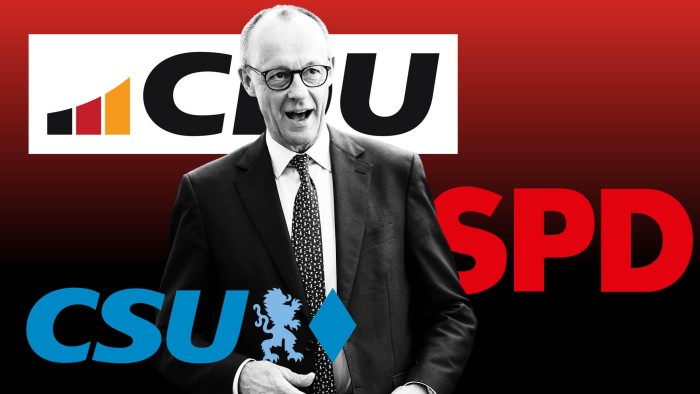
German conservative leader Friedrich Merz spent the past two months excoriating the country’s Social Democrats — blaming them for a stagnating economy, uncontrolled illegal migration and the rise of the far right.
Now that they have emerged as his only possible coalition partners, he wants to be friends again.
Merz, who is poised to become chancellor after his Christian Democrats (CDU/CSU) won federal elections on Sunday, said a government with the SPD was “what we want”. He was now “determined to hold constructive, good, rapid talks” with the party of outgoing Chancellor Olaf Scholz.
Who are the key players and how fast can talks conclude?
Merz indicated he would be “having talks in the next few days” with the SPD, setting himself the goal of signing a coalition agreement “around Easter”, in the second half of April.
His negotiation partner will be SPD co-leader Lars Klingbeil, though Merz said he also planned to meet Scholz to ensure a smooth transition of power. Advisers to Merz have indicated that consultations will take place to make sure Scholz, who will remain caretaker chancellor, represents the views of the future leader abroad. An emergency EU summit next week to discuss European defence will be attended by Scholz.
The two parties will also set up joint working groups to draft a coalition agreement.
Both the SPD and the conservatives seem to be intent on moving fast. Klingbeil, 47, who is expected to become the new head of the SPD parliamentary group, has said his party stands “ready to have conversations” with Merz.
Klingbeil said he would swiftly reorganise his party in the wake of its worst election defeat since 1887. “The world is very turbulent and decisions don’t wait,” he said.
“We see what the new American government is doing or not doing. We do not know what decisions may also be made in the next few days with regard to Ukraine and Germany,” said Klingbeil, who was the party’s spokesperson on foreign affairs. “It is the task of German politics to make Europe strong in this historic phase. And this requires a social democracy that is capable of action.”
What are the sticking points?
The CDU/CSU will focus on its pro-business economic agenda, which involves cutting taxes, slashing welfare and regulation. The SPD will seek to hold firm on social spending, including a plan to secure a minimum pension level, said Andreas Busch, professor of political sciences at Göttingen university.
“One side will have to accept that the other can claim some successes,” he said. “You need a creative fudge.”
Another potential bone of contention is migration. The topic was a source of friction during the campaign between Merz and Scholz when the former tried to strong-arm the government into tightening border checks and restricting asylum by passing a motion with the help of the far-right Alternative for Germany.
The parties may also clash over how to fund growing defence spending and infrastructure investment needs, while complying with the constitution’s strict limit on public borrowing.
Henning Meyer, public policy professor at Tübingen university close to the SPD, said a constitutional reform of the debt brake — one of the party’s central demands — would be a crucial feature of the government agreement.
The matter could be settled even before the start of coalition talks. Now that it is clear a CDU/CSU-SPD tie-up would not hold a Bundestag supermajority required to pass constitutional changes, Merz on Monday indicated he would explore reconvening the outgoing parliament to pass a constitutional amendment before the new legislature is installed on March 25.
Another topic of discussion will be the allocation of ministries. The CDU has indicated its desire to run the defence ministry. The SPD could claim the interior ministry, for which the name of the current defence minster Boris Pistorius is circulating. The CDU could take the finance ministry, while the SPD could be granted the foreign ministry — with Klingbeil potentially taking up that post.
Who has the strongest hand?
The coalition talks could hit snags but neither of the two parties have huge leverage on the other.
“The CDU has come out far stronger than the SPD from the election, but the SPD is the only suitable coalition partner for the CDU,” Busch said. “At least the two parties both agree that quick action is needed and both have indicated a focus on delivery.”
They have the example of Scholz’s ill-fated coalition with the Greens and the liberal Free Democrats still fresh in their minds.
That three-party government quickly descended into acrimony in the wake of Russia’s full-scale invasion of Ukraine, and ended before term last year when Scholz fired the FDP leader and finance minister, Christian Lindner.
This time round, there is talk of a programme renewed every year, which is focused on a handful of priority matters.
The SPD could decide to put the coalition agreement to a member’s vote, which could add a layer of uncertainty, given the harsh campaign led by Merz against the SPD. Such a vote could delay the coalition talks by about two weeks, Meyer estimated.
How solid would this coalition be?
The tie-up between Germany’s once-largest parties can no longer be called a “Grand Coalition”, as the SPD has been relegated to third place by a resurgent far right. Their 52 per cent majority pales by comparison with previous iterations of this coalition structure.
The first of the four so-called Grand Coalitions, which was led by CDU leader Kurt Georg Kiesinger, commanded 90 per cent in the Bundestag in 1966. Angela Merkel’s first of three governments with the SPD in 2005 represented a 73 per cent majority and her fourth, in 2018, relied on 56 per cent of the seats.
However, both parties will be brought closer together by the fear of being further outflanked by the AfD and the far-left Die Linke.
“It may even be our last chance” to regain voters’ trust again, Merz said on Monday.
“I know that this will be difficult . . . but I am counting on the SPD to recognise that this is urgently needed,” he added. “If we do not succeed in this parliamentary term, then we will not be talking about another normal change of government in Germany in 2029.”
Data visualisation by Martin Stabe
Read the full article here