


Stay informed with free updates
Simply sign up to the US-China relations myFT Digest — delivered directly to your inbox.
The writer is on the Development Advisory Council to the US International Development Finance Corporation and was president of its predecessor, the Overseas Private Investment Corporation
Although the first priority of the Trump administration when it comes to Latin America is stemming the flow of illegal immigrants and narcotics into the US, it is essential that a simultaneous initiative be undertaken to slow the expansion of Chinese economic influence and investment in the region. Under the cover of the Belt and Road Initiative, a multibillion-dollar global infrastructure development programme, China has made huge gains in access to critical minerals, power development and transportation infrastructure, while the US has been largely absent.
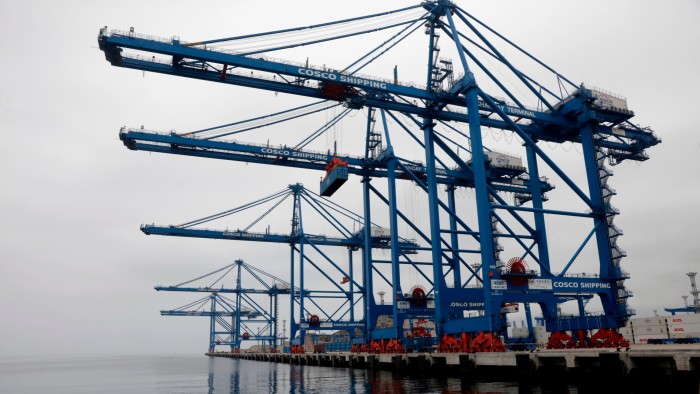
Among its many investments, China controls approximately two-thirds of the energy sector in Chile and virtually all of the power generation in Lima, Peru. In November, President Xi Jinping inaugurated a $3.5bn megaport north of the Peruvian capital, a state of the art logistics hub which serves as a critical link in the Belt and Road Initiative. China has now replaced the US as the predominant trading partner of many of the larger economies in the region, with the exception of Mexico and Colombia. As one observer put it, “the Chinese bring their cheque books and the Americans bring their notebooks”.
As a result, the US is losing not just market share and influence, but also the ideological battle between free market, rule-of-law capitalism and state-owned-enterprise autocracy. Pleading with host governments not to strike deals with the Chinese is not an effective strategy. Instead, what the US must do is construct a viable American-led alternative to Chinese investment. It needs a comprehensive, collaborative strategy that competes aggressively for investments, particularly in critical minerals and infrastructure, and formulates creative approaches to financing.
This starts with mobilising US and international public institutions that can support investment in Latin America, in partnership with the private sector. The US International Development Finance Corporation (DFC), for example, was created to facilitate investment in low income countries. The DFC has a flexible toolkit, expansive funding capacity and an established record of working with both US and international banks. It also enjoys bipartisan support in Congress.
The DFC must take the lead and collaborate with not only other US government players but with like-minded international development finance institutions such as the Inter-American Development Bank. The IDB’s private sector arm, IDB Invest, has the market intelligence and capacity to structure deals which maximise the private capital mobilised for projects.
Together, they must identify a few priority countries where they can align their financial support with the host country’s economic policy and development priorities. Working alongside those governments, they should encourage the pursuit of projects that will directly boost growth through the provision of critical infrastructure and enable secure access for commodities to regional and global markets.
The DFC and IDB Invest should also enlist US and international banks for project financing as well as companies that will provide the construction capacity to ensure these projects come to fruition. Putting together a package of resources in which all major players are in alignment would simplify and speed up the overall process.
A few successful projects will not only develop momentum but create a template for finance and development that can then be replicated. Once enough projects are in operation, investors and lenders can draw up a portfolio and sell these to investors such as pension funds that could accept a high single-digit blended return. This is a great way to get projects off the balance sheets of lenders, allowing them to recycle resources and make more loans.
The US cannot match Chinese investment dollar for dollar. It will always be at a disadvantage when competing against state-owned enterprises that do not need to earn a return. However, we can play to our strengths. This starts with innovation and entrepreneurship: high-quality infrastructure developments benefit both sides of the transaction with transparent and sustainable growth. We can also leverage our financial firepower through strong partnerships between our bilateral institutions and international organisations.
If the new administration wants to contain the growth of Chinese investment and influence in Latin America, they must take the lead in offering alternatives that are consistent with our values, reflect our historic ties to the region, and can drive economic growth.
Read the full article here