


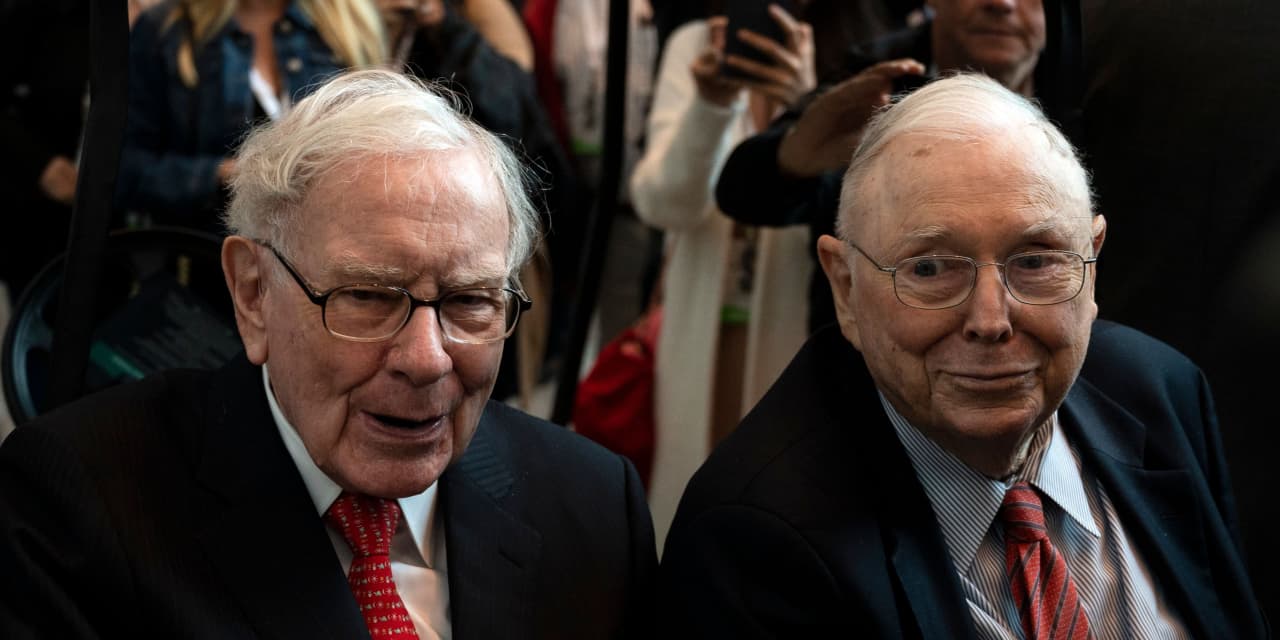
Warren Buffett has done it again, penning an annual letter to Berkshire Hathaway
BRK.A,
BRK.B,
shareholders with valuable lessons for both investors and business leaders — along with subtle signals about his investment intentions.
He opened with a tribute to his late partner, Charlie Munger, the architect of the Berkshire business model, with Buffett as the general contractor. It’s an apt analogy for their partnership in building Berkshire into a unique collection of businesses and business practices based on patient investing, disciplined decision-making, trust-based management, shareholder loyalty, permanent ownership and business savvy — all of which appear in the letter’s lessons.
1. Seek great businesses at good prices and hold them permanently: The tribute includes the first lesson, which Buffett credited Munger for teaching him: Seek great businesses at good prices and hold them permanently, rather than chase mediocre bargains. Quality investing is more prosperous at scale, Buffett has long advised.
2. Managers: write your own letters and investors rank managers accordingly: Another lesson is that managers should write their own letters and shareholders should evaluate them on their candor, clarity, and shareholder orientation. Buffett writes his own letter in his distinctive voice for Berkshire’s 3 million individual shareholders, picturing his sister as his reader. He does not outsource his communications to ghost writers or consultants to craft messages for institutional asset managers or promoters.
3. Understand the difference between price and value: This lesson is for corporate America at large: know the difference between price and value. A common misconception is that price and value are the same or nearly the same for any investment at any time. But this is not the case. Quoting his mentor Ben Graham, Buffett explains: “In the short run the market acts as a voting machine; in the long run it becomes a weighing machine.”
This distinction has important implications. Buffett illustrates this with accounting rules that require Berkshire to report in net income all unrealized gains and losses on securities. Condemning this fixation, Buffett derides the net income figure as “worse-than-useless,” and highlights economic operating earnings. Buffett focuses on underlying business value, not prevailing stock market price, a key factor in his investment success.
4. Trust-based management and screening out rascals: A fourth lesson is trust-based management. This means letting the person closest to a decision make it, without interference from senior managers. But this model of autonomy requires trustworthy personnel. While many managers rely on internal controls and systems to promote accountability, Berkshire has long preferred trust and autonomy. Yet Buffett stresses in this year’s letter that distinguishing the trustworthy from the rascals has been among his greatest business challenges.
5. Shareholder orientation and fiduciary duties: The next two lessons show how Buffett still uses conventional language like “shareholder oriented” and “built to last,” avoiding trendy terms that praise “stakeholders” and “sustainability.” He first affirms the value and reason of corporate leaders caring for their workers and communities, and then emphasizes that his fiduciary duties are to Berkshire shareholders: “While we emphasize treating our employees, communities and suppliers well — who wouldn’t wish to do so? — our allegiance will always be to our country and our shareholders.”
6. Built to last versus sustainability: Instead of the mantra of sustainability, Buffett stresses that Berkshire is “built to last.” Berkshire is fortified by deep liquidity, capital strength, low leverage, retained earnings, and a long-term track record and trajectory. It applies venerable business philosophies rooted in trust, loyalty, and rationality. Berkshire’s “extreme fiscal conservatism” makes it permanently “built to last,” not fashionably “sustainable.”
7. The value and logic of share buybacks: The seventh lesson builds on the previous two: share buybacks are valuable and laudable, despite criticism from politicians (whom Buffett denigrated in last year’s letter), as long as they are made at a price below value. Buffett shows how Berkshire shareholders benefit when Berkshire repurchases shares, as they end up owning slightly larger stakes in Berkshire’s long-term investments such as American Express
AXP,
and Coca-Cola
KO,
He also commends five large diversified Japanese companies — Itochu
8001,
Marubeni
8002,
Mitsubishi
8058,
Mitsui
8031,
and Sumitomo
8053,
— all recent Berkshire investments — for repurchasing their shares at attractive prices, calling them “shareholder-friendly.”
8. The importance and challenges of oil and gas and electric utilities: The last two lessons rebuke the oratorical excesses and regulatory zealotry of much of today’s climate activism. Instead of “net zero,” “the carbon transition,” and “save the planet” slogans, Buffett highlights the importance of U.S. security through domestic oil and gas production, to which portfolio holding Occidental Petroleum
OXY,
has contributed greatly. He acknowledges the potential of carbon capture initiatives but also their uncertainty and praises Berkshire’s investment in almost 30% of Occidental.
Similarly, rather than alarmist rhetoric of climate change catastrophes and demanding governmental intervention to address global warming, Buffett realistically describes scenarios of fire and flood that pose risks to businesses and notes that climate change is a real and continuing problem — while avoiding the emotions and overreactions it often provokes. Buffett highlights the importance of managing electric utilities effectively and economically, cautioning against heavy-handed regulations that could destabilize the power industry’s financial security. Berkshire can withstand substantial financial challenges, he says, but “will not knowingly throw good money after bad.”
9. The risks and costs of political control of business: Berkshire subsidiaries that are affected by political crosshairs include BNSF Railway and Berkshire Hathaway Energy (BHE), both of which underperformed last year, partly because of their capital intensity. But they faced other headwinds, largely neglected by today’s preoccupations with ESG. In the case of BNSF, worker shortages in its critical but dangerous functions create costs as the federal government imposed wage increases that far exceeded inflation.
For BHE, increasing regulatory burdens supported by climate activists raise “the specter of zero profitability or even bankruptcy (an actual outcome at California’s largest utility and a current threat in Hawaii),” Buffett warns. Buffett has long believed in the “social contract” between government and business but is obviously worried that it is being breached by excessive governmental interventions.
Buffett’s investment intentions and preferences
Regarding signals about investment intentions in this year’s letter, Buffett is following his proven strategy, meaning making opportunistic purchases of stocks or whole companies, possessing competitive advantages and offering attractive returns.
Ideal candidates are those with powerful franchises such as American Express and Coca-Cola. Buffett says Berkshire has no pending intention to enlarge holdings in Occidental Petroleum and appears averse to investing in capital-intensive businesses such as rail or energy — referring to the latter as “a costly mistake.”
Buffett expresses a sustained interest in acquiring insurance businesses, ideally very large ones that practice strict underwriting discipline with proven trust-based business models. He also signals interest in expanding Berkshire’s recent investments in the Japanese conglomerates, noting that they operate similarly to Berkshire.
“‘Neither Greg nor I …’”
Buffett celebrates Munger’s legacy and the achievements and prospects of Berkshire’s next generation of leaders, starting with a glowing tribute to insurance head Ajit Jain and commendations for non-insurance chief Greg Abel. Buffett also takes a pivot with a new line: “Neither Greg nor I believe we can forecast market prices of major currencies,” he wrote this year. He used to say “Neither Charlie nor I.”
Buffett’s latest letter is a reminder of timeless virtue and practical wisdom, epitomized by one piece of advice often shared by both Buffett and Munger as a lesson for investing and life: “Make a couple of good decisions during a lifetime and avoid serious mistakes.”
Lawrence A. Cunningham has written several books about Warren Buffett and the Berkshire business model, including “The Essays of Warren Buffett.” He is professor emeritus at George Washington University and special counsel at Mayer Brown LLP.
More: Buffett praises ‘architect’ Munger, but doesn’t reveal new investment in Berkshire’s 2024 shareholder letter
Also read: Even Warren Buffett is no match for the S&P 500
Read the full article here