


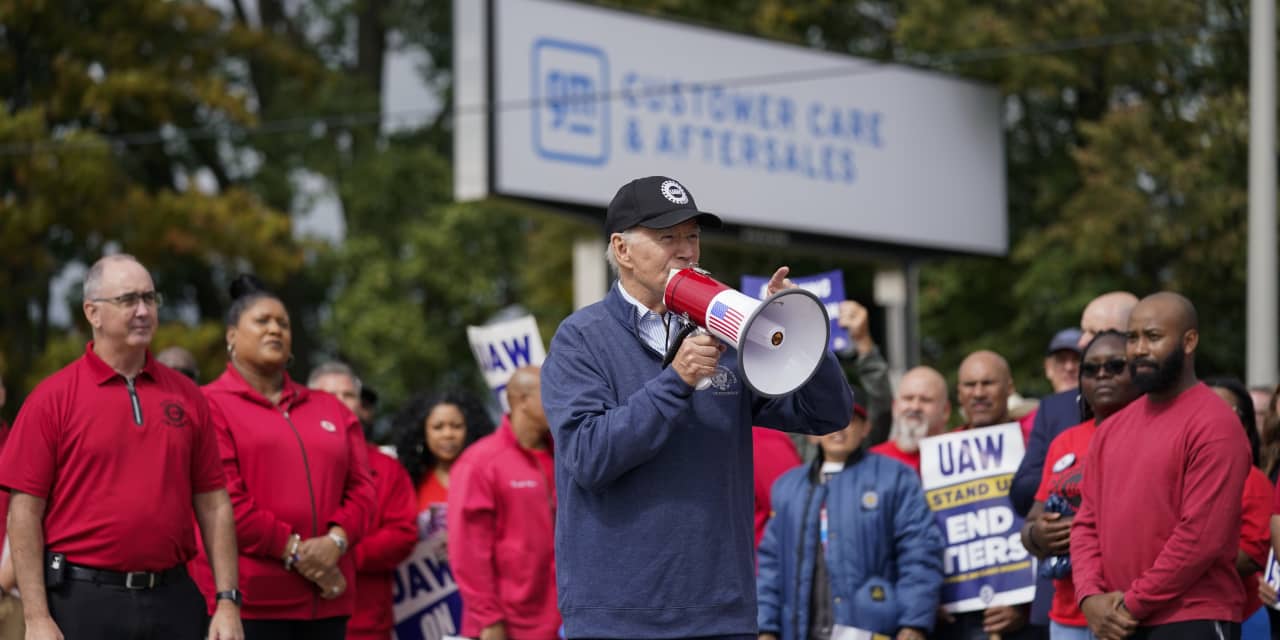
President Joe Biden joined striking United Auto Workers in Michigan on Tuesday. He’s not alone—former President Donald Trump plans to join the picket lines in Detroit on Wednesday, skipping the second Republican presidential primary debate.
It’s obvious why the most prominent political figures in the land are coming out on the side of unions and higher wages. Most Americans support the strikers, too, polls show.
But there’s a tension between support for stronger unions that can drive wages higher and the desire for slower inflation. When everyone’s pay is going up a lot, inflation is much tougher to break.
Broadly speaking, higher wages make people richer, whereas higher inflation rates make people poorer. In an ideal world, average pay growth always outpaces inflation, while increases in productivity—economic output per worker—prevent those pay gains from driving up inflation itself.
That system works well when inflation is close to the Fed’s 2% target. Average pay can then comfortably increase 3%-4% a year without fanning prices. That’s how societies prosper, getting a little richer every year.
It all breaks down when we have a burst of inflation like the current battle. When that happens, workers try to catch up with outsize pay gains. It doesn’t help when workers’ wages hadn’t actually been keeping up with inflation during the prior years when inflation was low.
That’s what’s behind the UAW’s demands for 40% pay increases over four years. It seems outlandish until you realize it’s because workers haven’t had much of a raise for years. It’s why
American Airlines
(ticker: AAL) pilots got a 46% raise, with 21% of it coming in the first year.
Being in a union greatly increases the chances of getting better pay. Research by the Treasury Department shows unions raise the wages of their members by 10% to 15% on average.
The problem is that it’s never clear what the right size of a pay raise is–big enough to fairly compensate workers, without fueling consumer prices gains. Inflation makes everyone poorer, but trying to overcome it with pay often makes it worse. That’s the lesson of the so-called wage-price spirals of the 1970s.
To be fair, the number of workers represented by the UAW isn’t big enough to influence inflation in the economy as a whole. And research by the Federal Reserve suggests that bigger wage demands haven’t been a driver of inflation so far.
So for now, Biden can credibly say that his support for striking workers doesn’t contradict his efforts to bring inflation down.
The risk is that if workers get big gains this year, they’ll ask again next year, even if inflation has cooled by then. Wage-fueled inflation could still become a problem in the future–especially if union power starts to grow again after three decades of decline.
Furthermore, the companies hit by the strikes—
Ford
(F),
General Motors
(GM) and
Stellantis
(STLA)—are facing real challenges. None of them are industry leaders in the shift to electric vehicles. Executives can argue that giving in to higher wage demands now makes them less competitive, ultimately endangering jobs for non-EV auto workers.
Tesla
(TSLA) workers, for example, aren’t unionized.
UAW is doing its best for its members. But it needs to be aware that doing too much now could unleash a new set of problems down the road.
Write to Brian Swint at [email protected]
Read the full article here