


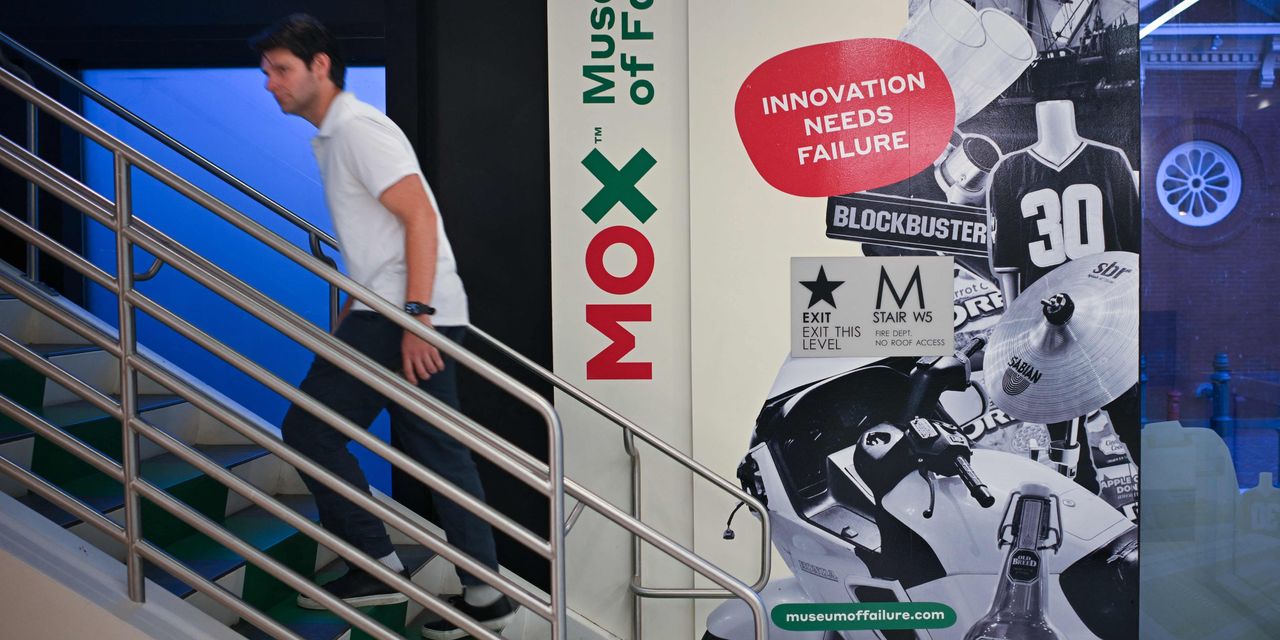
Innovation requires failure. That’s the painful, but ultimately uplifting, lesson taught by the Museum of Failure, a roving exhibit of failed products and services.
The Museum of Failure is an installation curated by Samuel West, an organizational psychologist and host of the “Art of Failure” podcast. Some of the products featured were high-profile and have become part of popular business lore, like the DeLorean car (it was too slow and mechanically temperamental), New Coke (consumers favored the old recipe and were horrified that it disappeared) and Google Glass (the technology didn’t work and was considered creepy).
But there are many products and even entire companies whose failures were quieter — many of which you can still find for sale on websites like eBay and Amazon.com, including:
- Adidas “Spring Blade” shoes, designed to give athletes an edge (lacked durability).
- The Nintendo Virtual Boy, an early version of the virtual reality metaverse (graphically poor, not a good gaming experience).
- The Fox Sports NHL FoxTrax puck , a technologically enabled hockey puck that was supposed to make NHL games easier to watch for casual fans by giving the puck a glowing tail as it moved around the ice (traditional fan base despised it).
- Jarts, a very popular suburban lawn game that notably included a skull-piercing metal pointed dart that trial lawyers came to love dearly.
“ Many of the failures on display come from remarkably successful companies. ”
The first reaction museum visitors have to many of the showcased products, services and companies is often laughter. But leaders interested in innovation can draw a much more important lesson from contemplating the displays.
What viewers begin to realize is that the Museum of Failure isn’t about failure at all. The exhibit’s most important lesson for leaders: Most innovation projects fail.
That may seem counterintuitive, but the point of the museum and West’s podcast is that failure is the necessary prelude to success and a motivator for companies and their innovators.
Innovation can be loosely defined as embracing and fostering new ideas, processes, products and services. But to be an innovator organization, companies must do two additional things: embrace and foster learning from the failures that inevitably accompany such pursuits, and support and reward leaders who do so.
The first thing to consider is just how many of the failures on display come from remarkably successful and highly innovative companies. Coca-Cola
KO,
Apple
AAPL,
McDonald’s
MCD,
Ford Motor
F,
and dozens of others. That’s no coincidence.
The history of business is filled with stories of entrepreneurs and organizations that failed before they succeeded. Remarkable businessmen such as Henry Ford, Bill Gates, and Mark Cuban all experienced company failures before hitting on the formula that rocketed them to success.
The clear message is that great and innovative companies — and their leaders — are willing to fail and anticipate this possibility from the outset. Their abilities to develop new products and services were what made them great in the first place, and their “nothing ventured, nothing gained” mindset is what compelled them to keep pushing the boundaries for new offerings.
Whether a company is pursuing “big bang” innovation (think the Apple iPhone) or continuous innovation, learning from failure is critical. Did the new process, or product or service fail because it was too early, too late, too expensive, required too much support, or just wasn’t capable of delivering what it promised? Figuring that out is crucial, because in most instances, there’s rarely a single point of failure.
Like a mini-grieving process, dealing with failure requires first acknowledging the failure. Companies and leaders that don’t may end up as exhibits in the Museum of Failure.
In addition, prior to returning with a new product or service, companies need to take a rigorous look at the holes in their plan and evaluate what it will take to be successful in a given market. Innovators tend to be overly forward-looking and optimistic about their product or service, which can lead to blind spots.
While it’s undeniably painful, reviewing what went wrong allows companies to see the failure points in other similar processes, products or services. That kind of pattern recognition can lead to systematic problem-solving that fuels further innovation, because most innovation is evolutionary and continuous. Ideas build on each other with course corrections from customer feedback steering toward market acceptance.
“ Fail fast to learn fast to improve fast. ”
Changes in customer demand, cost structure and technological capabilities also shape new products and services. Larger companies, in particular, have the ability to create “test kitchens” that allow people to try out their ideas and create models to see how an innovative product or service can work. Advancements in AI and automation make it possible to run simulations quickly, easily and inexpensively.
Speed is also important. Fail fast to learn fast to improve fast.
Of course, no company wants to fail. Yet with the right mindset it’s possible to take the risks required to innovate and win. The Museum of Failure, in the end, is really about the keys to success.
Richard Holt is a managing director at Alvarez & Marsal Corporate Performance Improvement in Houston and co-leader of its corporate transformation practice.
Read the full article here