


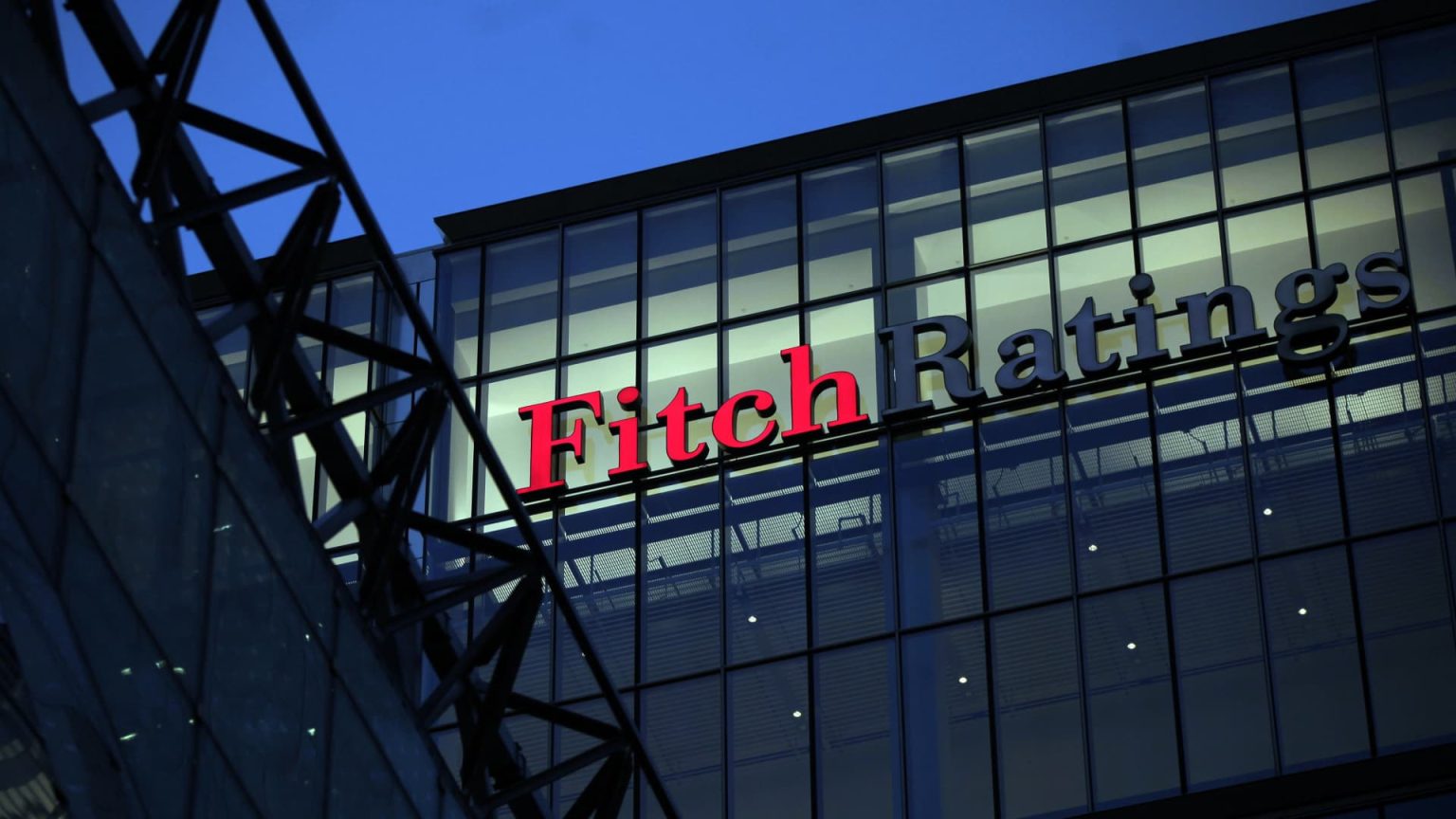
A sign for the financial agency Fitch Ratings on a building at the Canary Wharf business and shopping district in London, U.K., on Thursday, March 1, 2012.
Matt Lloyd | Bloomberg | Getty Images
A Fitch Ratings analyst warned that the U.S. banking industry has inched closer to another source of turbulence — the risk of sweeping rating downgrades on dozens of U.S. banks that could even include the likes of JPMorgan Chase.
The ratings agency cut its assessment of the industry’s health in June, a move that analyst Chris Wolfe said went largely unnoticed because it didn’t trigger downgrades on banks.
But another one-notch downgrade of the industry’s score, to A+ from AA-, would force Fitch to reevaluate ratings on each of the more than 70 U.S. banks it covers, Wolfe told CNBC in an exclusive interview at the firm’s New York headquarters.
“If we were to move it to A+, then that would recalibrate all our financial measures and would probably translate into negative rating actions,” Wolfe said.
The credit rating firms relied upon by bond investors have roiled markets lately with their actions. Last week, Moody’s downgraded 10 small and midsized banks and warned that cuts could come for another 17 lenders, including larger institutions like Truist and U.S. Bank. Earlier this month, Fitch downgraded the U.S. long-term credit rating because of political dysfunction and growing debt loads, a move that was derided by business leaders including JPMorgan CEO Jamie Dimon.
This time, Fitch is intent on signaling to the market that bank downgrades, while not a foregone conclusion, are a real risk, said Wolfe.
The firm’s June action took the industry’s “operating environment” score to AA- from AA because of pressure on the country’s credit rating, regulatory gaps exposed by the March regional bank failures and uncertainty around interest rates.
The problem created by another downgrade to A+ is that the industry’s score would then be lower than some of its top-rated lenders. The country’s two largest banks by assets, JPMorgan and Bank of America, would likely be cut to A+ from AA- in this scenario, since banks can’t be rated higher than the environment in which they operate.
And if top institutions like JPMorgan are cut, then Fitch would be forced to at least consider downgrades on all their peers’ ratings, according to Wolfe. That could potentially push some weaker lenders closer to non-investment grade status.
Hard decisions
For instance, Miami Lakes, Florida-based BankUnited, at BBB, is already at the lower bounds of what investors consider investment grade. If the firm, which has a negative outlook, falls another notch, it would be perilously close to a non-investment grade rating.
Wolfe said he didn’t want to speculate on the timing of this potential move or its impact to lower-rated firms.
“We’d have some decisions to make, both on an absolute and relative basis,” Wolfe said. “On an absolute basis, there might be some BBB- banks where we’ve already discounted a lot of things and maybe they could hold onto their rating.”
JPMorgan declined to comment for this article, while Bank of America and BankUnited didn’t immediately respond to messages seeking comment.
Rates, defaults
In terms of what could push Fitch to downgrade the industry, the biggest factor is the path of interest rates determined by the Federal Reserve. Some market forecasters have said the Fed may already be done raising rates and could cut them next year, but that isn’t a foregone conclusion. Higher rates for longer than expected would pressure the industry’s profit margins.
“What we don’t know is, where does the Fed stop? Because that is going to be a very important input into what it means for the banking system,” he said.
A related issue is if the industry’s loan defaults rise beyond what Fitch considers a historically normal level of losses, said Wolfe. Defaults tend to rise in a rate-hiking environment, and Fitch has expressed concern on the impact of office loan defaults on smaller banks.
“That shouldn’t be shocking or alarming,” he said. “But if we’re exceeding [normalized losses], that’s what maybe tips us over.”
The impact of such broad downgrades is hard to predict.
In the wake of the recent Moody’s cuts, Morgan Stanley analysts said that downgraded banks would have to pay investors more to buy their bonds, which further compresses profit margins. They even expressed concerns some banks could get locked out of debt markets entirely. Downgrades could also trigger unwelcome provisions in lending agreements or other complex contracts.
“It’s not inevitable that it goes down,” Wolfe said. “We could be at AA- for the next 10 years. But if it goes down, there will be consequences.”
Read the full article here