


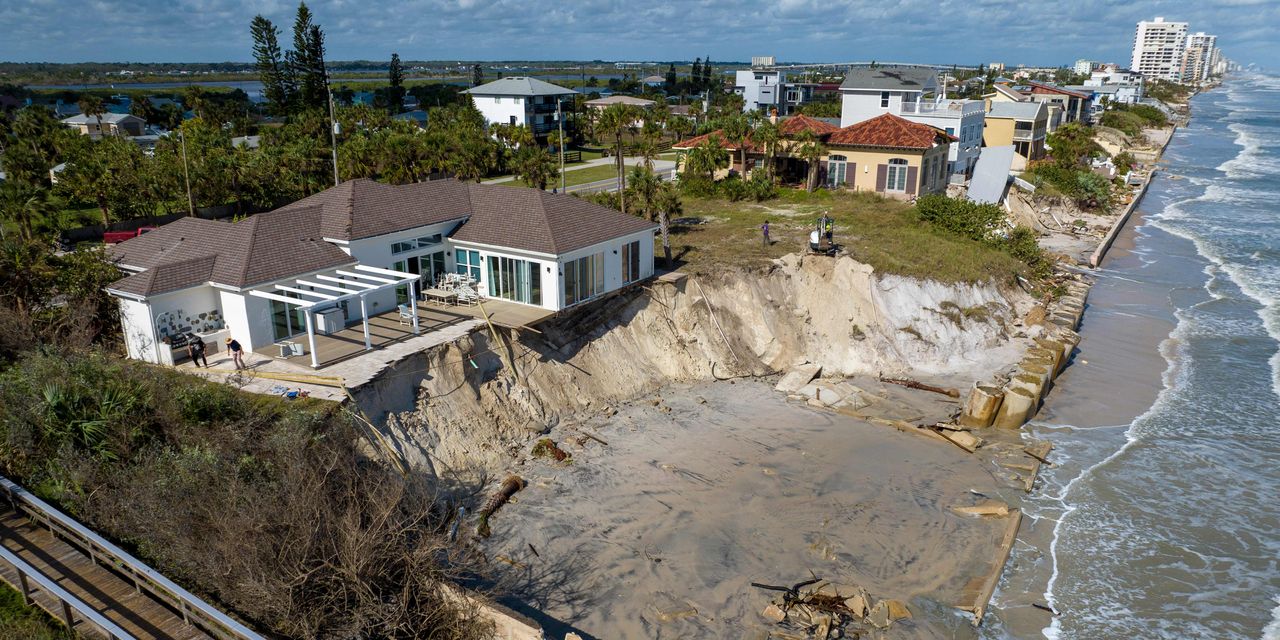
Natural disasters, including earthquakes and severe storms, caused global economic losses estimated at $194 billion in the first half of 2023, with only 27% covered by insurance, according to a new report from
Aon,
an insurance broker and professional services firm.
The losses so far this year, well above the 21st-century average of $128 billion, are the fifth-highest on record and the highest since 2011, said Aon (ticker: AON). None of that bodes well for insurance premiums.
During the first six months of the year, there were at least 25 individual billion-dollar economic loss events, with all but one of those related to weather, the report said.
Relentless severe storms in the U.S. were the biggest driver of insured losses. Global insured losses amounted to $53 billion, approaching the record set in 2011, Aon said.
The increased frequency of natural disasters is one of the main factors driving insurers to limit coverage in some markets and for reinsurance companies, which charge insurers premiums to help cover losses above certain levels, to raise their rates. Reinsurers’ rate increases get passed on to homeowners.
Aon said damage from the earthquake that hit Turkey and Syria in February, estimated at $91 billion, accounted for nearly half of the total economic losses so far this year. The event became the deadliest global disaster since 2010 and by far the costliest and deadliest natural event in Turkey and Syria’s modern history.
Earthquakes were by far the costliest type of natural disaster in terms of total economic losses, Aon said. However, because of a large “protection gap”—the difference between the economic loss of a catastrophe and the amount that is covered by insurance—insured losses stemmed mostly from severe storms.
In the first half of the year, the U.S. experienced at least 13 billion-dollar severe weather events and $35 billion in total preliminary insured losses, Aon said. Globally, insured storm losses stood at nearly $37 billion. More than 95% of the severe storm losses happened in the U.S.
“The severe convective storm losses in the United States were record breaking,” Michal Lörinc, head of catastrophe insight at Aon, told Barron’s. “It’s the highest on record for the first half of the year.”
Insurers have to contend with the destruction and resulting claims. On Thursday, The Travelers (TRV), a New York-based property and casualty insurer, said unusually high catastrophe losses put the company in the red in the second quarter.
The slump in second quarter earnings was mainly due to higher catastrophe losses from “numerous severe wind and hail storms in multiple states,” according to the company. In the second quarter, the firm paid $1.5 billion in catastrophe damages, twice as much as the $746 million in the year-earlier period.
“We had six events surpassed the $100 million mark in Q2, the most ever for a single quarter since we began disclosing the table in 2013,” said CFO Daniel Frey on a call to discuss the results with investors.
The catastrophe insurance market worldwide faces challenges with rapidly rising reinsurance costs and rising risk. Reinsurers share the financial hit with insurance companies and have taken a beating in recent years because of outsize losses from catastrophes around the world.
Earlier this year, Eric Andersen, president of Aon, told a Senate hearing that “the crisis of confidence that’s happening in the reinsurance market” is “essentially a crisis of confidence around the ability to predict loss.” Reinsurers, he added, “have been withdrawing from high-risk areas around wildfire, around flood in particular.”
Global economic losses could mount this year, depending on the hurricane season, which stretches from June 1 to Nov. 30.
While El Niño weather patterns such as the one that began this year tend to dampen the intensity of the Atlantic hurricanes, record heat at the ocean surface—partly caused by increased carbon-dioxide emissions from human activities—could mitigate that. Academic and government forecasters aren’t sure which of the competing forces will prevail.
Most, including the National Oceanic and Atmospheric Administration, expect the 2023 Atlantic hurricane season to be “near normal.” The NOAA is forecasting a range of 12 to 17 named storms, five to nine of which could become hurricanes, including one to four major hurricanes.
Hurricane Ian, which slammed into southwest Florida last September, was the third-costliest hurricane on record after Katrina in 2005 and Harvey in 2017, according to the National Hurricane Center. It was the most costly disaster of 2022, causing nearly $113 billion in damage and more than 150 deaths.
Write to Lauren Foster at [email protected]
Read the full article here