


Sotheby’s is selling mounted fossil skeletons of a Pteranodon from the late Cretaceous and a Plesiosaur from the lower Jurassic—both considered fearsome predators—at a natural history auction on July 26 in New York.
The Pteranodon, a flying species that existed some 85 million years ago, is expected to achieve as much as US$6 million. The Plesiosaur, a marine reptile that existed 190 million years ago, could achieve as much as US$800,000.
The fossils continue Sotheby’s foray into selling dinosaur bones. A year ago, the auction house sold a Gorgosaurus fossil for US$6.1 million, and in December, a Tyrannosaurus rex skull nicknamed Maximus also sold for US$6.1 million. Both sales include fees. The latter result fell far short of expectations that the 200-plus pound skull could fetch as much as US$20 million.
Fossil bones of the Pteranodon—named “Horus” in honor of an ancient Egyptian deity of kingship, protection, and sky—were found by an anonymous fossil hunter in 2002 in Logan County in Kansas. The bones had been buried under layers of chalk in the seabed of what was once an inland water body known as the Western Interior Seaway. The water had divided North America into two land masses at the time.
The resulting skeleton is one of the “largest well-preserved Pteranodons ever discovered,” Sotheby’s said in a news release, noting it is also the most complete and highest quality. Also, unusually, most of the original fossil bones are “essentially unrestored” without artificial filler, which the auction said is “especially ideal for scientific study and transparency of authenticity.” Mounted, the skeleton has a 20-foot wingspan.
The flying creature’s skull, however, was created with the help of 3-D restoration to fill in pieces that weren’t found at the site. Filling in missing parts of bone with sculpted epoxies or plasters that are painted to match the fossils is very common in the restoration of dinosaurs, because it’s extremely unlikely to ever dig up a full skeleton, according to Cassandra Hatton, global head of science and popular culture at Sotheby’s.
“You are incredibly lucky if you have half of the pieces,” Hatton says. “You have to fill in those blanks in order to do the kind of 3-D, big T. rexes and Apatosauruses [seen] at Natural History Museums.”
Hatton mentions this as the auction house is selling these fossils in the wake of questions raised about the authenticity of other specimens that have been sold commercially. Perhaps the most high-profile example was the scheduled auction of a T. rex that Christie’s canceled after questions were raised about the specimen’s authenticity. The fossil skeleton was estimated to fetch at least US$15 million.
Clients have become “uncomfortable with the fact that it’s hard for people to tell the
difference, or the fact that unscrupulous people can easily pull the wool over people’s eyes,” Hatton says.
To ensure the Pteranodon’s authenticity is evident, those who prepared it for display didn’t attempt to meld the original fossil bone with sculpted materials. “It’s really clear when you look at it that O.K., ‘this is original’ and ‘this isn’t,’” she says.
The rib cage area, for example, includes a big plate on the sternum that’s original and attached to a sculpted rib cage. But there’s been no attempt to make the rib cage look like actual bone, so what’s real and what isn’t is obvious even to an untrained eye, Hatton says. Potential buyers also will be able to see an osteograph, or bone map, which lists the actual bones in the skeleton, in addition to a site map of the discovery, and photos of the dinosaur bones being excavated
“We wanted to be sure that people understood what was going on,” she says.
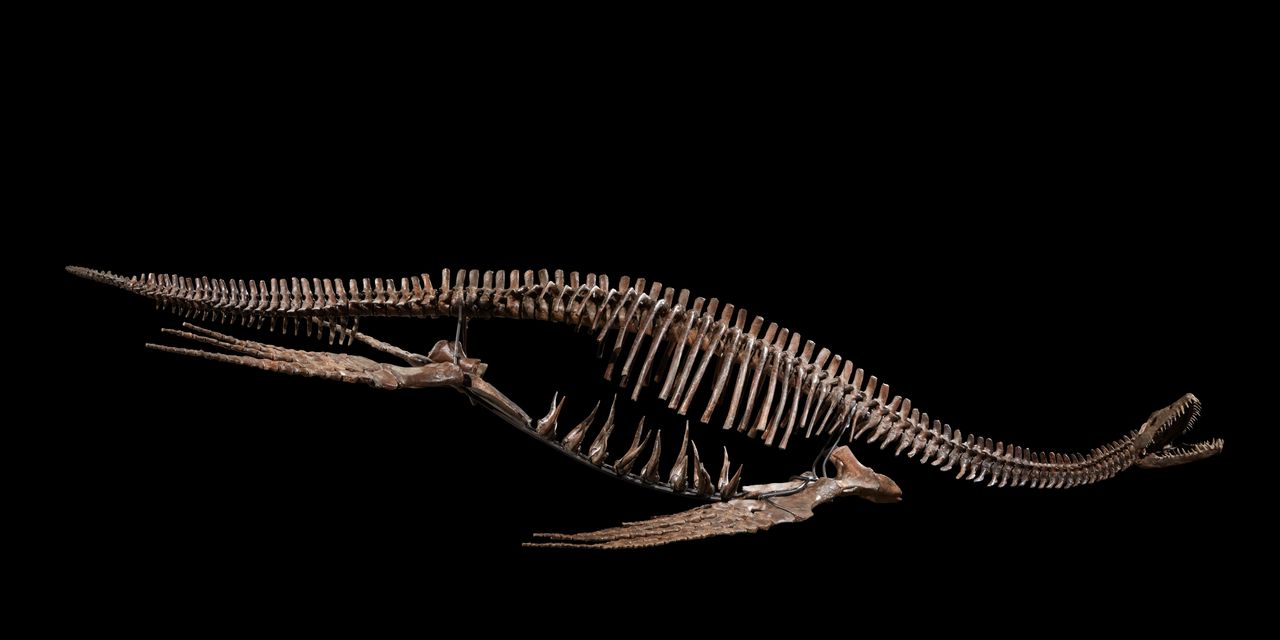
The 11-foot-long Plesiosaur Sotheby’s is selling was unearthed in the early 1990s in Blockley quarry, Gloucestershire, England. It was first prepared and studied by Mike Taylor, a British Plesiosaur expert, who discovered that it was a Cryptocleidus, a previously unknown species of the Jurassic, according to a Sotheby’s Paris catalog entry from 2010. The skeleton, which had been in a collection at a private museum in Germany, was sold at that time for €456,750. The current consignor is anonymous.
Unlike the Pteranodon, Sotheby’s doesn’t have a site map or photos of the Plesiosaur’s discovery, because no one at that time probably could have imagined the fossils being sold at a public auction, Hatton says.
The Plesiosaur has been nicknamed ‘Nessie’ in reference to the Loch Ness monster, as many sightings of the mythical beast describe a creature with similar features to the Plesiosaur, including a long neck, small head, and four flippers, Sotheby’s said. Reported sightings of the monster also increased in the years after the first Plesiosaur skeleton was discovered in 1823.
The highest price for a dinosaur skeleton to date is the nearly US$32 million, with fees, paid for a T. rex skeleton dubbed “Stan” in October 2020 at Christie’s in New York. The 39-foot-long skeleton will be displayed at the Natural History Museum Abu Dhabi when the institution opens in 2025.
Visitors to Sotheby’s New York galleries will have a chance to see if they can tell the difference between real bone and plaster casts by visiting the fossils on display before the auction later this month. The natural history sale is one in a series of “geek week” offerings at the auction house that also feature science and technology and space exploration.
Read the full article here