


Receive free Ivy League updates
We’ll send you a myFT Daily Digest email rounding up the latest Ivy League news every morning.
If Rome’s oligarchs could have travelled to the future, they might have learned a trick or two from the US Ivy League. It is hard to think of a better system of elite perpetuation than that practised by America’s top universities. Last week the US Supreme Court ended affirmative action in US higher education — a ruling mourned by the heads of each of the eight Ivy League schools. Dartmouth even offered counselling to traumatised students. An ancient Roman might have thought something radical had changed. Little could be further from the truth.
Of the 31mn Americans aged between 18 and 24, just 68,000 are Ivy League schools undergraduates — about a fifth of a per cent. Of these, a varying ratio are non-white beneficiaries of affirmative action. Many of those are from privileged black or Hispanic backgrounds, as opposed to Chicago’s South Side or the wastelands of Detroit. That is the basis on which the Ivy League lays claim to being a deliverer of social change. It is an optical illusion. In that respect the Supreme Court has done America a favour. Any disruption to this status quo is a plus.
But it is unlikely to trigger the soul-searching America needs. The US debate remains stubbornly monopolised by the ethnic breakdown of the tiny number of students who win the Ivy League lottery. The 19mn or so of those 31mn young Americans who do not progress beyond high school, and the roughly 12mn who go to less elite colleges, barely feature. Whatever tweaks the Ivy League has to make to keep its diversity ratios after last week’s ruling are thus largely irrelevant to the 99.8 per cent that will never get there.
The genuinely radical Ivy League option — spending their vast endowments to sharply increase student numbers — is unlikely to be entertained. The key to the Ivy League is exclusivity; a big expansion in intake would dilute that premium. We are thus likely to continue with a situation in which universities such as Harvard, with a $53bn endowment, or Princeton with $36bn, continue to get richer. Each of these fortunes could revolutionise financial aid at dozens of public universities.
The second most radical option would be for the Ivy League to abolish what is called “ALDC” — athletics, legacy, dean’s list and children of faculty and staff. Forty-three per cent of Harvard’s intake come from one of these groups. The first, athletics, includes sports that can only be learned by the privileged, such as lacrosse, sailing and rowing. The generous athletics intake by universities is why so many recent admission corruption scandals, such as the FBI’s Varsity Blues sting operation, involved athletics directors. Contrary to popular opinion, most athletics scholars are not black basketball players. Sixty-five per cent are white.
The second, legacy students, are the close relatives of alumni — the very definition of elite reproduction. Again, these are mostly white. The third, dean’s List, is a euphemism for the children of people who have donated a lot of money. An example of this is Jared Kushner, Donald Trump’s son-in-law, whose father, Charles, gave $2.5mn to Harvard. Finally, there are the children of faculty members and staff. Taken together, the Ivy League could as easily be construed as an affirmative action plan for wealthy white people, which is very far from the progressive brand it has cultivated.
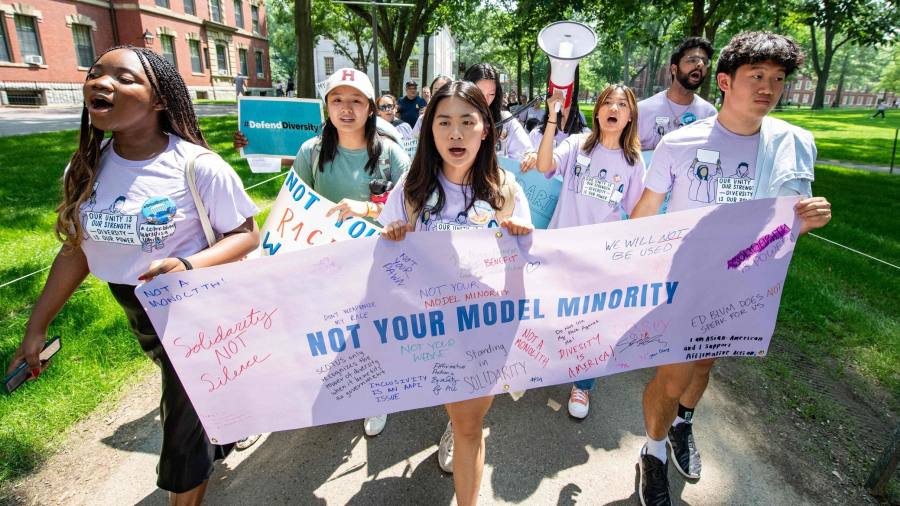
Its chief victims are Asian. The historic irony is rich. Affirmative action was conceived in the 1960s as a form of reparation for the descendants of slaves. It quickly morphed into a system of race-based gaming for many ethnicities. The group that has lost out the most, Asian-Americans, are immigrants from countries that had nothing to do with US slavery. The chief beneficiaries have been elite whites, rather than African-Americans. The latter supply window dressing for a system that remains substantially unchanged.
Perhaps the biggest cost to US society is the elite’s obsession with race. Having benefited from a system they want their children to inherit, it is little wonder they were outraged by last week’s ruling. The US media is dominated by Ivy League graduates. It is a life experience that moulds people to see colour over class.
The only change that would qualify as radical in a society that claims to be meritocratic is one that would boost life chances for the rest. That would mean starting at the beginning of a child’s life with better childcare, good pre-school education, and so on. It would entail dramatically increasing the pipeline of students who might have the chance to win the educational lottery. Until that changes — and unless it becomes America’s focus — the current debate is a big red herring.
Read the full article here