


Receive free JSR Corp updates
We’ll send you a myFT Daily Digest email rounding up the latest JSR Corp news every morning.
JSR, the Tokyo-based company that controls a critical link in the global semiconductor supply chain, will use a $6.4bn government-backed take-private deal to strengthen Japan’s arsenal in the US-China chip wars.
The company last week accepted a surprise buyout offer from JIC — a fund overseen by Japan’s powerful Ministry of Economy, Trade and Industry (METI) and whose choice of buyout candidate is seen by three investors who spoke to the FT as primarily motivated by geopolitics.
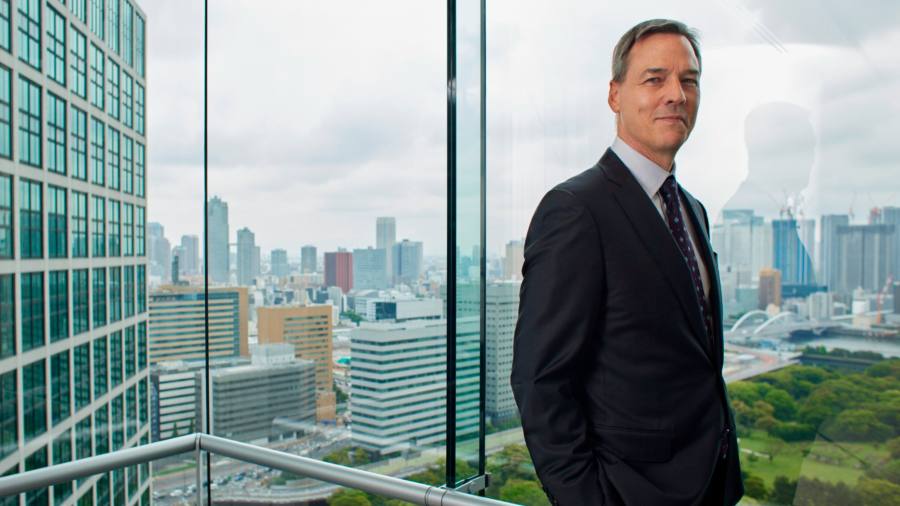
JSR’s American-born chief executive Eric Johnson told the Financial Times that the deal was not a de facto nationalisation and that while the capital behind JIC came from the government, there was a separation.
“Their [JIC’s] charter is to support an acceleration of competitiveness, and global competitiveness of Japan industry,” he said. “But this is not government ownership.”
Not all are convinced. Investors in JSR said the suddenness of the deal, combined with JIC’s total lack of experience in buyouts on this scale had left them “scratching their heads” over the ultimate motive even after explanations from the company.
Analysts said the deal could instead be a landmark in Japanese government efforts to steer the private sector into acts that place national strategy above financial logic.
JSR already has a global market share of 30 per cent in photoresists, which are specialist chemicals used for the process of printing circuit designs on chip wafers. Its clients include the world’s biggest chipmakers, including Samsung, TSMC and Intel.
Damian Thong, a semiconductors analyst at Macquarie, agreed that the full explanation for the buyout had not yet emerged. “There was a feeling that we weren’t supposed to get to the bottom of this,” he said, referring to a presentation made by JSR after the deal was announced last Monday.
Although JSR was adamant that it made the initial approach to JIC, people close to METI told the FT that the deal closely fitted with government ambitions for a stronger and more consolidated semiconductor materials industry.
Those ambitions, said the same people, had become much more clearly defined in recent months as the trade confrontation between the US and China had escalated.
In March, Japan placed restrictions on 23 types of semiconductor manufacturing equipment in alignment with Washington’s efforts to hinder China’s progress on producing the most advanced types of chip.
Japan’s move was last week partially matched by the Netherlands, which will impose export restrictions to China on the high-end chipmaking machines produced by the country’s largest company by market capitalisation, ASML.
“There may be some sort of national champion element to this, and once you start empire building for non-economic reasons, anything is possible,” said one analyst who has covered JSR for many years and said it was still unclear whether to think of the deal as a privatisation or a nationalisation of an important strategic asset.
“This deal will . . . enhance the global competitiveness in the area of semiconductor materials,” said Yasutoshi Nishimura, Japan’s minister of economy, trade and industry. “We understand that this is an extremely critical effort for strengthening our country’s industrial competitiveness.”
Analysts said that the idea of consolidation was legitimate. Beyond JSR, the Japanese semiconductor materials industry is highly fragmented, with companies historically unwilling to initiate merger discussions with one another.
If the buyout deal is successful, JSR will delist from the Tokyo Stock Exchange later this year and go private — a status that the company now believes will make it easier to reform itself and the industry. Johnson said that Japan’s semiconductor materials scene was characterised by a large number of relatively small companies each spending a lot of capital trying to remain at the leading edge.
Whenever JSR tried to engage in possible merger discussions, said Johnson, it encountered a “spectrum of resistance” that might now evaporate given the influence of METI and the prospect of JSR being a non-listed company.
“Everybody’s got their own reason why they’re not engaging. Some of that resistance can be decreased with a privatised company . . . with a single owner with a very clear strategy,” said Johnson, who added that while JIC ownership would not put JSR under direct government control, it would clearly open doors.
The ability to enter discussions as a government-backed company, and to say that the action is consistent with a bigger national strategy was critical, said Johnson, who added: “People listen, right? You start to gain momentum in a way that’s otherwise difficult to do.”
As the announcement of the deal sent JSR stock sharply higher last week, shares in other speciality chemicals companies associated with the semiconductor manufacturing process — in particular Tokyo Ohka Kogyo — also rose significantly on speculation that it could become a target of industrial consolidation.
The problem with that line of speculation, said Macquarie’s Thong, is that while it was possible to draw up lists of possible candidates that a government-backed JSR might approach, there were no easy steps from here economically. Deals, given the importance of retaining R&D expertise and specialised customer relationships, would probably produce only limited cost savings and other synergies. Antitrust concerns could also scupper potential deals.
Still, said Johnson, the symbolism of the deal was important.
“If you can start a trend, you can start to change the way people act and think about things,” he said. “So that’s the aspiration here . . . to drive real value creation for JSR and also to start to nudge this really strong part of the economy along.”
Read the full article here