


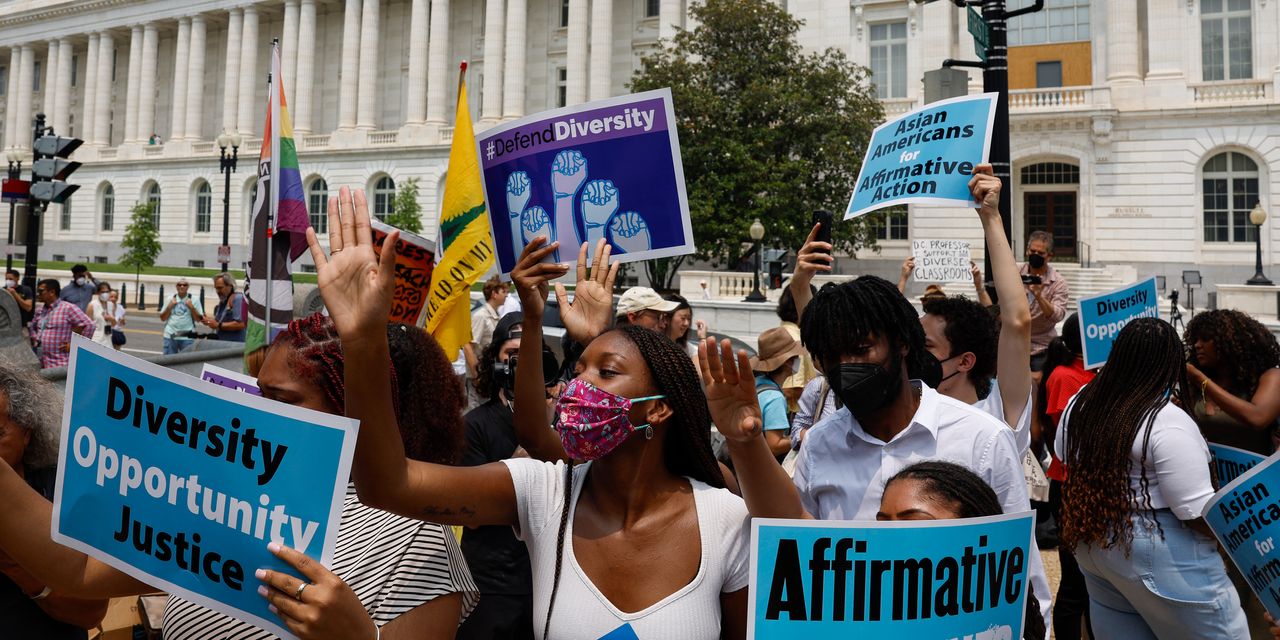
The Supreme Court’s ruling against affirmative action in college admissions not only dealt a blow to the higher-education system, but to America’s private sector as well.
That is because many companies have been running programs that promote diversity, equity, and inclusion at work. And conservative groups have said such initiatives amount to racially-based hiring that is akin to affirmative action in education.
The Supreme Court ruled on Thursday that it is unconstitutional to consider race in decisions on college admissions. Although the decision won’t have any direct legal implications on private-sector employment practices, it has paved the way for the court to outlaw similar practices at workplaces, said David Glasgow, executive director of NYU Law’s Meltzer Center for Diversity, Inclusion, and Belonging.
Companies have already been caught up in the in the culture wars over the past few years as Republican politicians and conservative groups call out “left-wing wokeism” in American corporations. Areas of conflict range from LGBTQ rights to climate change.
Anheuser-Busch InBev
‘s (ticker: BUD) Bud Light,
Target
(TGT), and
Disney
(DIS) are among the high-profile victims.
Workplace diversity, equity, and inclusion, or DEI, will likely be the next battleground. The court’s decision “really creates an impetus for employers to reaffirm their commitment to diversity, but to do so in a way that mitigates the potential of challenge down the line,” wrote Tim Bartl, CEO of the HR Policy Association, in a LinkedIn post on Thursday.
Many companies have already restated that commitment. Barron’s reached out to more than 40 companies asking how the end of affirmative action would affect their DEI initiatives. All of the 13 that responded said they won’t shift course.
“Diversity and inclusion remain important values for us and we will continue to invest in our work to attract a diverse workforce,” said Halimah DeLaine Prado, Google’s general counsel, in an email to Barron’s, noting that a diverse workforce is important to delivering better products and services.
“Our commitment to equality doesn’t waver, and we will continue to work toward our representation goals, regardless of the ruling,” said a
Salesforce
(CRM) spokesperson.
A
Johnson & Johnson
(JNJ) spokesperson told Barron’s that the firm believes a diverse workforce and environment is positive for business and innovation. Still, the company said it hires and promotes people “strictly on merit”.
That remark, highlighting the possibility that companies might make personnel decision on factors other than merit, points to the legal risks companies might face if their DEI initiatives aren’t executed carefully.
Last year, a former
AT&T
(T) employee sued the telecommunications company after being laid off in 2020, alleging that the firm’s diversity hiring practices discriminated against him because he is a middle-aged white man. U.S. District Judge Mark Cohen of Atlanta has ruled that the case can move forward.
Companies will likely see more challenges like this following the affirmative action ruling, said NYU’s Glasgow. “Companies need to be careful to make sure that they’re doing the DEI work in a responsible way,” he says, “I think it would be a good idea to do a self audit of these programs.”
Programs that look very much like affirmative action—such as setting aside a certain number of jobs or promotions for members of underrepresented groups, or using race or gender as a tiebreaker—would be at high risk, says Glasgow.
At the same time, companies that turn their back on DEI programs, or try to water them down, likely would face a backlash from progressive consumers and shareholders. That could lead to reputational trouble, employee pushback, and even lawsuits, he said.
Another risk is that the end of affirmative action could lead to a decline in college graduates from underrepresented backgrounds, which would result in a less diverse talent pool to choose from.
“We can only achieve a strong, diverse pipeline of #STEM talent if universities cultivate diverse student bodies and inclusive cultures,” Intel’s (INTC) public policy team tweeted on Thursday
Last year, nearly 70 employers, including General Electric (GE), Google, and JetBlue Airways (JBLU), signed an amicus brief to the court, warning that they would lose access to “a pipeline of highly qualified future workers and business leaders” without affirmative action.
Microsoft
(MSFT) said it hopes universities will continue to create opportunities for students from disadvantaged groups.
—Hannah Ziegler contributed to this article.
Write to Evie Liu at [email protected]
Read the full article here