


“A florist or gardener,” replies a young boy when asked what he wants to be when he grows up. “A paleo-artist . . . who makes art of prehistoric things,” proffers another child. Other children plump for “a police” [sic] and “a mathematician . . . because I could work on quantum gravity and I get a Nobel Prize.” One boy is already a model. A little girl plans to play for Arsenal.
The children, all six or seven years old, are the protagonists in “The Future (Sixes and Sevens)”, a new film by British artist Cornelia Parker. Just under nine minutes long, “The Future” is deceptively simple. Shown on two screens, each of which features two young children responding to questions by Parker — who is neither seen nor heard — so it appears that the youngsters are in conversation.
The upbeat tenor never wavers. Yet the children, who come from a range of cultures and backgrounds, know the challenges that lie ahead. Although one is looking forward to the future because he’ll be “taller and . . . can reach more things like the top of the fridge”, another observes that “the Earth is getting hotter and the ice is melting.” “Yeah,” says his friend, “especially with the polar bears. I’ve seen it on Netflix.”
The children proffer intriguing solutions. “I think if people just stop,” says one mini de-growther, adding that stopping is “pretty easy. It’s the persuading bit that’s hard.” Some have faith, occasionally misplaced, in invention: “More beaches, more sun,” requests one girl. The wannabe Nobel laureate has plans for black holes, settlements on the Moon, insect protein instead of beef and a somewhat risky strategy to “chop down all the trees” and replace them with water full of algae. “Then we’ll actually have an increase in oxygen.”
“The Future” has been created for Dear Earth: Art and Hope in a Time of Crisis, a collective show now at the Hayward Gallery in London. Dancing a tightrope between anxiety and hope, it blows a hole through arguments that “climate art” is an oxymoron. Although that genre is often afflicted by faux-scientific didacticism, Parker’s film does what such work should do, operating both as call to action and organic, imaginative experience.
“I’m hoping people watching will realise that we are the adults,” says Parker. “We can do something. The children can’t. We can’t wait for them to grow up. We have to act in every way we can,” she pauses, then exclaims: “And certainly don’t vote the Tories in!”
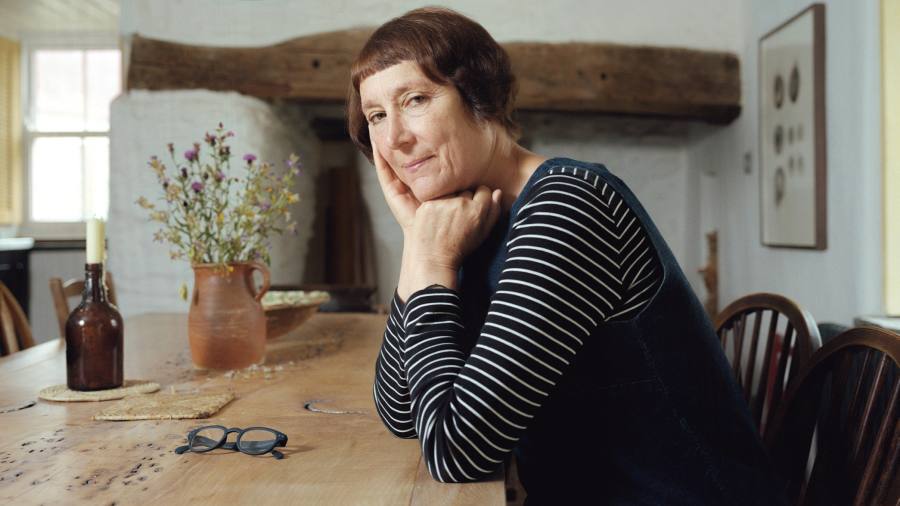
Such bluntness typifies one strand of Parker’s personality. On the one hand, she is all angles: from her ruler-straight fringe to the hem of her stylish, mini-pinafore dress. Yet as we chat over her kitchen table in her home in London’s Kentish Town, her soft centre shines through her speech which — though full of bold ideas and mostly delivered at rat-a-tat-tat speed — is curiously hesitant.
Parker’s skill at balancing opposing forces has made her one of Britain’s leading contemporary artists. Born in 1956, she grabbed public attention with “Cold Dark Matter” (1991), an installation for which she requested that the British army blow up a garden shed, then suspended the debris around a single lightbulb. The play between the charred material detritus and its flickering shadows on the wall felt like a metaphor for the unconscious. But were we looking at the chaos inside our country’s head, Parker’s or our own?
Her brilliance as an artist lies in her fusion of her heartfelt politics with a crystalline sense of form, pace and scale. Little wonder she was shortlisted for the Turner Prize in 1997, awarded an OBE in 2010 and given a triumphant retrospective at London’s Tate Britain in 2022.
The climate emergency leapt on to Parker’s radar in 2005 when she attended a workshop for scientists and artists at the University of Oxford. “I came away pretty shell-shocked. I had a four-year-old daughter,” she recalls. “What kind of future was she going to have?”
She poured her anxieties into a film, “Chomskian Abstract” (2007), in which the philosopher Noam Chomsky responds to her questions about environmental threat. “I wanted a very smart person who hadn’t talked about it very much,” she recalls, adding that Chomsky, known for his anti-capitalist, anti-militaristic theoretics has now “got it. He’s realised [climate change] is just as dangerous as nuclear annihilation or AI.”
In 2017, she accepted a post as the official artist for the British general election. Told that she couldn’t reveal her own persuasion, she put a drone and a wind machine in the House of Commons and filmed hundreds of newspapers drifting hither and thither. Entitled “Left Right & Centre”, the result is classic Parker: an oblique, eerie allusion to the sinister, ambiguous forces that decide our fates, rather than an ideological manifesto. She’s now agreed to make work to commemorate the coronation. “I’ve asked to see the Crown Jewels!” she says with a mischievous glint in her eye that suggests the monarchy doesn’t know what it has let itself in for.
Raised in rural Cheshire, Parker’s early life was far from the smart metropolitan circles she inhabits today. Her father — “a peasant farmer” ruled the roost while her German-born mother struggled to thrive in postwar Britain. Parker thinks that standing up to her father — “I must have a bit of his blood” — birthed her taste for creative friction.
“I had to fight to stay on at school for A-levels,” she says — adding that as a “poor, working-class, free-school-meals girl” she enjoyed a free education. “That would never happen now!” she exclaims, alluding to the rising cost of higher education.
Neither of her parents understood her choice of career. “My father wanted me to work in a factory and earn proper money.” Yet to Parker, orthodox employment sounded like “the worst thing in the world”. Even her Turner Prize nomination failed to impress them. “I used to say: ‘My job has taken me all over the world. Can’t you see this is an interesting life?’”
Yet rather than succumb to victimhood, this clever, straight-talking, amiable individual has chosen to channel her personal and political conflicts and contradictions into art. “I like formalising the unformalisable” is her way of explaining her spare, acute visions.
On the new film, she gives much of the credit to her collaborator, Harry Dwyer, who also operated the drone in “Left Right & Centre”. But Parker knows she has a gift for paring her art down to what really matters — however cold and dark. “I always assume my unconscious will come up with the goods. That’s what allows me to be brave.”
To September 3, southbankcentre.co.uk
Read the full article here