


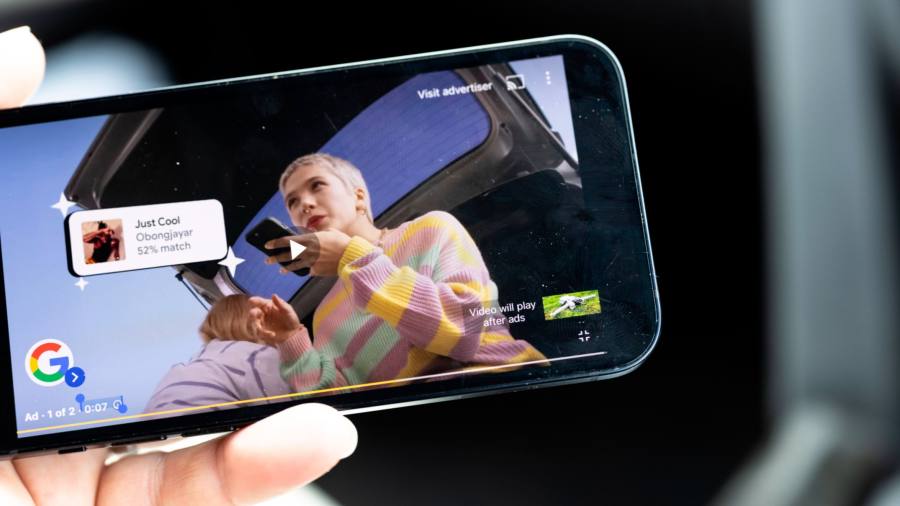
Advertising industry figures are demanding significant refunds from YouTube following new research that suggests millions of adverts on partner websites are hidden away from users in ways that breach the Google-owned group’s policies.
Adalytics, a digital ads analysis group, has conducted research into YouTube’s “TrueView” system, through which users can skip watching an advert after five seconds.
It found “hundreds of thousands of websites and apps” in which these ads play imperceptibly in the background, without sound and on automatic loop. This appears to be a way to avoid viewers noticing the videos altogether so ads are not skipped, but the strategy violates Google’s terms.
Google, which denied the researchers’ claims, tells advertisers that a key selling point for its “choice-based ad format” is that they are only charged if a user watches the full clip or at least 30 seconds of it. If skipped, an advertiser pays nothing.
TrueView ads are a core product for YouTube’s $30bn a year business. Ebiquity, a media investment analysis group in London, said its global clients typically allocate 40-50 per cent of their YouTube budgets on the skippable ads.
They are supposed to play “in-stream”, meaning viewers see them “before, during, or after other videos on YouTube” or through its Google video partners network of “high-quality publisher websites and mobile apps where you can show your video ads to viewers beyond YouTube”.
But Adalytics, which used web-crawler data to scour the internet and also worked with dozens of media buyers from brands and agencies, found thousands of TrueView ads were placed “out-stream” — tucked away on portions of a website where viewers had little to no interaction with them. The Wall Street Journal previously reported on some of the findings.
Joshua Lowcock, global chief media officer at UM, a New York-based ad agency, said he expected YouTube to investigate the issue and refund the affected advertisers. Adalytics created a list of those hit, which includes dozens of leading brands such as JPMorgan Chase and Johnson & Johnson, as well the US Department of Health & Human Services.
“This is a systemic failure by Google and YouTube to have proper oversight and enforce their policies,” Lowcock said. “Google must have a qualified third party do a full independent audit of policy enforcement, as well as this failure, and refund all impacted advertisers.”
He added: “It’s symptomatic of problems that occur in a concentrated and unregulated market.”
Giovanni Sollazzo, chair of Aidem, a UK-based platform helping marketers ensure they reach real users, added: “We are advising all our advertisers impacted to promptly ask for refunds.”
Ruben Schreurs, a Netherlands-based chief product officer at Ebiquity, said the research was likely to have a “significant negative impact” on Google’s perceived quality and reliability in the $400bn digital advertising industry.
Google published a blog in response, defending the quality of its partner network and saying the report makes some “extremely inaccurate claims”. After reviewing several websites shared by the Financial Times, the company also said it would take appropriate action including possibly removing all ads on the sites.
“We have strict policies that all third party publishers must follow in order for us to serve ads and we recently expanded our partnership with Integral Ad Science” — a San Francisco-based digital ad verification group — “to allow advertisers to measure where their ads run,” Google told the FT.
Inefficiencies across the digital ads industry are rife. Last week, the Association of National Advertisers, a US trade association, reported that 15 per cent of the $88bn spent on automated digital ads is wasted on “Made for Advertising” websites designed to flood the user with ads and garner accidental clicks.
Google tells advertisers that TrueView ads will only be shown on “high-quality publisher websites” that are “carefully vetted and must meet Google’s inventory quality standards”. The company stipulates that TrueView ads should not be initiated by passive scrolling, “must be audible by default”, and that content between ads must also be “at least” 10 minutes.
But Adalytics found many examples that broke with those rules. On one website, scrolling initiated a muted video feed of five back-to-back ads in the bottom right hand corner of the screen. That was followed by a one-minute “film” of random content, before five more ads begin playing. Each “view” is counted as an engaged consumer.
Advertisers are often unaware of exactly where their ads run because Google limits the use of independent, third-party tracking tools that can precisely measure how and where digital ads are placed.
“It is ultimately Google’s servers which adjudicate when or how often to insert a TrueView ad into a particular ad slot,” wrote Adalytics researcher Krzysztof Franaszek in the company’s study into TrueView.
Google allowed “video action campaigns” to spend exclusively on YouTube before September 2021, when it removed the ability to opt out of the video partners network. A Google spokesperson told the FT that marketers can, however, “work directly with their Google rep if they want to opt out of Google video partners”.
When Adalytics sampled some ad campaigns, it found that 42-75 per cent of TrueView ads were allocated to partner websites identified as serving video ads in muted, auto-playing, obscured, or “out-stream” video slots that did not meet Google’s standards. Less than one-fifth of ad budgets went to YouTube.com or the YouTube app.
Franaszek also documented finding TrueView ads on sites that have been criticised for allegedly spreading disinformation, including pravda.ru, a Russian state media site.
“This is an unprecedented opportunity for advertisers to claw back billions of dollars in refunds and lawsuits,” said Claire Atkin, cofounder of Check My Ads, a watchdog that tracks abuse in the digital adtech industry. “This research makes a mockery of any effort Google has claimed in the direction towards reasonable business practice in the ad industry.”
The article has been updated to clarify that the Adalytics research is related to Google partner video websites rather than the YouTube platform.
Read the full article here