


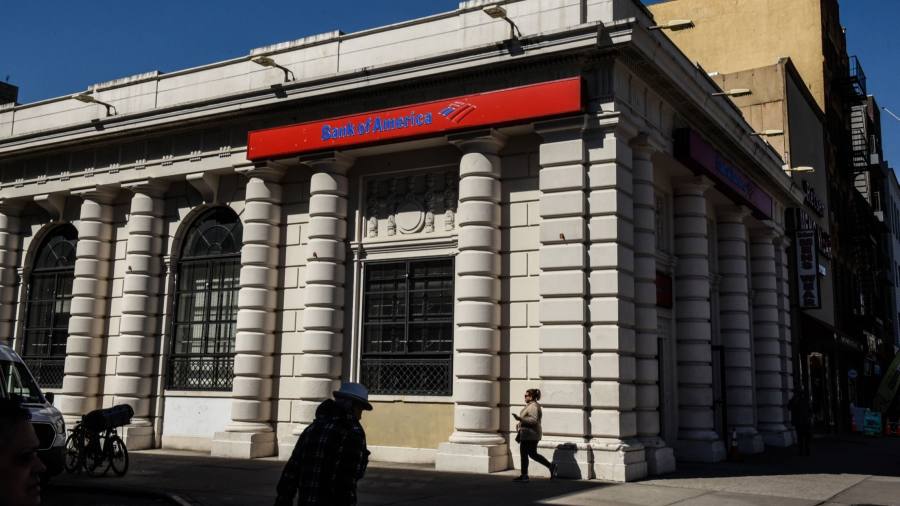
Bank of America is bearing the cost of decisions made three years ago to pump the majority of $670bn in pandemic-era deposit inflows into debt markets at a time when bonds traded at historically high prices and low yields.
The moves left BofA, the second-largest US bank by assets, with more than $100bn in paper losses at the end of the first quarter, according to data from the Federal Deposit Insurance Corporation. The sum far exceeds unrealised bond market losses reported by its largest peers.
The differing results reflect strategies undertaken early in the Covid-19 pandemic, when banks absorbed a flood of deposits from savers. BofA put more money into bonds, while others parked a greater share in cash.
Now that yields have risen and bond prices have fallen, the value of BofA’s portfolio has plunged. By contrast, JPMorgan Chase and Wells Fargo — the nation’s first and third-largest banks, respectively — each had about $40bn in unrealised bond market losses, while fourth-largest Citigroup’s paper losses were $25bn.
The losses at BofA accounted for a fifth of the $515bn in total unrealised losses in the securities portfolios among the nation’s nearly 4,600 banks at the end of the first quarter, FDIC data showed.
“[BofA chief executive] Brian Moynihan has done a phenomenal job in handling the bank’s operations,” said Dick Bove, a veteran bank analyst who is the chief strategist at boutique broker Odeon Capital. “But if you look at the bank’s balance sheet, it’s a mess.”
BofA has said it has no plans to sell the underwater bonds, avoiding crystallised losses that for now exist only on paper. The bank’s portfolio consists of highly rated government-backed securities that are likely to eventually be paid back when the underlying loans mature.
But holding on to the relatively low-yielding investments, many of which are backed by 30-year home loans, at a time when newly purchased bonds yield significantly more, could limit the income that BofA can generate from its customer deposits.
“I think the jury is still out,” said Jason Goldberg, a bank analyst at Barclays, of BofA’s bond portfolio. “When rates were low they were making more money then rivals. Fast-forward to today and they are making less.”
Years of low interest rates, increased regulation and tepid economic growth prompted banks of all sizes to put more deposits into bonds and other securities or boost lending by pursuing less creditworthy borrowers. From the end of 2019 to mid-2022, the total value of securities, mostly Treasuries and insured mortgage bonds, at all banks rose by 54 per cent, or $2tn, and about twice as fast as their overall assets, according to FDIC data.
Silicon Valley Bank, which both boosted securities holdings and lent to money-losing start-ups, is emblematic of how the strategy has backfired. A bank run torpedoed SVB in March, sparked by an announcement that it had lost $1.8bn in selling part of its securities portfolio.
BofA has $370bn in cash and is not facing any SVB-like liquidity crunch. In fact, BofA and other big banks have received inflows of deposits from customers of regional lenders. Most home loans are paid off far earlier than their 30-year term, and if interest rates were to fall again, then BofA’s bond holdings would regain value.
BofA, like other peers, also fared well in the Fed’s annual stress tests, the results of which were released on Wednesday.
Nonetheless, the effects of BofA’s securities portfolio mis-steps are being felt by investors, analysts say. Shares of BofA have fallen 15 per cent this year, making it the worst performer of any of its large rivals. JPMorgan shares have gained 3 per cent.
The impact is also weighing on BofA’s net interest margin, an important gauge of performance that measures how much profit a bank makes on its loans and investments.
For years, JPMorgan and BofA were neck and neck on this yardstick. But in the past year, JPMorgan pulled ahead and in the first quarter its annualised net interest margin was 2.6 per cent versus 2.2 per cent at BofA.
The unrealised losses are “a hot-button issue”, said Scott Siefers, a banking analyst at Piper Sandler, adding that they have “been one of the things weighing on the stock”.
A BofA spokesperson declined to comment.
Alastair Borthwick, BofA’s chief financial officer, fielded a half dozen questions about the securities portfolio and the potential losses on the bank’s most recent earnings call. Borthwick said BofA was in the process of winding down its securities investments, which had declined to $760bn at the end of the first quarter from a peak of $940bn in late 2021.
“Actually, this quarter, we ended up converting some of them into cash just because it’s simpler,” said Borthwick, referring to bonds that are accounted for in a way that makes them easier to sell. “It’s simpler for everyone to understand.”
Borthwick was promoted to CFO in late 2021 and has since been seen as the executive most likely to succeed Moynihan, who has been BofA’s chief executive since 2010. As CFO, Borthwick is directly responsible for managing BofA’s securities holdings and overall balance sheet.
The move into securities was initiated before Borthwick took on the role. At the time, the unrealised losses on the portfolio were less than $1bn.
A person familiar with Moynihan’s thinking said the securities losses had not affected succession planning or changed the timeline of when he might leave the bank. Moynihan has previously said he would like to remain as CEO until the end of this decade.
But Odeon Capital’s Bove is convinced that the way the bank has handled its securities portfolio will influence who takes over the top job — and when. “If the management of its balance sheet doesn’t impact succession planning, Bank of America’s board should be fired,” he said.
Read the full article here