


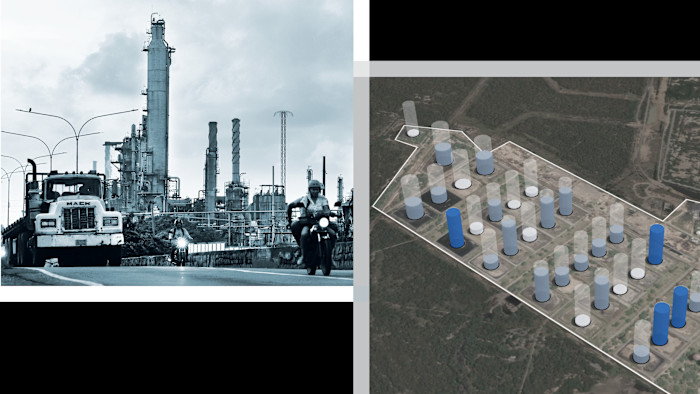
Carabobo, in the heart of Venezuela’s Orinoco belt, is one of the world’s largest oilfields and was expected to pump 325,000 barrels of crude a day this month — more than a third of the country’s entire oil production.
Instead the field, operated by the state-owned Petróleos de Venezuela (PDVSA), is languishing.
Internal projections seen by the Financial Times show its output a third below target for this month. One PDVSA engineer, speaking on condition of anonymity, blamed a US naval blockade for cutting off key supplies and the export route for oil.
But they acknowledged that, like all of Venezuela’s vast energy sector, Carabobo lacks equipment and investment. There were no rigs available to drill new wells, they said. Only one upgrader — which converts the country’s heavy, tar-like, crude into higher-quality oil — is fully operational.
Donald Trump has promised a reboot.
“We’re going to have our very large United States oil companies, the biggest anywhere in the world, go in, spend billions of dollars, fix the badly broken infrastructure, the oil infrastructure, and start making money for the country,” he said after ousting President Nicolás Maduro.
But Venezuela’s crumbling facilities could pose major obstacles.
Ailing infrastructure
Among visual signs of neglect are corroded tanks and unusual storage patterns at the country’s facilities, according to analysis by satellite intelligence company Kayrros.
While Venezuela holds about 17 per cent of the world’s proven crude reserves, and pumped more than 3.5mn barrels a day at its peak in the 1970s, today it produces less than a third of that total, according to the US Energy Information Administration.
Years of under-investment have left facilities and networks in tatters. Chronic maintenance failures have led to fires, explosions and leaks.
Analysts at Kayrros said some facilities were in a “catastrophic state”, citing disrepair, under-investment and “cannibalisation of equipment”.
Further satellite imagery and analysis suggest similar degradation across other sites.
At the industrial port and oil terminal of Puerto La Cruz, four large storage tanks have remained unfinished and have not been used for years, despite the country’s growing need for storage capacity as a result of the US blockade on Venezuela’s crude exports announced in December.
At the Bajo Grande and Puerto Miranda terminals in the western region, numerous tanks are out of order because of corrosion and a lack of maintenance, according to Kayrros, while sludge accumulation has reduced operating capacity.
At the large interconnected Amuay and Cardón refineries on the northern Paraguaná Peninsula, operations have fallen sharply. Reports last year indicated they were running at below 20 per cent of capacity, becoming “de facto storage centres”, Halff added.
A fire and a power blackout both halted operations at Cardón in the last two years, according to reports.
The country’s main export terminal, Puerto José, had some of the highest fill rates, yet disrepair still plagues some of its equipment, according to the analysts.
According to Kayrros’s estimates, roughly a third of Venezuela’s storage capacity is currently inactive, reflecting reduced refinery operating rates, storage tanks that are out of service, and declining oil production.
A leaked document from PDVSA in 2021 said its pipelines had not been updated in 50 years and estimated the cost to return the country’s systems to peak production levels would be $58bn.
More recent estimates have placed the figure at $100bn or more.
“The industry was basically destroyed by the regime,” said Jairo Rincón, a former PDVSA engineer who now sells equipment to Venezuela’s energy sector.
Wider decline
The deterioration of Venezuela’s energy industry began under Hugo Chávez in the early 2000s, when private companies were excluded and oilfields seized from the likes of ExxonMobil and ConocoPhillips, both of which are still seeking billions of dollars in compensation.
“All hell broke loose,” said Rincón, who noted that before Chávez, “everybody who was anybody in the oil and gas industry worldwide was involved in Venezuela”.
PDVSA was called on to fund social programmes to shore up support for the government, draining its resources. Companies providing the oil industry with high-tech services were left unpaid.
US sanctions imposed in 2017 blocked the company’s access to foreign capital, and then to the US market for its oil. PDVSA defaulted on its bonds and has had to pay its debt in crude.
Corruption has become endemic. “In the companies that are still owned by PDVSA or the government, you have to pay commissions. Corruption is the only way of life,” said Rincón.
While Venezuela’s reserves top international rankings, exports have crashed.
One of the biggest casualties of Venezuela’s isolation is a huge field called El Furrial that was producing more than 400,000 barrels of light crude in 2008, before technically challenging operations that were being run by two western companies, Wood Group and Williams, were nationalised.
Today, El Furrial’s production was “negligible”, said Carlos Bellorin of energy data company Welligence. Fixing the field is possible, but will require enormous investment and technical expertise.
Other parts of the oil supply chain are also facing long-term problems — symptomatic of broader systemic neglect.
At ports, sanctions and export restrictions have kept tankers stuck offshore, and poor equipment and mismanagement have reportedly slowed the loading of supertankers.
A 2023 report from state-run oil company PDVSA, leaked to Reuters, said more than half of the 22 oil tankers in Venezuela’s fleet were so run-down that they needed to be repaired or taken out of service.
The country also relies on an ageing pipeline network, with parts more than 50 years old, posing a structural challenge for transporting crude from wells to refineries, according to the US Energy Information Administration. The system often ruptures, causing leaks.
Lake Maracaibo suffers chronic oil contamination from decades of nearby extraction and infrastructure decay. Environmental groups and satellite analysis have pointed to ongoing oil spills over the years from corroded pipelines.
Reuters news agency also caught imagery of an oil spill at the El Palito refinery in August last year, which contaminated a bay off the country’s north-central coast in the Caribbean Sea.
The Washington-based Center for Strategic and International Studies reported in 2021 that the PDVSA itself estimated that about $8bn would be needed to update pipeline infrastructure alone to return production to late-1990s levels — a likely underestimate.
Venezuela’s economic and political collapse has led to widespread shortages of food, medicine and fuel, with reports of both criminals and residents looting infrastructure for income, says Tom Liskey, Latin America manager for energy analytics provider Enverus.
He describes desperation leading to “households trying to get some scrap metal to put some food on the table for their family”.
Chronic under-investment in the country’s wider infrastructure has also led to repeated nationwide electricity blackouts, leaking water pipes and roads riddled with potholes — failures likely to indirectly affect attempts to increase oil production.
A nationwide blackout in 2019 — triggered by brush fires and neglected transmission lines at the Guri dam — cut power to the oil-rich Orinoco belt, where heavy crude became sludge, causing permanent damage and an estimated $2.9bn hit to GDP.
The road back
To reboot the oil industry will require not only huge investment, but the return of the huge numbers of Venezuelan engineers and energy specialists who have fled overseas over the past two decades.
“We need to bring back the manpower,” said Rincón, who said he was planning to return. “We need the experts that we have throughout the world.” If they return, he added, “I’m very optimistic that the industry is fully recoverable and it won’t take decades, it will take years”.

Most analysts believe the country can increase production by a few hundred thousand barrels a day in the short term, but boosting it further would take the sort of investment that needed to be underpinned by legal assurances, said Elisabeth Eljuri, an oil and gas expert who has worked on energy reform across Latin America.
The US oil majors that Trump wanted to rebuild the sector would probably take their time to analyse the situation before investing, she said.
“You have to have a durable contract that will survive over time, granted by someone who has legitimate authority. You want the contract to be consistent with the constitution of the country and you want there to be rule of law.”
With companies investing billions over decades-long contracts, they will also look for international arbitration rights and international treaties between the government and the US to ensure the contracts are respected.
Venezuela’s current laws may need to be changed to permit foreign private participation, and its fiscal regime may also need to change before oil companies are willing to take the plunge.
She added: “It is going to take time. The infrastructure and everything that needs to be built will take time. The framework has to be put in place.”
Additional reporting by Caroline Nevitt and Clara Murray
Data on tank storage rates from Kayrros, last updated December 30 2025. Data on locations of pipelines, processing and storage facilities from Enverus
Read the full article here