


Good morning. There are only two stories in Europe today: First, will EU leaders agree to provide Ukraine with additional financing to prevent its collapse? And second, will intra-EU divisions destroy a trade deal with South America that has been 26 years in the making?
Face/Off
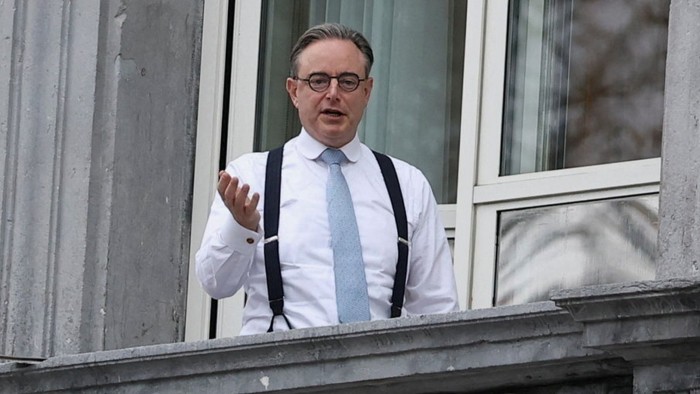
Belgium’s Prime Minister Bart De Wever will have to look Volodymyr Zelenskyy in the eye today and tell him why he believes Russian state assets immobilised in Brussels should not be used to keep the Ukrainian president’s war-torn country afloat.
Context: Ukraine will go bankrupt in the spring without additional funding, as Russia’s invasion continues. A European Commission proposal to loan Kyiv €90bn over the next two years raised against the Kremlin’s frozen cash is the focal point of a summit of EU leaders in Brussels that starts today and could run into the weekend.
De Wever argues that the risk of Russian retaliation against Belgium, where the majority of the assets are immobilised, is too great. He has demanded “unlimited” financial and legal guarantees from the EU’s other 26 member states.
The commission has proposed dozens of legal remedies and safeguards in response to Belgium’s demands, but says indefinite, all-encompassing guarantees are by definition impossible.
Zelenskyy was supposed to dial in to the summit by video call. His decision to attend in person underscores the existential importance of the financial lifeline, and the stakes of De Wever’s continued refusal to grant it.
The EU could legally implement the loan with a majority of its members — which comfortably exists — even if Belgium voted against. While many leaders are squeamish about this possible solution, others are open to the concept given that the alternative could be Ukraine’s capitulation.
“We have 36 hours and need to find a solution,” said one senior EU diplomat involved in the pre-summit negotiations. “This is not a European Council where [we] can afford to part ways and not have a solution.”
Belgium has instead been pushing to use the EU’s joint budget to fund Ukraine, arguing that special powers could be used to do this by majority voting, despite knowing that the EU’s legal service had already said that would be illegal under the bloc’s treaties.
Hungary and other Russia-leaning member states have already said they would veto the unanimity required to use the budget.
Short of a Plan C arriving in the next two days, the stand-off means that either De Wever or German Chancellor Friedrich Merz, the most prominent champion of the loan idea, appears set to leave the summit having been forced into a humiliating climbdown.
But that political wound will pale in comparison to the damage to Zelenskyy should the EU fail to find a financial solution. It would leave Kyiv staring at financial collapse just as Russian President Vladimir Putin vows to step up his onslaught and US officials increase the pressure on Ukraine to accept territorial concessions to secure a ceasefire.
Chart du jour: Trough
The EU’s next budget from 2028 requires unanimity among its 27 member states and approval from European parliament. The battle lines are already taking shape.
Last chance
With the EU’s biggest ever trade deal with Mercosur countries on life support, Sweden has lashed out at “protectionist” fellow member states blocking its signature, writes Andy Bounds.
Context: European Commission president Ursula von der Leyen wants to sign the trade deal with Brazil, Argentina, Uruguay and Paraguay on Saturday, but France and Italy want more safeguards for their farmers.
Brazilian President Luis Inácio Lula da Silva yesterday said that if the EU does not sign the agreement as planned this weekend, he would walk away from a deal.
“We’ve conceded to everything that diplomacy could possibly concede,” Lula said. “The agreement is more favourable to them than to us.”
Sweden’s trade minister Benjamin Dousa told the FT that the EU’s agricultural sector would benefit from tariff reductions under the deal. “The EU is actually the world’s largest net exporter of food and agricultural products,” he said.
EU legislators last night finalised support measures for European farmers, in the event that cheaper South American imports hit their incomes. Dousa said he hoped a deal could still be reached at today’s summit based on those additional measures.
“If we can’t get the Mercosur agreement . . . over the finish line . . . it sends a signal that maybe Europe isn’t open for business,” said Dousa.
“We see a clear push towards protectionism,” he said, and the country wanted to stand up for free trade. “We want to send a signal to Europe and to the world that we’re open for business and we want to help foreign companies investing here.”
“We want to attract talent from around the world so when other countries are shutting down, raising their tariffs, making high-skilled immigration tougher, we’re doing the opposite.”
What to watch today
-
EU leaders meet for summit in Brussels.
-
Nato secretary-general Mark Rutte visits Poland.
Now read these
-
Flip-flop: The car industry has soured on EU plans to ease the 2035 ban on petrol engines, warning the changes would lead to more expensive cars.
-
Swiss compromise: A proposal from a cross-party group of politicians could break the deadlock between UBS and the Swiss government.
-
Price tag: Rocket Internet has been accused of marking down the valuations of start-up investments in order to buy out its own backers at “bargain prices”.
Read the full article here