


Unlock the Editor’s Digest for free
Roula Khalaf, Editor of the FT, selects her favourite stories in this weekly newsletter.
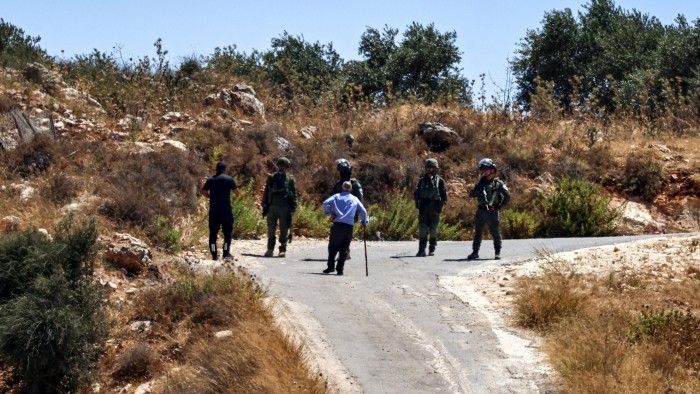
The Palestinian prime minister has accused Israel’s far-right government of intensifying efforts to make the West Bank “unlivable” and drive people out of the occupied territory as it endures rising violence by Jewish settlers, Israeli military raids and a deepening financial crisis.
Mohammad Mustafa told the Financial Times that Israeli Prime Minister Benjamin Netanyahu’s ruling coalition’s “ultimate objective is to get people to leave and make it easier to continue their programme of creeping annexation, day in day out”.
“There’s an increasing recognition that the Israeli government’s target is . . . to make things unlivable,” Mustafa said. “Even if you don’t put them in buses and take them to the bridge [on the border with Jordan], they thought people would volunteer [to leave] because things are very difficult.”
Since Hamas’s October 7, 2023 attack triggered the war in Gaza, the West Bank — which is home to more than 3mn Palestinians — has endured its most violent period in decades.
Extremist Jewish settlers have driven dozens of Palestinian communities from their land, and Israeli raids have killed nearly 1,000 people, according to the UN. Israel insists its raids target militants.
In tandem, Israel has tightened its stranglehold over the territory, setting up hundreds of barriers severely restricting Palestinians’ movement and announcing the biggest expansion of Jewish settlements in the West Bank — deemed illegal under international law — in years.
The far-right coalition, which includes ultranationalist settlers like finance minister Bezalel Smotrich who openly advocate for Israel to annex the West Bank, has also squeezed the territory financially by withholding $3.6bn in customs revenue owed to the Palestinian Authority, which administers limited parts of the area.
“Things are so bad . . . they are playing with explosive material, something can go really, really wrong any time,” Mustafa said.
The pressures have left the PA government able to pay only 60 per cent of salaries. At the end of October, its debts stood at $14.9bn, including $1.7bn in arrears to the private sector, and it is spending around a third of its depleted revenue on servicing debts.
It is not clear how many Palestinians have left the West Bank. But Jordan has long been worried about an influx, concerns that have heightened over the past two years.
Western governments have sanctioned Smotrich and far-right national security minister Itamar Ben-Gvir for inciting violence against Palestinians in the West Bank.
Mustafa said the Israeli government’s actions were designed, among other things, to undermine the PA and destroy the notion of a Palestinian state. The goal is “to eventually convince the rest of the world there’s no place for a state in this part of the world”, Mustafa said.
The PA, which has been led by 90-year-old President Mahmoud Abbas for two decades, has long struggled with legitimacy, with many Palestinians viewing it as corrupt and ineffectual in pushing back against Israel’s grip on the West Bank.
But European and Arab states still view the secular body as the only viable Palestinian partner and alternative to Islamist militant groups such as Hamas.
Since October 7, the PA has faced pressure from western and Arab partners to reform in order to boost its legitimacy and to eventually take over the governance of Gaza, which Hamas has controlled since 2007.
But Netanyahu has vociferously resisted any moves to give the PA a role in Gaza and boasts of blocking any steps towards the establishment of a Palestinian state.
Mustafa, a US-educated economist who previously headed the PA’s investment fund, was appointed prime minister in March 2024 as part of the organisation’s attempts to show it could reform. But his appointment was criticised by some as representing little change because he is a long-term ally of Abbas.
The PA this year has pushed through some reforms, such as overhauling its system of payments to the families of Palestinians jailed or killed by Israel, including those involved in violent attacks. Both the EU and US had called for the changes.
Abbas also promised to hold national elections within a year of the war ending in Gaza, which would be the first since 2006. But the PA insists they should be held not just in the West Bank, but also in Gaza and East Jerusalem, which Israel annexed after seizing it in the 1967 war, as all three are considered integral to a future Palestinian state.
Mustafa insisted the PA would do “everything we can” to hold elections, but blamed Israel for attempting to scupper the process.
“If there are any shortcomings [in the PA], it is the responsibility of the leadership to continue to work towards delivering to our people . . . But we also have to admit that there are challenges,” he said.
“How can you expect, for example, free elections when Hamas was in charge of Gaza for 17 years and the Israeli government was doing everything possible that the separation continues?”
Read the full article here