


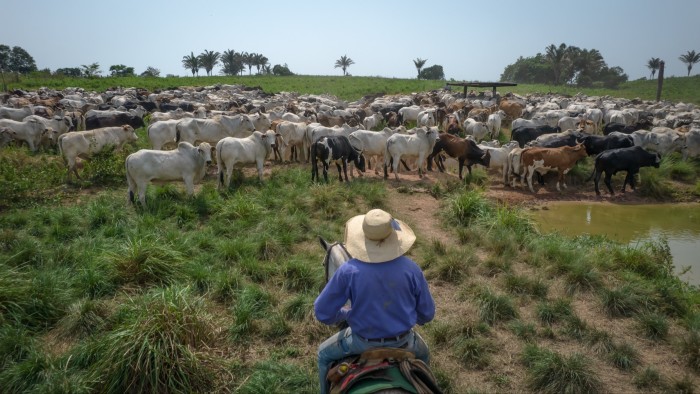
The US and China’s dizzying tariff tit-for-tat has spurred Brazil’s agricultural sector and pummelled American farmers, as Beijing looks to Latin America’s largest economy for a swath of goods from soyabeans to beef.
Brazil was a major winner in President Donald Trump’s first trade war with China, dramatically expanding its then-narrow lead over the US as Beijing’s biggest food supplier. It now looks set to pull further ahead, with exports to China already surging before Trump hiked his tariffs on the country by 145 per cent and Beijing added levies of 125 per cent.
“It is a boon for farmers in Brazil and Argentina, and it will help their industry a lot,” said Ishan Bhanu, lead agriculture analyst at commodities data provider Kpler. “The ramifications of this will be longer lasting than the actual measures — in Asia, countries will build better relationships with South America.”
Brazil’s beef sales to China climbed a third in the first quarter of 2025, compared with a year earlier, while Chinese imports of its poultry increased 19 per cent year on year in March, according to local trade associations. Meanwhile, foreign demand has seen Brazilian soyabeans trading at a $1.15 premium to their US counterparts on global markets, having sold at a 25-cent discount only in January.
“China is moving quickly to secure supplies of not only soya, but other commodities,” said Rodrigo Alvim, international director of Brazil’s Minas Port Group. “This will result in less demand for American grains.”
US agricultural shipments to China sank 54 per cent in January compared with a year earlier. The Asian giant typically buys 90 per cent of US sorghum exports and about half its soyabean exports.
US farmers were “still reeling” from Trump’s first trade war and “certainly not thrilled about an extended” second one, Kentucky soyabean farmer Caleb Ragland, a three-time Trump voter, said on Thursday.
In an open letter, Ragland, president of the American Soybean Association, pleaded with Trump to make a deal with China.
“It is urgent that a deal happens. The farm economy is much weaker now than it was in his first term. After the first trade war, we lost nearly 10 per cent of market share to China that we never regained,” he wrote.
China also last month in effect blocked a significant share of the entry of US beef exports to the country, valued last year at $1.6bn, by not renewing registrations that allow hundreds of US meat facilities to export there. There had also been only limited soy, wheat, corn or sorghum shipments this year, said a person familiar with US agricultural exports, who requested anonymity as they were not authorised to speak to the media.
Many Chinese grain crushers had halted imports from the US, as tariffs eviscerated their margins, the person familiar with the industry said. “If the situation continues, grain shipments could go to zero by May,” they said. “The only way we could have a normal year is if tariffs go back to zero.”
Brazil was in a strong position to capitalise on the shift, said Aurélio Pavinato, chief executive of SLC Agrícola, one of Brazil’s largest grain producers. “With China looking to diversify its suppliers and Europe increasingly viewing Brazil as a stable option, we’re seeing increased foreign demand and a significant uptick in prices,” he said.
The South American country has Trump to thank, at least in part, for helping it build exporters capable of stepping into the US void. During the first US trade war with China, Brazilian soyabeans traded at about a 20-per cent premium compared to US soyabeans, helping funnel investment into the country’s agricultural sector, said Jim Sutter, chief executive of the US Soybean Export Council.
That investment cut into the US’s competitive advantage, which was based around strong infrastructure and reliability, Sutter said.
The US share of China’s food imports collapsed from 20.7 per cent in 2016 to 13.5 per cent in 2023, while Brazil’s grew from 17.2 per cent to 25.2 per cent in the same period.
Brazil’s logistics infrastructure still lags behind the US, with bottlenecks at ports often holding up exports. But the latest trade war may once again bring a surge of capital, said Eugenio Figueiredo, chief executive of the Port of Açu, who hoped the instability would encourage China to invest in Brazilian logistics.
Europeans, who are awaiting ratification of a bumper free trade deal between the EU and Mercosur, could also be forced to switch to sourcing protein for animal feed from Brazil instead of the US, according to the European Feed Manufacturers’ Federation (FEFAC).
With the EU set to slap 25 per cent retaliatory tariffs on US soyabeans, beef and poultry between April and December, concerns are mounting that the South American country may not have enough produce to satisfy demand. Although Brazil has had a bumper crop, Sutter said, its large supply “will quickly be absorbed” if both China and the EU “focus all their sourcing on Brazil”.
Pedro Cordero of FEFAC said Europeans shared that concern.
“We will compete with China, among other countries, for the same products,” he said. “That means higher prices for the feed, which means higher prices for food.” If South America cannot step up, he added, “we will be in trouble”.
Data visualisations by Jonathan Vincent
Read the full article here