


Stay informed with free updates
Simply sign up to the US inflation myFT Digest — delivered directly to your inbox.
The writer is chair of Rockefeller International. His latest book is ‘What Went Wrong With Capitalism’
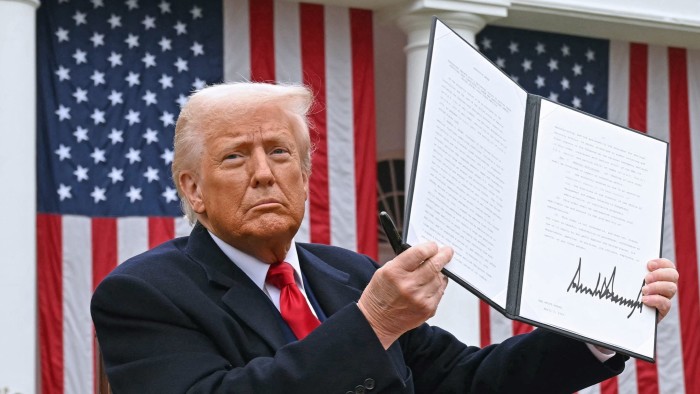
After Donald Trump chose the nuclear option for delivering on his tariff threats, adding to fears of global stagflation, US Federal Reserve chair Jay Powell made clear the central bank is in no hurry to respond. The market, however, is already pricing in four rate cuts this year, suggesting that soon enough the Fed will choose stimulating growth over controlling inflation.
That path would further undermine the Fed’s anti-inflation credentials. For five years in a row the US central bank has failed to meet its 2 per cent inflation target. By its own estimates, it will fail again this year and next. So far, the only public figure who has paid a price is Joe Biden.
As for the Fed’s governors, they keep offering excuses for missing the inflation target — supply disruptions caused by Covid lockdowns, then massive government spending during the pandemic and now tariffs. Most economists accept these excuses and buy the Fed’s argument that when adjusted for inflation, its rates are still “restrictive”.
Compared with the easy money era of the last 15 years, when real rates turned negative for the first time, a real fed funds rate of around 1.8 per cent does look relatively high. Compared with the norms before 2009, however, the rate is not very high and hasn’t been restrictive enough.
Whether the measure is the consumer price index or the Fed’s preferred data on personal consumption expenditures, the persistently high inflation of the last five years has more than wiped out the low inflation of the previous 20. Now, the CPI and PCE are both significantly higher than they would have been had the Fed kept hitting its 2 per cent target since the start of this century.
The last PCE report came in nearly a full point above the Fed target. Yet governors have been contemplating when to cut rates in the belief that the increase in the inflation rate from tariffs this year could be “transitory”.
Evidence for a restrictive Fed has been hard to find. As the latest jobs report on Friday showed, unemployment remains low and steady. US house prices are at a historic high compared with median income, placing the dream of home ownership increasingly out of reach. Despite the recent correction in financial markets, valuations remain high for asset prices, which benefit mainly the very rich.
The Fed had as recently as 2020 toyed with the idea of allowing inflation to run higher than its target for extended periods to make up for runs of below-target inflation, but not vice versa. This “asymmetric” bias tilts the wrong way. Historically, rising inflation has almost always led to slower growth, falling inflation has not. Going back to steam engines, new technologies have often increased productivity, raising output while driving prices down.
If anything, there’s a case for lowering the target below 2 per cent. That number was based on an offhand comment made back in the 1980s by an official in New Zealand, who was trying to signal his nation’s seriousness in fighting inflation — then running much higher worldwide.
The signal worked. Inflation fell and the 2 per cent target caught on. Now, the signal is going soft in the US. In the rest of the world, many central banks are more serious, and inflation is running at or at least closer to their targets.
The Fed reconfirmed its bias last September. Responding to minor signs of weakness in the labour market, it cut its key rate by 50 basis points, double what the market expected. Stock prices jumped anew, and inflation reaccelerated. Unsurprisingly the market is now betting it will respond similarly to Trump’s tariffs with more rate cuts.
Criticising the Fed is often seen as the province of cranks who want to bring back the gold standard or tamper with the central bank’s independence. But the main reason for freeing the Fed from political pressure is so that it can take unpopular steps to control inflation, when necessary. Independence should not rule out holding it accountable for repeated failures to meet the inflation target. The Fed should reaffirm its independence by not bowing to pressure from Trump, who predictably wants rate cuts now.
Americans continue to reel from higher prices. Polls show that inflation is by far their most pressing concern and trust in the Fed is declining sharply. Powell himself acknowledged on Friday the risk that expectations of rising inflation will become entrenched. After missing its target for many years, it would be a mistake for the Fed to dismiss the inflation fallout from tariffs as transitory and revert once again to stimulating the economy.
Read the full article here