


Stay informed with free updates
Simply sign up to the US economy myFT Digest — delivered directly to your inbox.
The writer is founder and chief executive of Algebris Investments
In markets, the most valuable currency is trust. As investors, we learnt this simple fact over the years, sometimes the hard way. Trust underlies every number, from earnings reports to macroeconomic data. It represents the key bond between investors and investments. When trust is lost, it takes a long time to rebuild it.
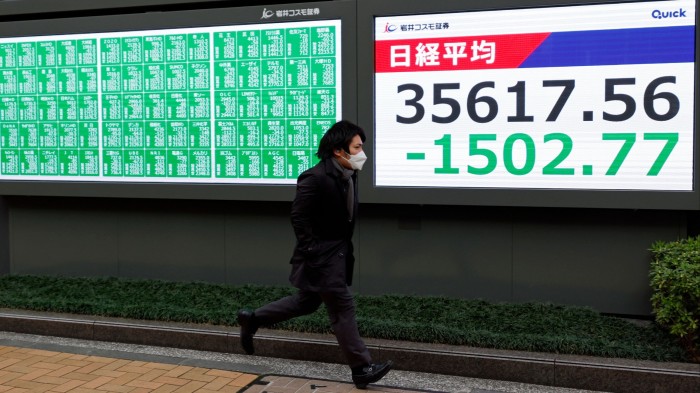
The Trump administration is taking over at a time when investor trust in the US is high but creaking. Combined foreign ownership of US marketable securities stands at just over $31tn, a testament of confidence. However, the past three years have seen the boundaries of the system that prevailed post-2008 being tested. As such, keeping trust strong is paramount and difficult at the same time. Today’s tariff-induced market sell-off is proof of this.
US debt management has never been so challenging. Federal debt held by the public has reached 100 per cent of GDP, the highest postwar level. It was 36 per cent in 2005. Interest costs constitute 3.2 per cent of GDP, twice the average of the last decade.
That interest bill is comparable to levels reached in the mid-1990s, when interest rates were 6 per cent. But the administration was running a primary surplus back then, and debt levels were substantially lower. Even the most conservative projections expect public debt to rise quickly over the next 10 years.
Global investors hold an important role in funding this leveraging process.
International holdings of US Treasury securities stand at $8.5tn, a quarter of the total. Debt portfolio flows fund 90 per cent of the US current account deficit. Both public and total US liabilities are heavily reliant on overseas appetite for US debt securities.
When it comes to debt build-ups, history rhymes. No matter the position of the country or the narrative of the time, there’s a tipping point above which risks of debt increase. This is especially true when the country, and not just the government, is a persevering borrower. When the point is reached, confidence can be suddenly lost, with nasty implications for interest rates and the currency.
While anticipating the precise tipping level is impossible, there are ways to mitigate the risks around it.
First, the US Treasury should give markets a sign of discipline. US spending failed to normalise post-Covid, despite healthy economic growth. Primary deficits stabilised just below 4 per cent after 2021, with an increasing social security burden and little action taken on the discretionary front. Interest expense won’t provide relief as the cost of US debt is below market rates.
The Trump administration’s well-anticipated extension of the 2017 individual tax cuts will be the first real test in this direction. The Congressional Budget Office estimates it could cost $4.6tn in lost revenues over 10 years, a number hard to digest for markets.
Second, US policy needs to be predictable. Since inauguration day, global markets have been wondering what the country’s plan really is. The president and his key staff have made various and sometimes conflicting statements regarding trade, fiscal and regulatory policy. Markets are lost, and so is Main Street. Market weakness following tariff announcements is a testament of this.
Policy uncertainty indices in the US are close to all-time highs. Only 2020 was higher. This is unnecessary, as the US is not in the midst of crisis. Predictability is a low-hanging fruit that carries a high confidence dividend.
Third, international relations should be smoother. The US is the most powerful nation in the world, and using leverage to extract concessions from partners is natural. However, recent rhetoric underlies an excessive optimism on US leverage — the world needs America, but not the opposite.
This view is only right insofar as global investors are willing to fund US growing imbalances. Gunboat diplomacy and harsh protectionism risk alienating partners. This carries the threat of reduced foreign direct investment and a lack of marginal buyers for US assets, if not outright selling. The opposite of what the US advocates.
For decades, the US has enjoyed a stronger currency and lower interest rates than its economy would justify, in exchange for supplying the world with reliable safe assets.
Economists call this the “exorbitant privilege”. But every privilege demands responsibility. For global capital, the currency of choice is trust. It is in America’s best interest to not let that currency debase.
Read the full article here