


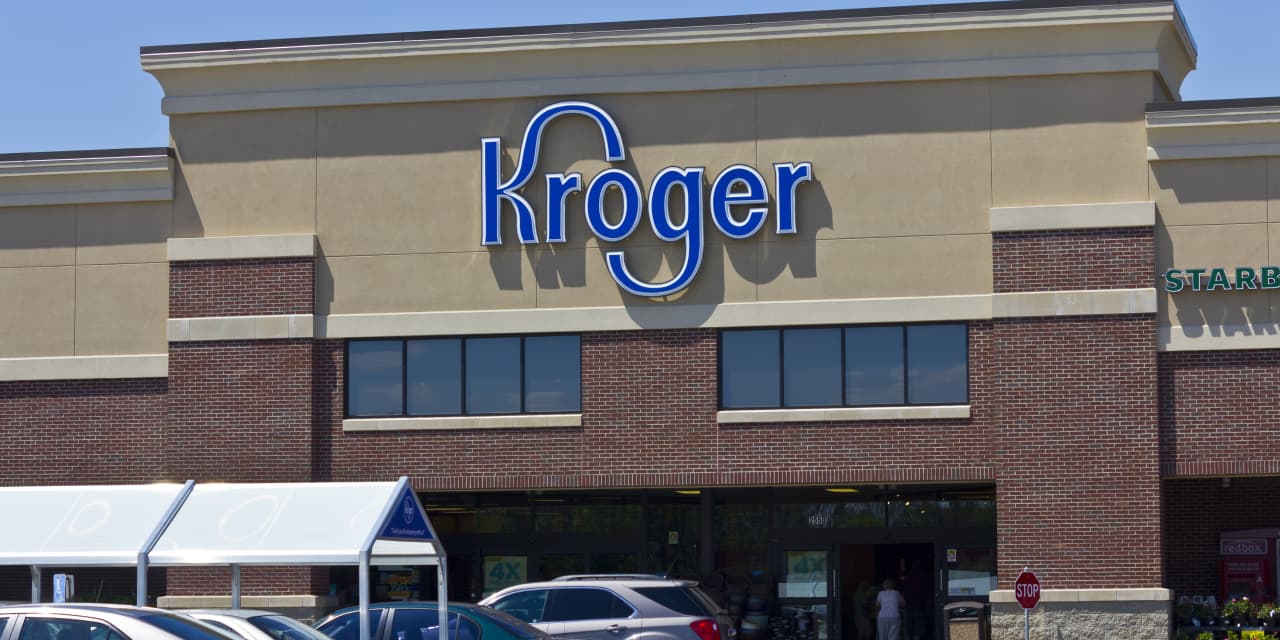
The Federal Trade Commission on Monday sued to block a proposed $25 billion merger between
Kroger,
the nation’s largest grocery operator, and rival
Albertsons.
The FTC cited concerns about reduced competition and higher prices for consumers. The companies say costs would be reduced, resulting in lower prices. The reality is much more layered.
Investors shrugged off the expected news.
Kroger
stock dropped 2% on Monday, while
Albertsons
share are up 0.6%.
The merger would lead to higher food prices, lower quality products, narrowing consumer choices, and lower wages for workers, the FTC said in the lawsuit filed in federal court in Oregon. The companies’ plan to divest hundreds of stores in concentrated markets won’t solve the problem, the agency said.
“This supermarket mega merger comes as American consumers have seen the cost of groceries rise steadily over the past few years. Kroger’s acquisition of Albertsons would lead to additional grocery price hikes for everyday goods, further exacerbating the financial strain consumers across the country face today,” said Henry Liu, Director of the FTC’s Bureau of Competition.
A bipartisan group of nine attorneys general is joining the FTC’s federal court complaint.
Following the FTC’s decision, Kroger said in a statement that blocking the merger would harm consumers, who would most likely see higher prices and fewer grocery stores at a time when shoppers are already facing food inflation.
“Kroger has reduced prices every year since 2003, resulting in $5 billion invested to lower prices and a 5% reduction in gross margin over this period,” the company said. “This business model is immediately applied to merger companies.”
Big-box chains like
Walmart
and
Costco Wholesale
have been gaining market share in food retail as they leverage their size for cheaper prices. Meanwhile, e-commerce competitors like
Amazon.com
have disrupted the bricks-and-mortar business, making store pickup and home delivery nearly a necessity for grocers to stay competitive.
Blocking the deal would allow nonunionized retailers like
Walmart,
Costco and
Amazon.com
to further dominate the grocery industry, said Kroger. The merging parties said they plan to litigate the agency’s action in court.
There have been cases where companies persuaded judges that the FTC is wrong and they’re not in violation of the antitrust laws, says Carl Tobias, a law professor at University of Richmond.
Mergers don’t always lead to higher prices. Larger companies can be more efficient and pass the saved costs to consumers to stay competitive.
A 2018 paper from the FTC examined how consumer prices changed following 14 mergers in the supermarket industry. The paper found that mergers are likely to result in price increases—roughly 2%—in highly concentrated markets with less competition, but the mergers tend to lead to price decreases in less concentrated markets.
The task for regulators like FTC, is to determine which markets are too concentrated and which mergers could lead to reduced competition. The antitrust agency has become more aggressive against mergers under Biden administration, says Tobias.
One of the big challenges for the FTC is to define the market in which Kroger and Albertsons compete—whether it should be limited to just grocery stores or expanded to include other retailers that sell grocery items, says Jeff May, senior analyst at legal content and solutions provider
Wolters Kluwer.
When Whole Foods proposed to acquire Wild Oats Markets in 2007, for example, the agency blocked the deal on the grounds that both are premium organic supermarkets. The case was eventually settled with Whole Foods selling 32 stores.
The combined Kroger-Albertsons would become a much larger company with 5,000 stores and $228 billion in annual sales. Still, with a combined market share of 15% to 20%, it would be smaller than Walmart, which has more than 5,200 U.S. locations and makes up over a quarter of sales in the grocery market.
“There’re so many options for the consumer to get their groceries today, so it’s very difficult for the FTC to make its case that prices will necessarily increase when there’s so much competition from other outlets,” says May.
Kroger and Albertsons have agreed to sell over 400 stores to C&S Wholesale Grocers in areas where their stores are the only dominant grocery sellers. More than 60% of the proposed divestitures are located in four states—Washington, California, Colorado, and Oregon.
But FTC’s new head Lina Khan, who took over the helm in 2021, has been skeptical about whether divestiture would replace the competition lost by the merger.
When Albertsons merged with Safeway in 2015, it sold off 168 stores to get the deal through the FTC. Within months, one of the buyers filed for bankruptcy and Albertsons bought back a number of the stores at a discount.
The FTC alleges that Kroger and Albertsons’ divestiture proposal is a hodgepodge of unconnected stores, banners, and brands that “falls far short of mitigating the lost competition.” C&S would face significant obstacles stitching together the various parts and pieces into a functioning business, says the agency.
“The FTC is looking for a stand-alone business that could compete effectively with the merging parties,” says May.
Write to Evie Liu at [email protected]
Read the full article here