



By using this site, you agree to the Privacy Policy and Terms of Use.
Accept
AmextaFinanceAmextaFinance
  • Home
  • News
  • Banking
  • Credit Cards
  • Loans
  • Mortgage
  • Investing
  • Markets
    • Stocks
    • Commodities
    • Crypto
    • Forex
  • Videos
  • More
    • Finance
    • Dept Management
    • Small Business
Notification Show More
Aa
AmextaFinanceAmextaFinance
Aa
  • Banking
  • Credit Cards
  • Loans
  • Dept Management
  • Mortgage
  • Markets
  • Investing
  • Small Business
  • Videos
  • Home
  • News
  • Banking
  • Credit Cards
  • Loans
  • Mortgage
  • Investing
  • Markets
    • Stocks
    • Commodities
    • Crypto
    • Forex
  • Videos
  • More
    • Finance
    • Dept Management
    • Small Business
Follow US
AmextaFinance > Investing > This bond-market reality could crush investors’ hopes for a soft landing
Investing

This bond-market reality could crush investors’ hopes for a soft landing

News Room
Last updated: 2024/02/11 at 3:44 AM
By News Room
Share
4 Min Read
SHARE

The “junk spread” is abnormally low right now, and that elevates the risk of an imminent recession. The junk spread is the difference between the yield on corporate high-yield bonds and U.S. Treasurys of comparable maturities. This spread represents the extra yield that investors demand to compensate them for the additional risk of investing in junk bonds rather than Treasurys.

The spread currently stands at 3.5 percentage points, well below its average since 1997 of 5.4 percentage points, as shown in the chart above. That means investors believe economic risk to be abnormally low right now, which is hardly surprising given the widespread consensus that the U.S. Federal Reserve has perfectly executed the proverbial soft landing.

Nevertheless, as Humphrey Neill, the father of contrarian analysis, reminded us, “When everyone thinks alike, everyone is likely to be wrong.” Contrarians believe that the low current spread represents an excess of exuberance that will correct itself in coming months.

History provides strong support for this contrarian belief, as the table below shows. The results reported are based on one of the market’s standard ways of measuring the spread, the ICE BofA U.S. High-Yield Index Option-Adjusted Spread.
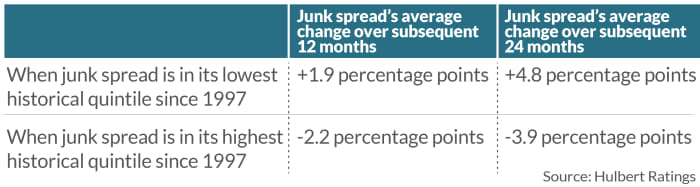
The differences shown in the chart are significant at the 95% confidence level that statisticians often use when determining whether a pattern is genuine. The junk spread is currently in the lowest historical quintile, represented by the first row of the chart, and that’s why contrarians conclude there is an elevated risk of a recession. Increases in the junk spread of 1.9 to 4.8 percentage points over a one- to two-year period would not only reflect increased economic risk but would also contribute to that increase.

“The junk-bond spread has greater explanatory power in the one- to three-year horizon.”

A longer-term contrarian indicator

Contrarians therefore should add the junk spread to the set of sentiment indicators on which they focus when assessing the mood of investors. One advantage this indicator has over most others is that its greatest explanatory power is for the much longer term. Most other sentiment indicators tell you little about the market beyond a one- to three-month horizon. The junk-bond spread, in contrast, has greater explanatory power in the one- to three-year horizon.

On the one hand, you might take some solace from this longer explanatory horizon, since it means a recession doesn’t have to begin in the next several months. On the other hand, this analysis suggests this heightened risk of a recession is not going away soon.

That doesn’t guarantee that a recession will occur, of course. But it would be entirely consistent with contrarian theory for a recession to begin just as the market is celebrating a soft landing.

Mark Hulbert is a regular contributor to MarketWatch. His Hulbert Ratings tracks investment newsletters that pay a flat fee to be audited. He can be reached at [email protected].

More: The stock market’s ‘bad breadth’ is making even stalwart bulls nervous

Also read: Here’s what to expect from stocks in February after January’s big rally

Read the full article here

News Room February 11, 2024 February 11, 2024
Share this Article
Facebook Twitter Copy Link Print
Leave a comment Leave a comment

Leave a Reply Cancel reply

Your email address will not be published. Required fields are marked *

Finance Weekly Newsletter

Join now for the latest news, tips, and analysis about personal finance, credit cards, dept management, and many more from our experts.
Join Now
The power crunch threatening America’s AI ambitions

Many utility companies are pinning their short-term hopes on “demand response” solutions…

Why beef prices are out of control in the U.S.

Watch full video on YouTube

Stocks close lower to start the week, Stifel’s bullish Tesla call

Watch full video on YouTube

Touchstone Dynamic Large Cap Growth Fund Q3 2025 Commentary

At Touchstone Investments, we recognize that not all mutual fund companies are…

Israel stepping up ‘creeping annexation’ of West Bank, Palestinian PM says

Unlock the Editor’s Digest for freeRoula Khalaf, Editor of the FT, selects…

- Advertisement -
Ad imageAd image

You Might Also Like

Investing

Why Home Builders Are Bouncing Today—and Why Their Stocks Are Good Buys

By News Room
Investing

This Beaten-Down Industrial Stock Wants to Call America Home. Why It’s Time to Buy.

By News Room
Investing

These 8 Dividend Aristocrats Can Protect Your Portfolio in a Downturn

By News Room
Investing

Some Lenders Benefit From SBA’s Troubled Loan Program

By News Room
Investing

Social Security Is in Turmoil. Should You Lock In Benefits Now?

By News Room
Investing

Hims & Hers Stock Is Due for a Crash Diet. The GLP-1 Surge Is Fading Fast.

By News Room
Investing

Opinion: The stock-market selloff isn’t over yet. Here are 4 reasons why.

By News Room
Investing

With Trump’s tariffs paused, ‘Big Three’ automakers may race to build inventories

By News Room
Facebook Twitter Pinterest Youtube Instagram
Company
  • Privacy Policy
  • Terms & Conditions
  • Press Release
  • Contact
  • Advertisement
More Info
  • Newsletter
  • Market Data
  • Credit Cards
  • Videos

Sign Up For Free

Subscribe to our newsletter and don't miss out on our programs, webinars and trainings.

I have read and agree to the terms & conditions
Join Community

2023 © Indepta.com. All Rights Reserved.

YOUR EMAIL HAS BEEN CONFIRMED.
THANK YOU!

Welcome Back!

Sign in to your account

Lost your password?