


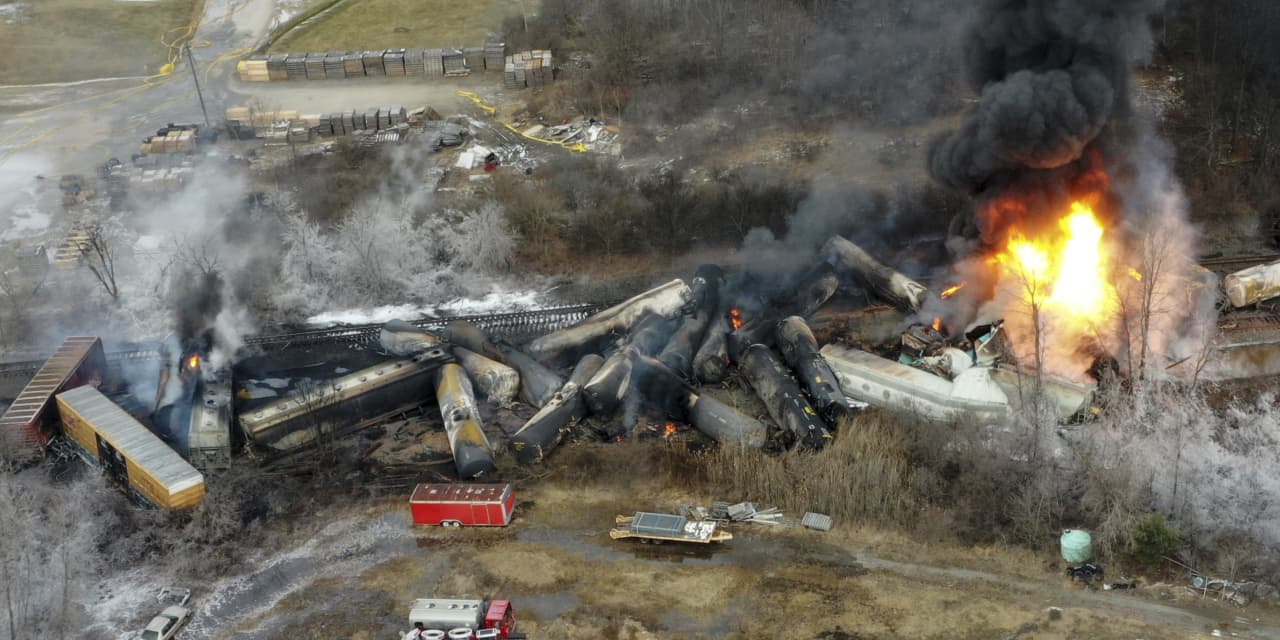
On Feb. 3, 2023, a Norfolk Southern Corp. train derailed in East Palestine, Ohio, thrusting the issue of rail safety into the national spotlight.
No one was killed or injured in the derailment, but the incident was described as a “PR nightmare” for Norfolk Southern
NSC,
and the rail industry. The derailed cars included 11 tank cars carrying hazardous materials that subsequently ignited, fueling fires that damaged an additional 12 railcars, according to the National Transportation Safety Board.
The shockwaves from the incident continue to reverberate around the industry and on Capitol Hill, prompting the introduction of the Rail Safety Act. On Wednesday, Sen. Maria Cantwell, a Democrat from Washington and chair of the Senate Committee on Commerce, Science, and Transportation, again urged Congress to pass the bipartisan bill.
“In the year since the East Palestine derailment, rail safety has headed in the wrong direction,” said Cantwell, noting that the number of derailments since East Palestine has increased by over 13%.
Related: ‘We’re going to do everything it takes’: Norfolk Southern CEO
Supply-chain analytics company Everstream Analytics says accidents on main lines of Class I railroads Union Pacific Corp.
UNP,
CSX Corp.
CSX,
Norfolk Southern, Canadian National Railway Co.
CNI,
CNR,
and BNSF last year through October increased 11% from the same period in 2022. Derailments involving Class I railroads also increased 13.5% year over year, according to Everstream.
A Class I railroad is defined as any carrier earning annual revenue greater than $1.032 billion, according to the U.S. government’s Surface Transportation Board. Canadian Pacific Kansas City Ltd.
CP,
CP,
is also classified as a Class I railroad. The Federal Railroad Administration defines a main line as “a segment or route of railroad tracks over which 5 million or more gross tons of freight-railroad traffic is transported annually.”
The rail industry says the latest safety data from the FRA tells a different, more optimistic story. Based on preliminary data from the FRA for the January to November timeframe, which is the latest available, there were 3.105 train accidents per million train miles in 2023, down from 3.340 train accidents per million miles train miles in the same period the previous year. The number for 2021 was 2.935 accidents per million train miles, while the three prior years were in a similar range.
Related: Norfolk Southern stock on pace for biggest gain since 2020 on report of investor-led shakeup — but one analyst notes skepticism
Additionally, there were five employee fatalities in calendar year 2023, according to FRA data, down from seven in 2022 and eight in 2021. “2023 saw the lowest number of employee fatalities in the industry’s history,” a spokesperson for the American Association of Railroads told MarketWatch. “While even one fatality is too many, railroads continue to make progress on their enduring responsibility to ensure every railroader returns home safely at the end of each day.”
In a statement released last week, the AAR pointed to efforts by Class I railroads to boost rail safety and prevent derailments. In particular, it pointed to initiatives such as increasing hot-bearing detectors, or HBDs, across key routes, and the implementation of a new industry standard of stopping and inspecting trains when an HBD reading exceeds 170 degrees Fahrenheit. HBDs are installed on the sides of tracks and use infrared technology to monitor wheel-bearing temperatures and prevent overheating.
Additionally, more than 99.9% of all hazardous materials moved by rail reaches its destination without a release caused by a train accident, according to the AAR. “The fact remains that rail is by far the safest way to move goods, including hazardous materials, over land, and we are in the safest era ever for rail safety,” the AAR spokesperson told MarketWatch.
A spokesperson for Norfolk Southern told MarketWatch that in 2023, the company’s FRA accident rate decreased by 10% year over year. During its fourth-quarter earnings call last week, Paul Duncan, Norfolk Southern’s chief operating officer, said that the company ended 2023 with a 42% reduction in its accident rate on main lines, and its fewest main-line accidents since 1999.
Related: Norfolk Southern books another charge for Ohio derailment and misses on profit again
CSX told MarketWatch that its train-accident rate was lower in 2023 than the previous year. “Safety is an unwavering commitment and a core value at CSX,” a spokesperson said. “We are proud of our safety record and will never stop striving to improve it.”
BNSF told MarketWatch that its accident rate has also been declining. “Though the full FRA report for last year is yet to be released, over the past four years, including [year-to-date] 2023, BNSF’s main-line accident rate has gone down by more than 15 percent,” a spokesperson said.
“For example, it wouldn’t have been uncommon a few decades ago to have more than 20 rail-equipment incidents per year due to a journal-bearing (wheel) defect,” the spokesperson added. “In recent years, we have reduced that number of journal-bearing incidents to low-single digits, while continuing on our path to zero. That’s thanks to the development and use of hot-bearing detectors (HBDs), in conjunction with trending algorithms and handling instructions.”
“It is also worth noting that railroads are still the safest form of land-surface transportation and have continued to improve and become safer over time,” the BNSF spokesperson said. “Train accidents continue to be reduced by using extensive training, processes and new technology.”
In a recent article on the Union Pacific website, Eric Gehringer, the company’s executive vice president of operations, said that serious derailments on Union Pacific’s network declined 26% in 2023 compared with 2019, while average maximum train length grew. Over the past 10 years, track-related derailments declined 28%, Gehringer added.
Related: CSX clinches agreement on paid sick leave with Brotherhood of Railroad Signalmen
Gehringer explained that Union Pacific has a network of more than 7,000 wayside detection devices that monitor the condition of freight cars and locomotives in real time, and the company plans to add more.
Read the full article here