


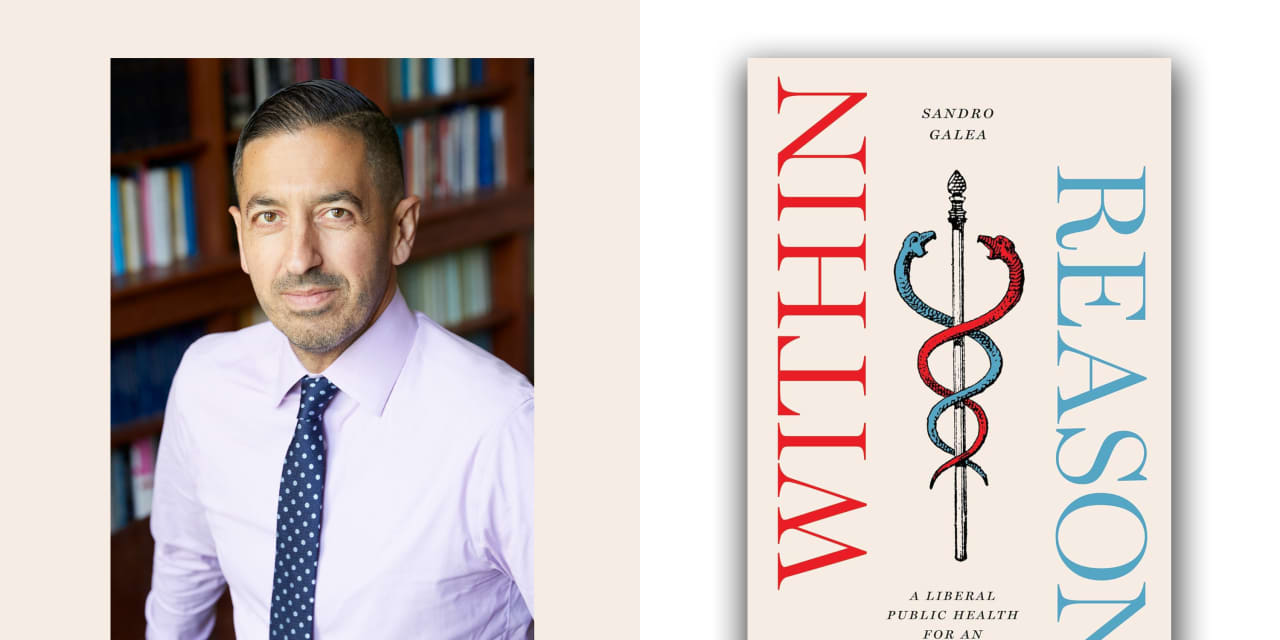
The Covid-19 pandemic delivered a blow to the public health system, both through the physical and emotional toll it took on those affected, and through the intense politics that accompanied the disease. Dr. Sandro Galea, epidemiologist and dean at Boston University School of Public Health, writes about what went wrong in his new book, Within Reason: A Liberal Public Health for an Illiberal Time.
In this week’s book Q&A, Dr. Galea talks about how to fix public health’s trust problems and how ready we are for the world’s next big disease. The following transcript has been edited.
Barron’s: Your book revisits the distrust toward public health messaging during the Covid-19 pandemic. What went wrong there?
Sandro Galea: No. 1, we [public health professionals] miscalibrated in terms of how confident we were in our messaging. It’s a concept that I’ve used before, the term “false certitude.” We portrayed confidence when we should not have had as much. In the context of a rapidly evolving pandemic that became problematic because then it seems like we’re changing our mind.
No. 2, the medium of communication—social media, which took over the Covid narrative—was such that it made it difficult to convey complexity. As a result it accentuated the false certitude.
No. 3, we were communicating in a time of enormous crosscurrents and political tides, and as a result, it created a confrontational aspect to our messaging that did not allow us to reach people who might feel differently about the approaches to Covid.
Covid is surging right now, but restrictions are limited. Is that another failure of public health?
No, the Covid surge right now is not accompanied by disease with significant morbidity or mortality. So the fact that we have a surge does not necessarily need to be accompanied by restrictions. It simply means that we are adjusting well to Covid becoming a common part of how we do what we do. I do think that our approach right now is probably rational given the stage we’re at with the coronavirus that has become part of our environment.
How do other illnesses such as RSV and the flu fit into this picture?
One of the challenges that we had with Covid was that we over-focused on Covid. As a result, we did not have space to talk about viruses like RSV and the flu, and things like drug overdoses and car accidents. When one focuses so narrowly on one disease, one does not pay attention to other diseases that are equally creating health problems for society. We’re now at a phase where we need to integrate our thinking about Covid with our thinking about other diseases. It’s the collective of those that ultimately shape our health.
The World Health Organization and others have been discussing the idea of preparing for a hypothetical “Disease X,” which would be worse than Covid. Is the public health system ready for a scenario like that?
I don’t think so. We have systematically underinvested in public health as a country and as a world over the past 20 years. A bunch of what happened in Covid was due to the fact that our public health system was ill prepared. So it will require substantially more effort to prepare our public health system for a new Disease X.
What steps should be taken to prepare?
First of all we need to invest. In this country, just to focus on the U.S., most states spend less than $100 per person per year on public health. Most states have had a decrease in the number of people working in public health. Less than 3% of our health expenditure is actually in public health. We spend 97% of our health expenditure on medicine, which is treating people once they’re already sick. But we forget that our goal should be to keep you from getting sick to begin with.
How can public health officials win back public trust?
The key thing that we need to accept is that people can handle uncertainty. One of things that we did [during the pandemic] was we did not trust that people could handle doubt. We [need to] communicate with humility and convey when it is that we know something and when it is that we don’t. In the context of a new disease and a rapidly evolving pandemic, there was much more that we did not know.
The other element of this is getting better at navigating and learning how to use social media. Social media is a very particular medium of communication. It relies on people who are prominent in social media, relies on communicating in short bursts, relies on the engagement of a broad range of people, which is different than things like television and newspapers. Our established public health sector was not prepared to communicate that way.
Are we in a good place with vaccinations now?
I think the Covid vaccine and boosters will become part of the routine annual boosters that we get for any number of viruses, and that’s appropriate. These [boosters] typically have fairly low uptake every year and in part that’s because people do not see their value. I would like us to focus less on the Covid vaccine and more on just building trust for public health messaging, which will then spill over and serve us well in public health across the board.
Thanks, Dr. Galea.
Write to Stevie Rosignol-Cortez at [email protected]
Read the full article here