


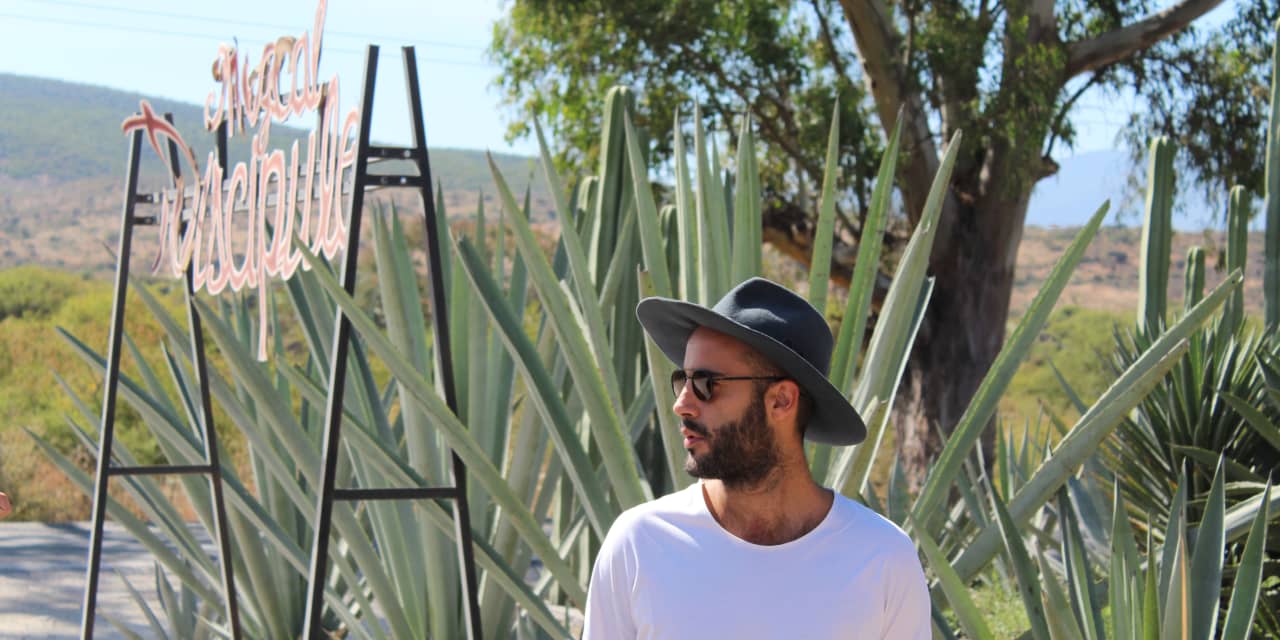
In Mexico City, socialites and aficionados filled Hotel Volga’s lobby bar for the launch of Logia Horno, the inaugural limited-edition from Mezcal Amarás, one of Mexico’s largest producers of ancestral and artisanal organic mezcals. The Mexico City-based company auctioned the bottle for US$6,500, with its proceeds benefiting a local charity. Only 400 bottles, retailing for US$400, became available globally in November, with 180 allocated to the U.S. market.
The annual releases that will follow are an ode to the unattainable and scarce, and the start of what Mezcal Amarás hopes to be a new era for the mezcal category.
“There are people collecting top spirits in the world, similar to collecting wine and art,” says co-founder Santiago Suarez, 37, who formed Mezcal Amarás in 2011 to honor the deeply rooted history and craftsmanship of mezcal. “And I really believe mezcal has the same collecting potential. It’s one of the best investments in terms of spirits because [right now] mezcal is cheap compared to others in the collectible market.”
There are more than 50 varieties and 200 species of mezcal agaves, and traditionally, the most efficient to make, blue agave and espadín, were once the only agaves used. Those also have the highest sugar content. Now, however, wild agaves are highly sought after because they are rarer and result in a more herbaceous finish that accentuates the natural flavors of the agave plant. The problem is that wild varieties are increasingly overharvested due to the rising popularity of mezcal.
“We use wild agaves,” Suarez says, adding that Mezcal Amarás farms new agaves with regeneration techniques, a practice not commonly seen in this industry. This year, they planted 16 different varieties, adhering to a biological growth approach, which avoids deforestation and chemical fertilizers.
“To ensure a sustainable future, which is vital, we collect seeds from wild mountain agaves and cultivate them in nurseries, a process that domesticates them,” says Suarez, who co-founded Mezcal Amarás with Luis Niño de Rivera Mesta.
This allows Mezcal Amarás to craft unique and ultra-premium varieties at a high volume while adhering to sustainability. The outcome is what Suarez hopes will entice collectors to invest in mezcal.
Suarez, who lives in Mexico City, spoke with Penta about the newannual limited-release series, differentiating quality in the oversaturated market, and why he thinks mezcal is entering its collectors’ era.
Penta: What makes the launch of Mezcal Amarás’ Logia Horno special and why did you release such a limited quantity of bottles? What does this mean for this new “collectors’ era” of mezcal?
Santiago Suarez: Horno is made from one of the rarest wild agave species. Because this agave and spirit are so revered, and sustainability is so important to us as a company, we only harvested enough Horno Agave to produce 400 bottles. In a world where exclusivity has become a cherished hallmark, we wanted to capture a similar experience for mezcal enthusiasts through Horno. Our distilling process paired with Horno Agave is the first time that it has been launched as a mezcal.
What inspired the limited-edition series and how do you plan to make these bottles rare enough to collect?
Our sustainability efforts include planting wild agaves, an initiative we were the first to undertake in the category, and we remain among the few who do it. With so many varieties of agave and two main processes—artisanal and ancestral—mezcal is a lot like wine in how diverse it can be. And that can be completely overwhelming to a consumer, especially because the agave names are hard to decipher: some are scientific, and some local words. Together with all of the agave we have planted, all the understanding we have about mezcal, the years we spent researching with scientists and collecting data, we discovered how to deliver something unique and collectible from recipes that can never be replicated. Every year we will do a limited release like this.
How do collectors know which mezcals to buy?
It’s not easy explaining to our final consumer why a bottle of wild agave is US$150 or US$300. So, we’ve conceptualized a nomenclature based on each production’s process and the rarity of the agave used. It’s taken years of learning mezcal to come to this idea. A key realization was the direct correlation between the amount of organic agave compound used in distillation and the intensity of its flavor in mezcal. A higher ratio of plant per liter results in a more savory, herbaceous flavor, while a lower ratio is sweeter and more floral because there is more sugar. The latter is not rare. Whereas, certain agaves need 15 times more raw material than something more standard like blue agave. Those harder-to-produce agaves are like 40-year-old whiskies. In essence, that’s the nomenclature: differentiating how much agave is being used and how it is being processed. That is what we are trying to communicate with the nomenclature and I believe it’s a game changer for mezcal.
In your nomenclature, what’s the highest category?
Essentially, like the older age statements on whiskey, the highest “rated” are the ones that are more labor intensive and harder to produce. In mezcal’s case, that would be the higher agave-to-liter bottles, or the more herbaceous ones. So, on a scale of one to five, five would be the most savory and herbaceous, and one would be sugary and floral. Then you have the process that also creates differences within the flavor: artisanal mezcal, that is mostly done in copper pot stills, which gives roundness to the texture, and ancestral mezcal, which is done in clay pot distillation and has a silky smoothness and toasted notes.
Do you foresee this being adopted across the mezcal category?
All of this is proven scientifically, and we want to have the nomenclature for about a year until it’s perfected. After that, we’d love for the industry to hop on board because we think nomenclature like this will help promote mezcal and pave a clearer path for collectors. We’re already speaking to the director of the Consejo Regulador del Mezcal (CRM), who supervises the Denomination of Origin of Mezcal and ensures quality throughout the industry, and they love the nomenclature. It has taken a lot of effort, investment, research, and development. We are not taking this task lightly, and we hope that others adopt it and retain the standards. The nomenclature showcases that mezcal is the most complex and versatile spirit in the world.
This interview has been edited for length and clarity
Read the full article here