


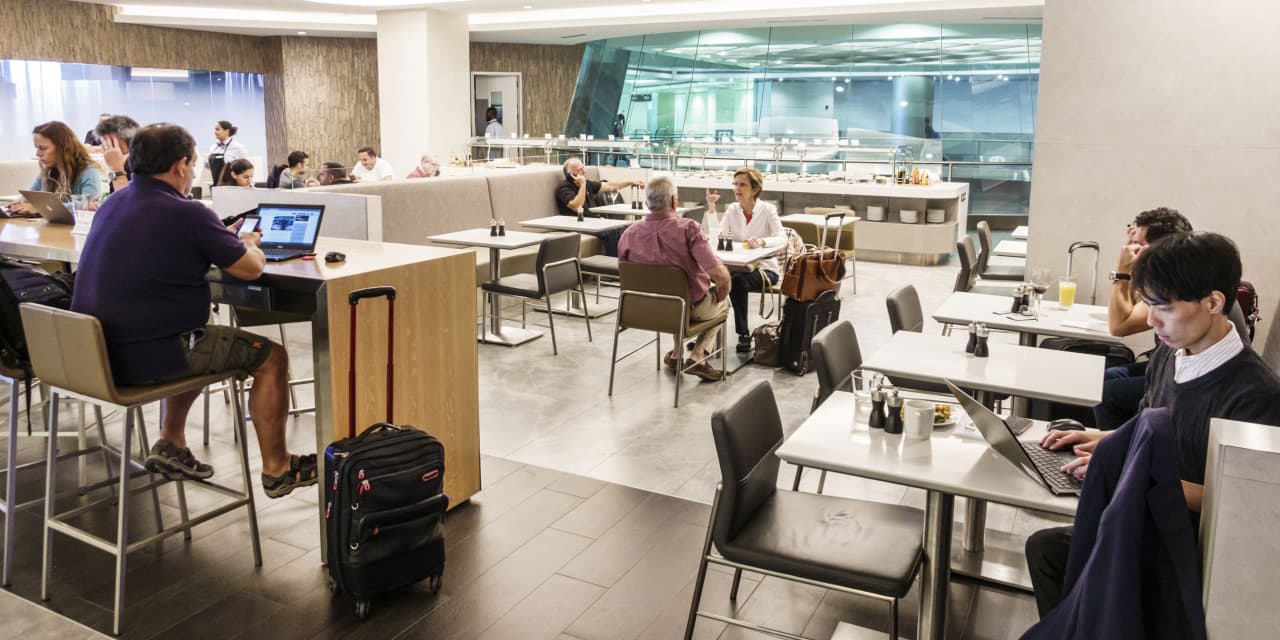
Corporate travel may finally be back in business, unlocking higher profit margins for airlines and hotel companies and a much-needed revenue boost for the next few months, typically a slow season for leisure travel.
Travel manager surveys, anecdotal evidence from airlines, hotel company earnings, and the end of the Hollywood and auto makers’ strikes all signal a long-awaited uptick after a slow postpandemic recovery. The key for investors is that there looks to be more upside ahead.
The challenge, though, is determining which travel stocks can fully benefit. The larger, more corporate-exposed airlines, such as
Delta Air Lines
(ticker: DAL) and
United Airlines Holdings
(UAL) could get a boost, but the sector is battling myriad capacity issues that cloud the picture.
Hotel chains such as
Hilton
Worldwide Holdings (HLT) and
Marriott
International (MAR) are also potential beneficiaries, particularly if larger corporations, which have lagged behind smaller businesses in travel spending, boost budgets into 2024.
The postpandemic business travel recovery has had a number of false dawns, but signs of a sustained comeback are beginning to emerge. Most major U.S. airlines flagged an improvement in business travel in the third quarter, but they would really commit only to “steady”—very much the buzzword this time around.
American Airlines Group
(AAL), one of the biggest carriers for corporate travel, said total business revenue rose 2% in the third quarter and that it has seen a “steady improvement” since Labor Day. Discounter
JetBlue Airways
(JBLU) said the recovery is in a “steady state” and will grow with the economy. Delta noted that it continues to “steadily improve,” citing return-to-the-office initiatives.
You get the picture—slow and steady wins the race. But the pace could pick up. Corporate travel surveys are pointing to budgets growing in 2024.
The Global Business Travel Association’s latest outlook shows that 67% of the 860 global businesses surveyed expect their travel budgets to increase or stay the same in 2024, with 39% seeing a rise. Morgan Stanley’s October survey of corporate travel managers found that 2024 budgets are expected to be up an average 8% year over year. That’s after an 11% rise in 2023.
Such continued growth, if it materializes, is good news for airlines and hotel companies. The U.S. Travel Association said that, at the end of 2022, corporate and group business travel was still 29% below 2019 levels. A full recovery, and beyond, isn’t out of the question in 2024. It’s likely to be a boon for airlines. Despite making up just 12% of total passengers, corporate travelers generated up to 75% of profit on certain flights prepandemic, according to a PwC report. It will also help Hilton, Marriott, and Holiday Inn–owner
InterContinental Hotels Group
(IHG), for which business travelers accounted for about 45% to 50% of revenue in 2019.
The elephant in the room is the evolving macroeconomic environment. Travel budgets are often among the first casualties when companies are looking to cut costs. While that’s a valid risk, it’s more likely to delay a recovery than put a permanent stop to it.
Aspects of current business travel also suggest that a rebound may be about to accelerate. Right now, smaller businesses lead the recovery—41% of enterprises with less than $1 billion in revenue said they have already returned to pre-Covid travel levels, according to Morgan Stanley’s survey. But only 22% of businesses with $16 billion or more of revenue were at 2019 levels—lower than the 26% in the bank’s May survey. Analyst Ravi Shanker says that “likely indicates that larger corporations may be a bit more stagnant, which could indicate there is more upside to come.”
Another reason to believe the recovery will accelerate is the settlement of the entertainment and auto-maker strikes. Delta President Glen Hauenstein described the United Auto Workers and Hollywood strikes as a “drag” on corporate revenue in the third quarter. Delta’s business revenue is still accelerating, though, with corporate travelers working in both the tech and financial services sectors posting double-digit revenue growth—so the two strike-hit sectors offer more upside now that agreements have been reached.
Delta may be in the best position to benefit. “We continue to like Delta Air Lines as possibly the most corporate-exposed carrier in the U.S.,” Shanker says. He has an Overweight rating on the stock.
Airlines stocks have been battered since their July peak, and Delta’s shares are cheap, trading at 5.5 times projected 2024 earnings. A corporate uptick could lift the shares. Wall Street is bullish, with 96% of analysts rating the stock a Buy. The average price target of $52.30 implies a 44% upside to Monday’s trading.
United Airlines is on a similar path—a major corporate carrier whose stock is flashing signs of being too cheap.
Airlines could do with the revenue boost, particularly as cost pressures mount and the peak summer travel period becomes an increasingly distant memory, but they may find it difficult to fully capitalize on greater demand. The industry has a number of capacity problems, including a shortage of pilots and air-traffic control staff, as well as engine and maintenance problems for aging fleets. The pilot shortage won bumper pay raises through union negotiations: American and United pilots gained about 40% pay hikes over four years. But with pilots required to train for 1,500 hours before obtaining a Federal Aviation Administration certificate, fixing the shortage is taking time.
Carriers also need to juggle reallocating capacity that is available to them, balancing business and leisure-travel demand. “Depressed business traffic is pushing too much capacity into traditional leisure markets,” noted TD Cowen analyst Helane Becker in a report on why airline multiples remain stuck below prepandemic levels. “Demand is normalizing and resulting in losses in oversupplied markets,” she wrote.
Larger carriers such as Delta and United, with the most capacity, have the best chance of capitalizing on a business recovery. Greater capacity means they can be more agile in reallocating aircraft to capture demand. The pair, plus American, have historically strong corporate customer bases.
It’s a similar story for hotels. An acceleration in corporate travel is a tailwind, but hotel companies are facing inflationary pressures and a burning question: How high can they hike room rates? International travel, particularly in and out of the key Asian market, is also lagging, and an uptick there could boost the stocks.
Business travel exceeding 2019 levels would help. Macquarie analyst Chad Beynon tells Barron’s that it could happen in 2024. “It’s the big corporations that are not back [in 2023],” he says, adding that trends for next year look good. “Business-travel pricing for the big corporates is up more than 5%. In terms of getting back to those prepandemic levels, we could see that it in 2024.”
If business travel does come back, Beynon sees Marriott International and Hilton as the biggest beneficiaries. Marriott has 180 million loyalty members—typically business travelers—the most in the industry. It’s worth noting that in 2019 both hotel groups had the largest exposure to business travel, with 50% of Hilton’s revenue coming from corporate travelers, and 47% of Marriott’s. And the hotel companies are also renegotiating corporate room rates upward in 2024. So all bodes well.
The recovery, however, appears inextricably linked to the fortunes of the U.S. economy, which may be why it isn’t being priced into the stocks. That’s not necessarily a bad thing, and could be a buying opportunity. “If we go into a little bit of a downturn and there are layoffs and companies pull back on travel spending, then you’re probably not going to see that [recovery] in 2024. But as of now, based on everything we see with macro, we would see that [return to prepandemic levels],” he says.
Whether business travel would ever return to prepandemic levels was once a hotly contested debate. Now, it seems to be a given. The big question: when?
Write to Callum Keown at [email protected]
Read the full article here