


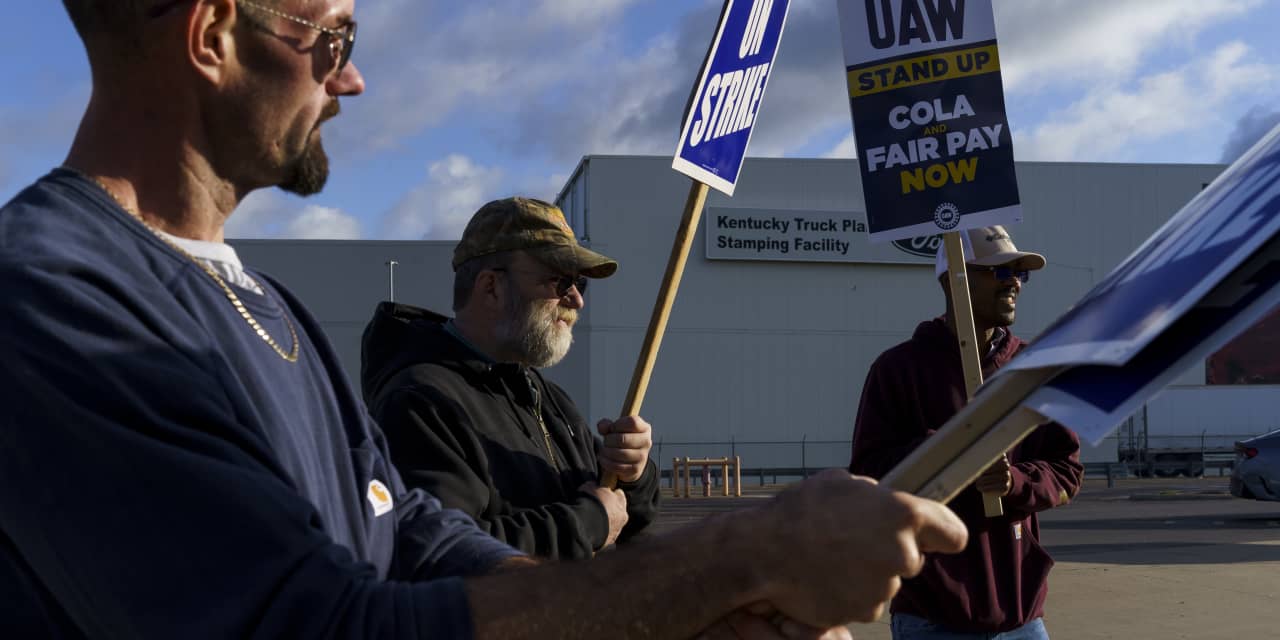
The ayes have it. So far. About 25% of the votes have been counted and of those about 75% of
Ford Motor
employees represented by the United Auto Workers have said yes to a new labor contract.
At this point, contract ratification looks like a fait accompli. The new deals will raise labor costs at Ford (ticker: F) just like the deals being voted on by UAW members at
General Motors
(GM) and
Stellantis
(STLA).
After the very public, and contentious, negotiations, investors are worried that the new contract will cripple the Detroit-Three auto markers against their nonunion competition that makes both electric vehicles and traditional gasoline-powered cars. It won’t. Labor isn’t the main issue and investors caught up in the public rhetoric could miss out on what will really determine winners and losers in the car business.
Management quality is the much more important thing. Not relative labor rates.
“A lot of [industry participants] were disappointed in the adversarial nature that negotiations took this time,” says Brian Irwin, Managing Director with Alvarez & Marsal’s Automotive and Industrials Group in Detroit.
UAW President Shawn Fain used war metaphors, occasionally dressed in camo or a T-shirt that read “Eat the Rich,” while railing against the billionaire class. That said, Irwin isn’t surprised how things turned out. “No one expected the wage increase would start with anything less than a two.” The new labor agreements include base wage increases of about 25% over the life of the deal, including an 11% bump upon ratification.
The two in 25 is what Irwin is referring to.
The average annual increase over the four-plus-year contract, including inflation protection, will work out to between 5% and 6%. That helps workers make up for recent years when annual wage increases were closer to 1% while inflation was running closer to 4%.
“Honestly, none of this was really much of a surprise,” says RBC automotive analyst Tom Narayan. “The narrative is that this was very good for the UAW, but this, I think, was always going to be a decent-sized concession.”
Inflation is one reason for that conclusion. Profits are another. Ford and GM made more than $100 billion in operating profit, combined, over the past 10 years, including 2023 full-year estimates. The number over the prior 10 years ending in 2013 was a combined loss of about $71 billion.
Things were terrible and the losses accumulated around the Financial Crisis ultimately led to GM declaring bankruptcy and led to so many changes at Stellants that it is difficult to include any of its prior results in comparative numbers.
Labor did their part to help to turn things around, offering wage and benefit concessions. Barron’s estimates, with the help of Federal Reserve data, that the average annual saving from labor concessions over the past 10 years amounts to roughly $2 billion.
That’s $20 billion in incremental profits over the decade. Significant, but it doesn’t account for the turnaround in profits at Ford and GM. If labor costs weren’t responsible for all of the improvement, they also weren’t responsible for all of the losses.
Still, relative profitability matters in any industry, and market share stabilized for the Detroit-Three after labor concessions and the Financial Crisis. So maybe lower labor costs helped the companies preserve market share.
The combined U.S. market share for Ford, GM, and Stellantis was roughly 44% in 2010. It was about 43% in 2020. The combined share in 1980 was roughly 74%.
The loss of share to foreign competition has resulted in a process that Benchmark analyst Mike Ward refers to as chasing a ball down a hill. Market share losses necessitate plant closures and layoffs. It’s a downward spiral.
According to Ward, one of the ways the Detroit-Three worked to offset that dynamic was to, essentially, cede share to foreign auto makers in the lower-end portion of the market—think small sedans—and focus on higher-cost vehicles, such as trucks and SUVs, that are less labor intensive.
That decision wasn’t the fault of the workforce. Management thought it was the way forward. It didn’t work out for the stocks so well. GM and Chrysler eventually restructured in bankruptcy. Ford avoided bankruptcy, but its shares are the same price as they were in 1993. The
S&P 500
is up about tenfold over that span.
Getting out of a 30-year funk isn’t easy. Ceding market share, investing in larger vehicles, and continuing to chase the ball down the hill probably isn’t the best way forward this time.
If Ford, GM, and Stellantis want to win in the future, a maniacal focus on cost management will be key, says Irwin. That includes adopting technology in assembly plants as well as working more proactively with suppliers. What’s more, “you need to be strategic and agile in your transformation from
ICE
to BEV.”
ICE is short for internal combustion engine and BEV is short for battery electric vehicle.
After weak third-quarter earnings from
Tesla
(TSLA) and disappointing BEV sales growth at GM and Ford, investors are starting to question EV technology. Sales are still growing in the U.S. and around the world, but early adopters are all, essentially, driving Teslas. The Detroit-Three all need to be smarter in designing EVs that are attractive to traditional buyers of their ICE vehicles.
Technology, supply chain management, along with vehicle design and marketing are critical to future success. None of those things require fretting about or trying to depress labor costs.
It would be great if the UAW and Detroit-Three management saw each other as allies instead of adversaries. That might make things easier. Improving the relationship could become a reality if the union sees Ford, GM, and Stellantis winning back market share and growing their businesses through smart management decisions.
Write to Al Root at [email protected]
Read the full article here